Home Buyer's Guide
GMADA Approved” Does Not Mean “GMADA Property” — A Difference Every Buyer Should Understand
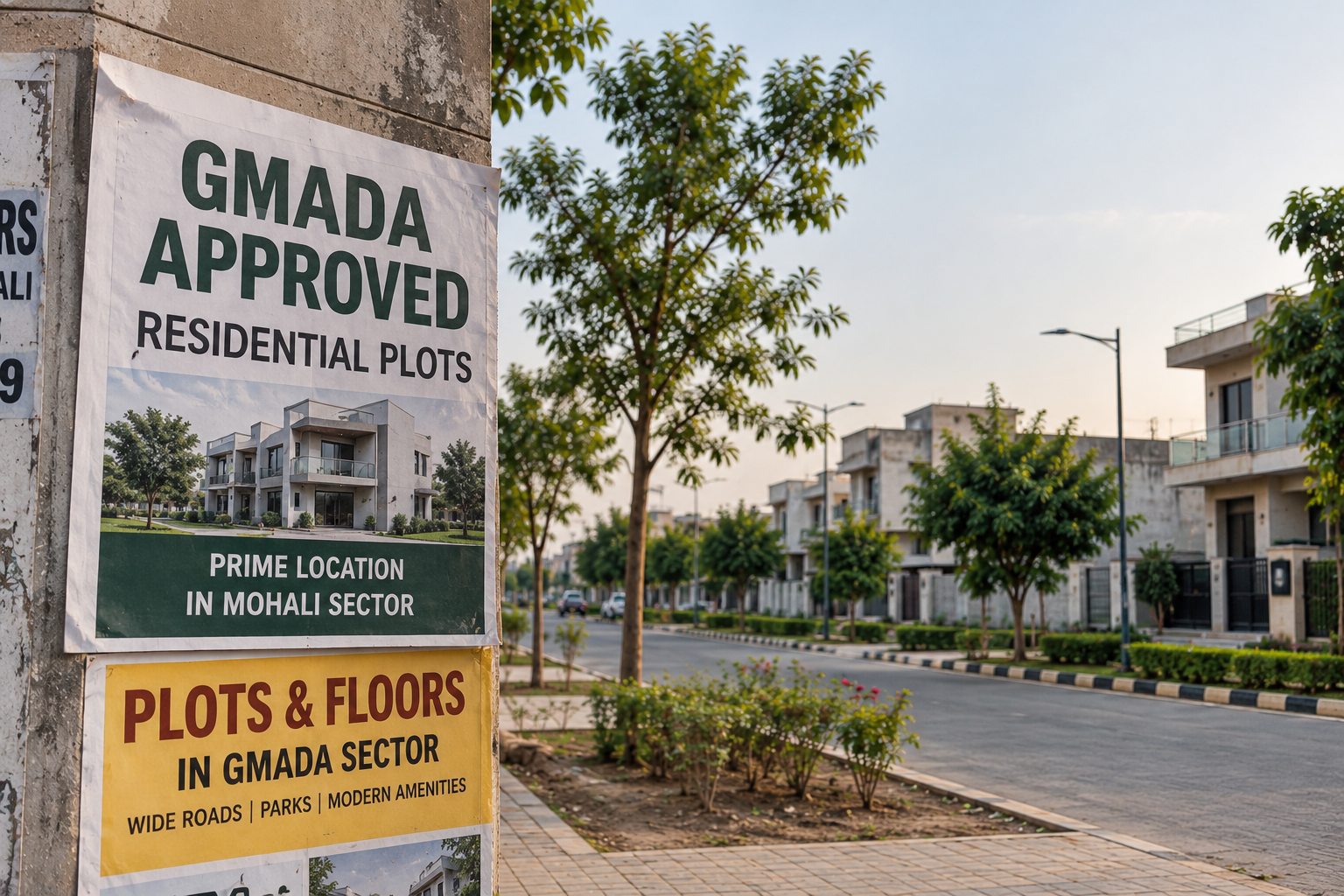
When looking for a plot, flat or commercial property around Mohali, buyers often hear phrases such as:
“This is a GMADA-approved project.”
“It is in a GMADA sector.”
“This is a GMADA property.”
They sound similar. But they do not necessarily mean the same thing.
A privately developed colony can have approvals or a licence from the competent authority and still remain a private developer's project. On the other hand, a property directly allotted, auctioned or developed by the Greater Mohali Area Development Authority is a different category altogether.
That difference matters because it can affect whom you deal with, which records you need to verify, who is responsible for development obligations and where you need to check the property's history. Before paying token money simply because someone says “GMADA approved,” first ask a more useful question:
Approved by GMADA for what—and who actually developed and allotted this property?
First, What Is a GMADA Property?
In everyday language, a “GMADA property” usually refers to a plot, flat, booth, SCO or other site that has been developed, allotted or disposed of directly by GMADA under one of its schemes or through an e-auction. For such properties, GMADA is itself acting as the development authority and, in legal terms, can also function as the promoter for properties developed or allotted by it.
The Punjab Apartment and Property Regulation Act recognises that a development authority can itself be treated as a promoter for buildings or plots developed on land owned by it or placed at its disposal. That is very different from a private company developing a licensed residential colony within the GMADA area.
Then What Does “GMADA Approved” Mean?
This is where buyers need to be careful.
“GMADA approved” is often used casually in property advertising and conversations. It is not enough by itself to tell you exactly what legal status a property has. A private promoter may develop a colony after obtaining the required permission or licence from the competent authority.
Under Punjab's property-regulation framework, a private promoter seeking to develop a colony must go through a formal process dealing with matters such as land title, land-use permission, the proposed layout, development works and other conditions. A licence can then be granted subject to the prescribed requirements.
That means:
GMADA may regulate or approve a private development without becoming the owner or developer of that project.
The individual plots or apartments remain part of the private promoter's development. So:
Approved by GMADA ≠ developed by GMADA.
This Can Happen Even Inside Numbered Mohali Sectors
A sector number can make the distinction even more confusing. Many people naturally assume that if an address says Sector 92, Sector 116 or another numbered Mohali sector, the property must have been allotted by GMADA. That assumption is unsafe. GMADA's own approved-colonies database contains privately promoted projects located within numbered sectors.
For example, the official database lists an affordable residential colony by Jubilee Joy Homes LLP in Sectors 92 and 116, with the private company shown as the promoter. The important lesson is not about that particular project. It is this:
The sector tells you where the property is. It does not necessarily tell you who developed it.
Why Does This Difference Matter?
Imagine two properties located in the broader GMADA planning area.
Property A
The plot was originally allotted directly by GMADA. The allotment letter, transfer history, dues, conveyance process and many subsequent property services may therefore involve GMADA's estate records.
Property B
The plot is inside a privately developed colony for which the promoter obtained the necessary licence and approved layout. The project may be completely legitimate, but the original allotment or sale came from the private promoter rather than GMADA. Both properties may be within Greater Mohali. Both may fall under planning controls administered by the authority. But their property histories are not the same.
This distinction becomes particularly important when you need to check ownership, transfer records, development obligations, promoter commitments or documents relating to the original allotment.
What Should You Ask When Someone Says “GMADA Approved”?
Do not stop at the phrase.
Ask:
“Can you show me exactly which approval you mean?”
Ideally, the seller or developer should be able to identify the relevant official record. For a private colony, this may include the colony licence, approved layout and promoter details. GMADA itself publishes an Approved Colonies database containing fields such as:
- Colony location
- Colony name
- Licence number
- Approval date
- Approved plan
- Promoter name
- Promoter licence details
GMADA also publishes a separate list of licensed colonies and mega projects where NOC is not required for registry. That list includes the promoter, project area, licence details, Khasra numbers and layout information. These records are far more useful than a brochure saying simply “GMADA approved.”
Check the Exact Project, Not Just the Developer's Name
A developer may operate several projects. Approval of one project does not automatically prove the status of every other project marketed under the same brand. Punjab law requires separate permission for each colony. So if you are buying in “Project X,” verify Project X.
Do not rely only on statements such as:
- “Our company has many approved projects.”
- “We have been working in Mohali for 20 years.”
- “All our projects are GMADA approved.”
The exact colony, land and layout matter.
Check the Khasra Numbers Too
This is particularly important when buying plotted property. An approval relates to specific land. GMADA's licensed-colony records therefore contain Khasra numbers, not merely project names. Suppose a large approved colony sits next to another parcel of land.The fact that the neighbouring colony is approved does not automatically bring the adjoining land inside that approval.
That is why a buyer should verify that the specific land containing the property being sold forms part of the approved/licensed project. A familiar project name alone is not enough.
What About the Approved Layout?
The approved layout is another important document. Under Punjab's regulatory framework, a promoter is required to make the approved colony layout and proposed development works available for inspection.
For a buyer, that means the layout can help answer questions such as:
- Does this plot actually appear in the sanctioned development?
- What is the plot number and location?
- What surrounds it?
- Is the neighbouring area residential, commercial, open space or another designated use?
- Is the road being advertised actually part of the approved layout?
Do not rely entirely on a marketing map if an official approved layout is available.
And What About RERA?
RERA is another layer of verification. A project's RERA registration and its planning/licensing approvals answer different questions. One should not automatically be treated as a substitute for the other. Where RERA registration applies, buyers should independently check the project's registration details and information disclosed by the promoter.
Similarly, seeing a project in GMADA's licensed-colony records does not remove the need to carry out the other checks relevant to the transaction. Think of property verification as several boxes that may all need to be checked, rather than one magic approval.
“NOC Not Required for Registry” Also Does Not Mean “No Checking Required”
GMADA publishes a specific list titled Licensed Colonies (NOC Not Required for Registry). That can be useful information. But buyers should not read the words “NOC not required” as meaning:
“Nothing else needs to be verified.”
Registry requirements are only one part of due diligence. Ownership, title, approved layout, exact Khasra, promoter status, applicable dues, possession and project-specific permissions may still matter depending on the property.
A Simple Check Before Paying Token Money
Before paying for a plot or flat marketed as “GMADA approved,” try to establish these five things:
1. Who is the actual promoter or original allotting authority?
- GMADA or a private developer?
2. What exact official approval is being referred to?
- Ask for the licence, approval or official record rather than relying on the phrase “approved.”
3. Does the exact project appear in official GMADA records?
- Check the project name, promoter and location.
4. Does the exact land match the approved project?
- For plotted developments, compare the relevant Khasra details and approved layout.
5. What other approvals apply?
- Check RERA registration where applicable and verify property-specific title, dues and transaction documents.
Those five questions can tell you far more than simply asking:
“Is it GMADA approved?”
The Most Important Difference to Remember
A private project can be properly licensed and approved without being a GMADA-owned or GMADA-allotted property. There is nothing inherently wrong with that. The problem begins when these different ideas are presented to a buyer as though they mean the same thing.
A simple way to remember the distinction is:
- GMADA property: GMADA itself developed, allotted or disposed of the property.
- Private licensed/approved project: A private promoter developed the project under the applicable approvals and regulatory framework.
- GMADA planning area or sector: This tells you something about location and planning jurisdiction—not automatically who owns or developed the property.
Before You Buy, Ask a Better Question
When someone says:
“Don't worry, this is GMADA approved.”
Don't immediately assume that means the property came from GMADA.
Ask instead:
“Show me the official record for this exact project and this exact property.”
That one question changes the conversation from a sales claim to something you can actually verify. And when lakhs or crores of rupees may be involved, that difference is worth understanding before—not after—you make the payment.
Where to Check
For official records of approved colonies, licensed projects, promoter details, approved layouts and other property-related information, visit gmada.gov.in.
For simplified explanations of GMADA projects, property-related updates and what official records mean for users, visit gmada.in.
Important Disclaimer
gmada.in is an independent information portal and is not affiliated with, endorsed by or operated by the Greater Mohali Area Development Authority (GMADA), PUDA, Punjab RERA, the Government of Punjab or any other government department.