Master Plan & Town Development
₹17,686 Crore for 14 GMADA Projects: What Will the Money Cover?
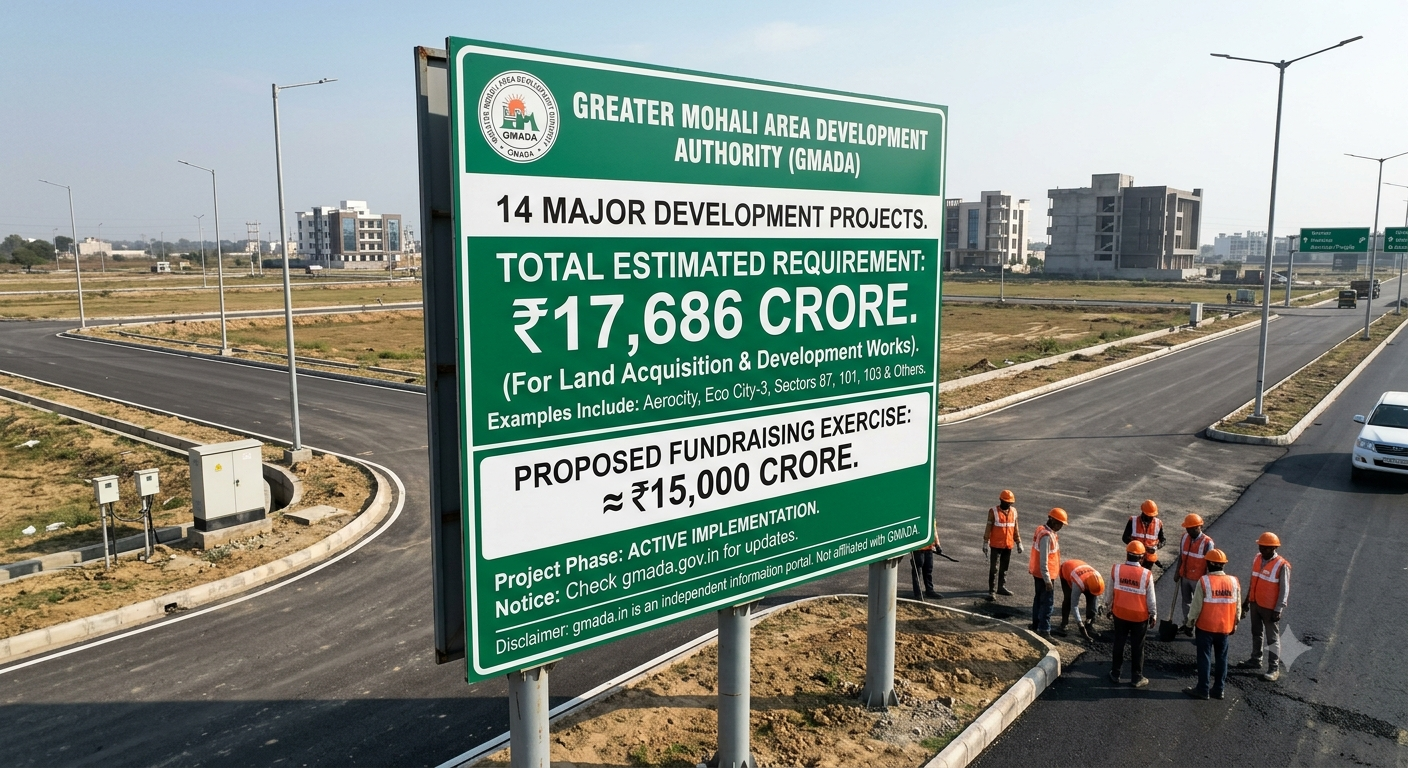
GMADA has told the Punjab and Haryana High Court that 14 development projects require around ₹17,686 crore for land acquisition and development works. But what does a figure this large actually pay for?
₹17,686 crore is a difficult number to visualise. More importantly, it can create the impression that the entire amount is meant for roads, buildings and other visible infrastructure. The available record shows otherwise.
According to an affidavit filed by GMADA's Chief Administrator before the Punjab and Haryana High Court, the authority has taken up 14 development projects requiring approximately ₹17,686 crore for land acquisition and development works on identified land parcels. That distinction is important. The estimate covers two broad stages: acquiring the land and developing that land after acquisition. So where could ₹17,686 crore actually go?
What Has GMADA Actually Said?
The figure emerged during proceedings concerning GMADA's proposal to raise substantial funds from the market.
According to The Tribune, GMADA informed the High Court that it has taken up 14 development projects and requires approximately ₹17,686 crore for their land acquisition and development. Separate reporting has identified areas including Aerocity, Eco City-3 and Sectors 87, 101 and 103 among projects where land acquisition and infrastructure development are being pursued. However, the publicly available reporting reviewed for this article does not provide a complete project-by-project allocation of the ₹17,686 crore.
That means it would be incorrect to say, for example:
“₹X crore is going to Eco City-3 and ₹Y crore is going to Sector 101”
unless GMADA publishes a detailed financial breakup confirming those amounts. For now, the ₹17,686 crore should be understood as an overall requirement across the 14 projects.
The First Major Cost: Acquiring the Land
Before GMADA can build a new urban estate, commercial area or other planned development, it first needs control of the land required for the project. That can be one of the largest expenses. Land acquisition can involve payment of compensation determined under the applicable land-acquisition process, along with other statutory obligations arising under the Right to Fair Compensation and Transparency in Land Acquisition, Rehabilitation and Resettlement Act, 2013.
For a project involving hundreds of acres, the land component alone can run into thousands of crores. This is why the ₹17,686 crore figure should not be viewed purely as an infrastructure-construction budget. A substantial part may be needed before physical development is even visible.
Then Comes the Cost of Turning Land Into a Developed Urban Area
Acquiring land does not create a functioning sector or township. After land is secured, it has to be developed. GMADA's statutory functions include planning and developing urban areas and carrying out works connected with services such as water supply, sewerage and other infrastructure and amenities.
In practical terms, development of a new area can involve work such as:
- Roads and internal streets
- Water-supply infrastructure
- Sewerage systems
- Storm-water and drainage works
- Utility infrastructure
- Parks and green areas
- Public and community facilities
- Site levelling and civil works
- Connections between the new development and existing infrastructure
- Other services required before the area can function properly
The exact mix depends on the individual project. So even after the land has been acquired, significant expenditure may still be required before plots, commercial sites or other developed parcels are ready for use.
Why Is Land Acquisition So Different From Development Cost?
Consider a simplified example. Suppose GMADA wants to develop a new sector. First, it may have to acquire the required land. Only after that comes the work of creating:
- Roads
- Sewer lines
- Water infrastructure
- Green spaces
- Utilities
- Public facilities
- And connections to the wider city
The first stage pays for the land itself and acquisition-related obligations. The second stage pays for turning that land into an urban development. That is why a large GMADA project can require substantial money long before residents see construction activity.
What About the ₹6,210 Crore Already Deposited?
This is another figure that needs careful interpretation. According to the affidavit-related reporting, housing-development authorities had deposited around ₹6,400 crore with the state treasury under the land-acquisition framework, of which approximately ₹6,210 crore was attributed to GMADA.
At first glance, that may raise an obvious question:
If ₹6,210 crore has already been deposited, why does GMADA need more money?
The important point is that this figure should not automatically be treated as ₹6,210 crore of unrestricted spare cash available for any GMADA project. The reported amount is connected to the land-acquisition process.
It therefore has to be understood in the context of the purpose for which the money was deposited and the corresponding acquisition obligations. A treasury deposit and an available project-development budget are not necessarily the same thing.
Then Why Is GMADA Looking to Raise ₹15,000 Crore?
GMADA has proposed raising approximately ₹15,000 crore from the market. Earlier reporting said the fundraising exercise could involve instruments such as loans, bonds or debentures. There is a legal basis for this.
Section 51 of the Punjab Regional and Town Planning and Development Act, 1995 allows an authority to borrow money through loans, debentures, bonds or other financial instruments from sources other than the State Government, subject to applicable terms and conditions.
This is important because GMADA does not necessarily need to wait until it has generated the entire ₹17,686 crore internally before progressing with development. Borrowing can provide funds earlier, with repayment occurring according to the financing arrangement.
₹17,686 Crore Needed—but ₹15,000 Crore Being Raised. Why Are the Numbers Different?
These numbers should not automatically be expected to match. ₹17,686 crore is the reported requirement for land acquisition and development across 14 projects. ₹15,000 crore is the proposed fundraising exercise.
The publicly available material reviewed for this article does not provide a complete reconciliation explaining exactly how every rupee of the remaining requirement will be funded. Possible funding sources in a development authority's broader finances can differ from project to project, but readers should not assume the balance will come from any particular source until GMADA provides the relevant financial details.
The safest interpretation is simply:
₹17,686 crore is the estimated project requirement, while ₹15,000 crore is the amount GMADA has proposed raising through the financing exercise.
They represent related but different figures.
Which Projects Are Included?
This is where the publicly available information remains incomplete. The High Court affidavit, as reported, refers to 14 development projects. Recent reporting has specifically mentioned major development activity involving areas such as:
- Aerocity;
- Eco City-3;
- Sector 87;
- Sector 101; and
- Sector 103.
However, the reporting currently available does not provide a verified public table listing:
all 14 projects + the exact land-acquisition cost + development cost + total requirement for each project.
Until such a breakup is officially available, those figures should not be estimated.
Does ₹17,686 Crore Mean GMADA Will Spend It Immediately?
No. A project requirement is not the same as money being spent on one day. Large development projects move through stages. For example:
Planning
↓
Land acquisition
↓
Compensation and other applicable land processes
↓
Detailed development planning
↓
Infrastructure approvals
↓
Tendering
↓
Work awards
↓
Construction
↓
Completion and maintenance
Different projects can be at different points in this sequence at the same time. That means expenditure may also take place over different periods rather than all at once.
Where Would Residents Actually See This Money Being Used?
For an ordinary resident, the most visible expenditure usually comes later. You may eventually see:
- New roads
- Water and sewer networks
- Street infrastructure
- Parks
- Public facilities
- Utility works
- Junction improvements
- And development of previously undeveloped land
But by the time those works become visible, significant money may already have been committed to land acquisition. That is why judging project expenditure only by what is physically visible on the ground can be misleading.
Is the ₹191.16 Crore Fundraising Fee Part of the ₹17,686 Crore?
A separate figure has also attracted attention. The Tribune reported that Tipsons Consultancy Services Private Limited is to receive an arranger fee of approximately ₹191.16 crore for raising ₹15,000 crore, described as a success fee of around 1.27% of the funds raised. This is a cost associated with the fundraising arrangement.
However, the reporting reviewed for this article does not establish that this ₹191.16 crore forms part of the ₹17,686 crore estimate for the 14 projects. Therefore, the two figures should not automatically be combined. The project requirement and the cost of arranging financing are separate issues unless an official financial statement specifically shows otherwise.
Does Borrowing ₹15,000 Crore Mean GMADA Has Already Received the Money?
No. A proposal to raise funds should not be confused with completed borrowing. Earlier reporting described the exercise as GMADA's plan to mobilise up to ₹15,000 crore through the market, with a merchant banker/fund arranger involved in structuring the fundraising.
So readers should distinguish between: fundraising proposed and money actually raised and available. Future financial disclosures will be needed to show how much is ultimately borrowed, through which instruments, on what terms and according to what schedule.
How Does GMADA Normally Manage Its Budget?
Under Section 52 of the Punjab Regional and Town Planning and Development Act, 1995, the authority is required to prepare an annual budget showing its estimated receipts and expenditure for the coming financial year. GMADA's own disclosure also states that funds for executing works are disbursed to executing offices through the authority's administrative process.
So a large project figure such as ₹17,686 crore should not be interpreted as one undifferentiated pool being spent without budgeting or project-level execution. Individual works still move through their respective administrative, financial and procurement processes.
What Should the Public Watch Next?
The ₹17,686 crore headline is useful, but the more important information will come from what GMADA publishes next.
For transparency, users should watch for:
- Complete list of the 14 projects — Which developments are included?
- Project-wise estimates — How much is for land acquisition and how much for development?
- Land-acquisition progress — How much land has been acquired and what remains?
- Fundraising progress — How much of the proposed ₹15,000 crore is actually raised?
- Borrowing terms — What interest rate, tenure and repayment conditions apply?
- Development tenders — Which projects actually move into execution?
- Budgets and accounts — How are these commitments reflected in GMADA's financial statements?
These details will provide a clearer picture than the headline figure alone.
Why This Matters to Ordinary Users
At first glance, ₹17,686 crore may look like a purely financial story. It is not. The money is connected to land and development that can eventually determine:
- Where new sectors come up
- How quickly new townships progress
- When roads and utilities are built
- When acquired land moves into development
- And how GMADA finances Greater Mohali's expansion
For landowners, the important issue may be acquisition and compensation. For residents, it may be infrastructure. For future allottees, it may be how quickly a new sector becomes usable. And for taxpayers and the wider public, the issue is how such a large financing requirement is structured and ultimately repaid.
What Is Confirmed — and What Is Still Unknown
What is confirmed through the reporting and official law
- GMADA has stated that 14 development projects require approximately ₹17,686 crore for land acquisition and development works.
- GMADA accounted for around ₹6,210 crore of the housing authorities' deposits with the state treasury referred to in the High Court proceedings.
- GMADA has proposed a ₹15,000 crore fundraising exercise.
- Section 51 of the Punjab Regional and Town Planning and Development Act, 1995 allows the authority to borrow through loans, debentures, bonds and other financial instruments.
What is not yet clear from the public material reviewed
- the complete list of all 14 projects;
- the exact cost allocated to each project;
- how much of ₹17,686 crore is specifically for land acquisition;
- how much is specifically for development works;
- the exact funding mix for the entire ₹17,686 crore; and
- how much of the proposed ₹15,000 crore has ultimately been raised.
These distinctions matter because they prevent estimates or news headlines from being presented as more detailed than the underlying record actually is.
Final Takeaway
GMADA's reported ₹17,686 crore requirement is not simply a construction budget. It covers the estimated requirement for land acquisition and development works across 14 projects.
Separately, GMADA has proposed raising around ₹15,000 crore through market borrowing, while approximately ₹6,210 crore has been reported as deposited by GMADA with the state treasury in connection with land acquisition. These figures are related to GMADA's wider development programme, but they should not be treated as interchangeable.
What is still missing is a project-wise financial breakup identifying all 14 projects and showing how much is required for land acquisition and how much for development.
Until that information is published, the clearest interpretation is: ₹17,686 crore is the estimated requirement for acquiring and developing land across 14 GMADA projects—not ₹17,686 crore being spent only on construction.
Where to Check
Source: This report is based on information published by The Tribune, published on October 10, 2026
For official GMADA budgets, notices, project information, land-acquisition records and statutory information, visit gmada.gov.in.
For simplified explanations of GMADA projects, Greater Mohali development and important public information, visit gmada.in.
Important Disclaimer
gmada.in is an independent information portal and is not affiliated with, endorsed by or operated by the Greater Mohali Area Development Authority (GMADA), PUDA, the Government of Punjab or any other government department.