GMADA News & Updates
200-Foot Roads Could Become 120 Feet — Why Is GMADA Rethinking Mohali’s Road Widths?
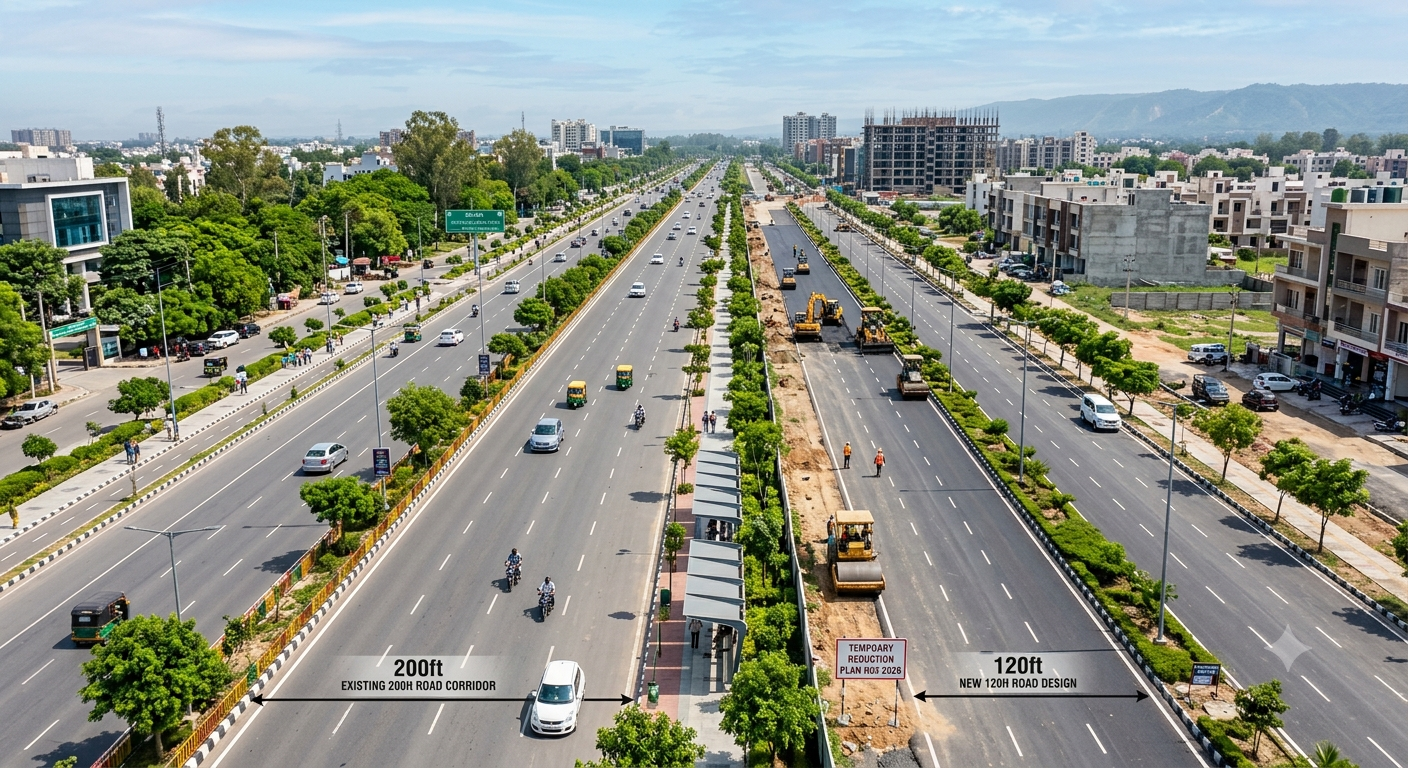
GMADA has approved a move to reduce road widths in some future projects, including bringing certain 200-foot sector-dividing roads down to 120 feet and, in some cases, 80 feet. But there is an important distinction:
This does not mean Mohali’s existing 200-foot roads have suddenly become 120 feet wide.
The proposed changes still have to be reflected through the applicable Master Plan amendment and statutory approval process before they become part of the final planning framework for individual projects. So why is the Greater Mohali Area Development Authority reconsidering something as fundamental as road width—and what could this mean for Eco City, Aerotropolis and other future GMADA developments?
What Exactly Does GMADA Want to Change?
According to a Hindustan Times report published on October 18, 2026, the proposed approach includes two significant changes. In residential areas containing plots of up to 200 square yards, roads currently planned at 40 feet could be reduced to 30 feet.
At a larger scale, certain 200-foot sector-dividing roads could be reduced to 120 feet, while widths of around 80 feet may be considered in some locations. GMADA Chief Administrator Sandeep Rishi told the newspaper that the decision to reduce road widths had been approved and would apply to projects undertaken by the authority going forward.
Projects identified as likely to be affected include Eco City-3, Eco City-4 in New Chandigarh and Aerotropolis near the airport, apart from future GMADA projects. However, approval of the policy direction and amendment of a statutory Master Plan are not the same thing.
Senior architect Surya Kant told the newspaper that the proposed reductions had not yet reached final notification and would have to pass through the prescribed approval process, including consideration by the Punjab Regional and Town Planning and Development Board and an opportunity for public objections.
In simple terms:
GMADA has decided the direction it wants to take, but the planning documents still have to catch up with that decision.
Why Does GMADA Want Narrower Roads?
The main reason is the increasing cost of land. Building a road is not only about paying for asphalt, drainage, streetlights and construction. First, the entire land corridor required for that road has to be acquired, pooled or otherwise made available. A 200-foot-wide road naturally requires significantly more land than a 120-foot road running along the same distance.
According to Sandeep Rishi, increasing financial liabilities associated with land acquisition and conversion of agricultural land for urban development have made GMADA projects considerably more expensive. He said reducing road widths is one of the measures being considered to contain those costs.
That creates a fairly straightforward financial equation:
Wider road → more land required → higher land cost
Narrower road → less land required → lower land requirement
But the planning question is more complicated. The land removed from a road corridor does not only represent fewer traffic lanes. It may also affect the space available for service roads, utilities, medians, pedestrian areas, landscaping and future expansion. That is why the difference between 200 feet and 120 feet matters.
What Does a 200-Foot Road Actually Contain?
A 200-foot road does not mean 200 feet of continuous asphalt for moving vehicles. The number normally refers to the broader right-of-way reserved for the road and associated infrastructure. GMADA's own infrastructure records provide a useful real-world example. The authority describes a 200-foot-wide, approximately 8-km road in New Chandigarh connecting the Chandigarh/Punjab boundary with the Kurali-Siswan road.
The road has six traffic lanes. GMADA's description also provides for two 22.5-foot service roads, one on either side, along with a 14-foot central verge that can accommodate an additional lane on each carriageway in the future. That tells us something important. When planners reserve 200 feet, they are not necessarily planning to fill the entire width with traffic today.Part of that land can provide flexibility for tomorrow. Therefore, the real question is not simply:
“Can traffic still fit inside 120 feet?”
It is:
“What infrastructure will GMADA fit inside those 120 feet, and what flexibility will remain for the future?”
GMADA Does Not Use One Standard Road Width Everywhere
It would also be incorrect to assume that every major GMADA road is currently 200 feet wide. Official GMADA notification records from 2026 already show different road widths being used depending on location and function. For example, notifications dated February 4, 2026 include:
- A 60-metre-wide dividing road for Sectors 120/121 and 122/123
- 50-metre-wide roads around Sectors 116/117 and between Sectors 82 and 83
- 30-metre-wide roads around Sectors 84 to 100 and Sectors 103, 101 and 83
- A 33.5-metre-wide road between Sectors 127 and 104
GMADA also has longstanding records for 200-foot Master Plan roads in New Chandigarh and other parts of its planning area. This means road width is already determined according to the role and location of an individual road. The new issue is whether the planning standard itself should now become narrower in future projects because of rising land costs.
Would a 120-Foot Road Automatically Have Fewer Lanes?
Not necessarily. Road right-of-way and carriageway width are two different things. A 120-foot corridor could still accommodate several traffic lanes depending on how the road is designed. What may change is how that overall space is divided among:
Traffic lanes, medians, service roads, footpaths, cycle infrastructure, stormwater drainage, underground services, landscaping and future expansion.
That is why the final road cross-section matters more than the headline number alone. Until project-specific plans are approved, it would be premature to say exactly what a 120-foot GMADA sector road will look like.
Why Are Urban Planners Concerned?
The concern is largely about what happens 20 or 30 years from now, not merely whether the road can handle traffic when a new sector is first occupied. Former Punjab senior town planner Jit Kumar Gupta told Hindustan Times that roads are the lifelines of a city and warned that reducing their widths to increase saleable land could create long-term traffic problems.
His concern is straightforward: if development brings more homes, people and vehicles while the road corridor becomes smaller, future congestion could become more difficult to manage. Senior architect Surya Kant raised another issue—the space required for infrastructure such as water supply, electricity and other utilities.
A road corridor often carries much more than vehicles. Once buildings and plots develop alongside it, acquiring additional strips of land to widen the corridor later can become considerably more difficult and expensive. These concerns do not automatically prove that a 120-foot road is inadequate. They do show why the quality of the final design matters. A narrower road designed around realistic traffic projections and well-planned utilities is very different from simply removing 80 feet from an older road plan without redesigning the infrastructure around it.
Why Could Narrower Roads Reduce GMADA’s Costs?
Consider the same road running for several kilometres. Reducing its right-of-way from 200 feet to 120 feet means that the authority needs substantially less land along the entire route. Across a large township containing several such corridors, that difference can become substantial. For GMADA, less land dedicated to roads could mean:
- Lower land-acquisition requirements
- Less compensation liability
- More land remaining within the overall development area
- Potentially better financial viability for new projects
But there is an important distinction for property buyers:
Lower development costs for GMADA do not automatically mean lower plot prices for allottees.
No current decision establishes that savings created through smaller road corridors would necessarily be passed directly to buyers. That should therefore not be assumed.
Why Eco City and Aerotropolis Matter
The proposal becomes particularly important because it may affect projects that are still taking shape rather than only long-established parts of Mohali. The October 18 report specifically identifies Eco City-3, Eco City-4 and Aerotropolis among projects likely to be affected. These are not minor neighbourhood roads being altered after construction.
They are development areas where planning decisions made today could determine the urban structure people use for decades. That is why the final Master Plans and approved layouts will matter. For an allottee, a road marked as 200 feet on an earlier plan and a road finally approved at 120 feet are not necessarily the same planning proposition.
Are Existing 200-Foot Roads Being Reduced?
There is currently no basis to conclude that every existing 200-foot road across Mohali or New Chandigarh will be physically narrowed. GMADA continues to maintain project-specific records for existing and proposed roads of different widths.
For instance, official records continue to identify a 200-foot-wide Master Plan road from the UT/Punjab border towards the Majra T-junction in New Chandigarh, as well as a separately notified 200-foot VR-3 road. Other current notifications specify roads of 30 metres, 33.5 metres, 50 metres and 60 metres depending on the relevant sectors.
Therefore, an existing road should not be assumed to have changed merely because GMADA has approved a new policy direction for future projects. The applicable Master Plan, notification and latest approved layout remain the documents that matter.
Buying in Eco City, Aerotropolis or Another Upcoming GMADA Project? Check This First
For prospective buyers and existing allottees, the news makes one thing especially important:
Do not rely only on the road width mentioned in an old brochure, map, advertisement or preliminary plan.
Before making a property decision, check:
1. The applicable notified Master Plan
- What width is shown for the relevant road?
2. The latest approved project layout
- Has the layout subsequently been revised?
3. The exact road adjoining the property
- Do not assume the width of one sector road applies to every road in the development.
4. Any subsequent notification or amendment
- A newer statutory document may change an earlier planning provision.
5. The status of the road itself
- A road may be proposed, under acquisition, tendered, under construction or completed. These stages are not interchangeable.
This is particularly important while a major planning change is still moving through the approval process.
What Has to Happen Before the Change Becomes Final?
This is perhaps the most important part of the current story. According to the October 18 report, the proposed amendments have not yet completed formal notification. The relevant planning changes would still need to pass through the prescribed statutory process.
Surya Kant said the proposal would need in-principle consideration by the Punjab Regional and Town Planning and Development Board, followed by publication inviting public objections and consideration of those objections before final notification.
That means the situation should currently be understood as:
Policy direction approved by GMADA → planning amendment process → public objections/consideration → final notification → project-specific implementation
Until those later stages are completed, a buyer should not assume that every old Master Plan has already been altered.
The Bigger Question: How Much Road Space Will Future Mohali Need?
There are two legitimate planning concerns competing here. GMADA has to control the rapidly rising cost of acquiring land. Reserving very wide road corridors across large townships can significantly increase the cost of development. At the same time, roads are infrastructure that must continue functioning long after today's acquisition costs have been forgotten.
A road corridor that appears unnecessarily wide when a township has only a few residents may look very different after thousands of homes, businesses and vehicles arrive. That makes this more than a debate about 200 feet versus 120 feet. The real test will be whether GMADA can reduce the amount of land consumed by roads without reducing the long-term capacity and quality of the infrastructure those roads are expected to carry. The answer will become clearer only when the revised Master Plans, road cross-sections and project layouts are formally available.
For residents, allottees and prospective buyers, those documents—not the headline number alone—are what will ultimately matter.
What This Means for Mohali
GMADA has approved a policy move towards narrower roads in future projects as it attempts to control rising land-acquisition costs. The reported changes could reduce some 40-foot roads to 30 feet and certain 200-foot sector-dividing roads to 120 feet or, in selected cases, around 80 feet. Eco City-3, Eco City-4 and Aerotropolis are among the projects reported as potentially affected.
But the Master Plan changes have not yet completed their formal statutory process, and existing GMADA roads should not be assumed to have changed automatically. The issue to watch now is therefore not simply whether GMADA says “120 feet”. It is where the new width is formally approved, what infrastructure is designed within it, and whether the revised road network can still meet Greater Mohali's long-term needs.
Where to Check
Source: This report is based primarily on information published by Hindustan Times on October 18, 2026.
Official GMADA records, including Authority Meeting agendas, proceedings, notifications and project-related documents, can be accessed at gmada.gov.in.
For easy-to-understand updates, local development news and explanatory coverage related to Greater Mohali, visit gmada.in.
Important Disclaimer
gmada.in is an independent information portal. It is not affiliated with, endorsed by, or operated by the Greater Mohali Area Development Authority (GMADA), PUDA, the Government of Punjab, or any other government department.