GMADA News & Updates
3,500 Aerotropolis LOIs Are Coming — Can GMADA Clear the Backlog by December?
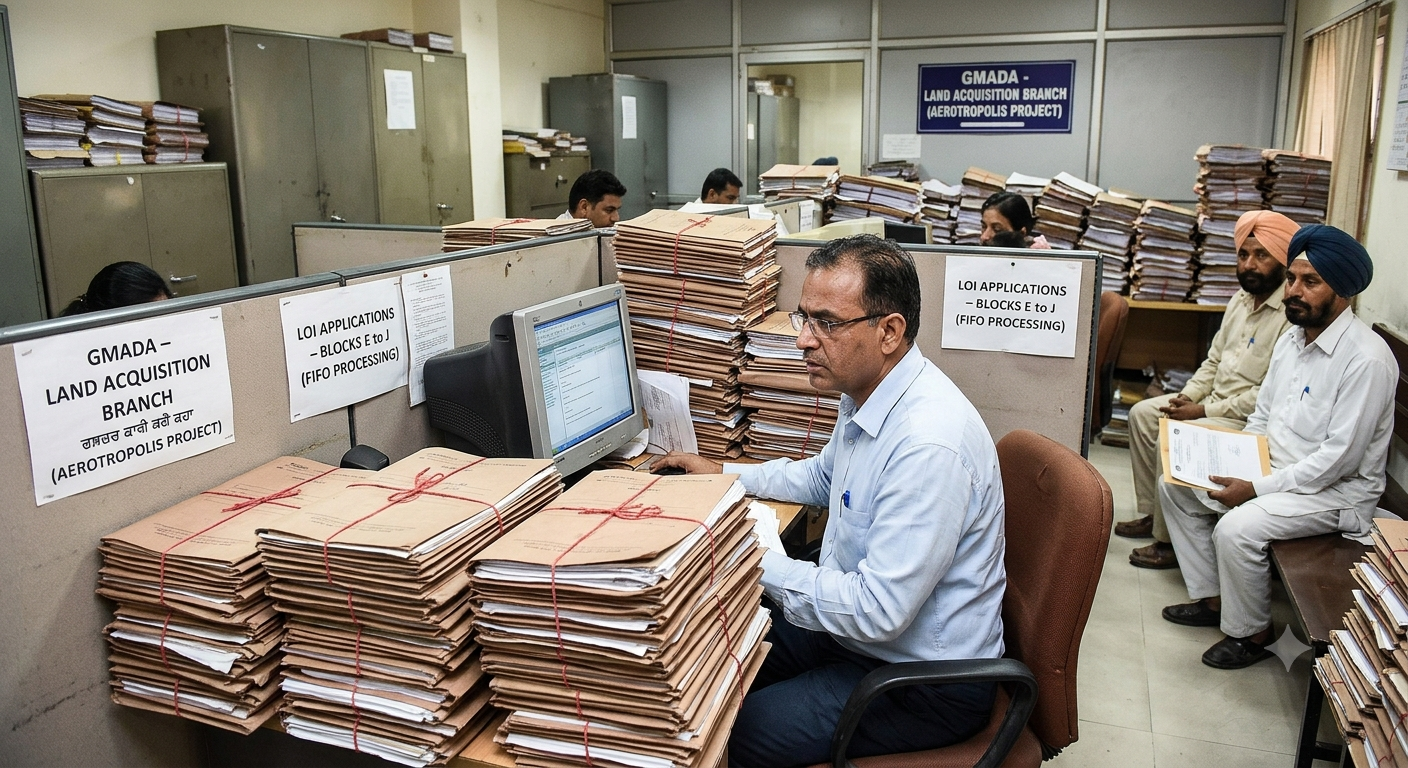
For thousands of landowners connected with GMADA’s Aerotropolis project, the next major issue is no longer just land acquisition.
It is paperwork — and a very large amount of it.
GMADA is expected to issue around 3,500 Letters of Intent (LOIs) for Aerotropolis Blocks E to J, according to information shared by officials during a recent meeting on land acquisition and compensation issues in Mohali.
That number becomes much more significant when compared with GMADA’s earlier processing capacity.
Officials said that only around 500 LOIs had previously been processed in a year. Now, the authority is preparing to deal with a workload several times larger while the staff handling these cases has largely remained the same.
So the real question is not simply whether LOIs will be issued.
It is how quickly GMADA can process thousands of individual landowner files — and whether the system can handle them without creating another long queue.
Why Are So Many LOIs Expected?
The latest phase of the Aerotropolis project covers Blocks E, F, G, H, I and J.
In July 2026, GMADA announced land-acquisition awards covering 3,522.98 acres across eight villages for this phase of the project. The villages included Kurdi, Kishanpura, Siaun, Patton, Bari, Matran, Bakarpur and Chhat.
Landowners eligible under the land-pooling framework can opt for developed property instead of taking the entire entitlement as monetary compensation.
That is where LOIs become important.
An LOI represents a landowner's entitlement under the applicable land-pooling arrangement before the process eventually moves further towards formal allotment.
Because of the enormous area involved in Blocks E–J, GMADA officials now expect approximately 3,500 LOIs to be generated.
This is not a normal administrative workload.
It is effectively thousands of individual land records, ownership details and eligibility files that have to move through GMADA’s system.
GMADA Has Changed How the Queue Works
One important change is that files for Blocks E–J are now being processed under a first-in, first-out, or FIFO, system.
In simple terms:
The file received first should be processed first.
According to GMADA officials, applications are being taken up strictly according to the order in which they are received on the online portal.
That sounds like a small administrative change, but for landowners it is important. Under such a system, the processing sequence should depend on the application's position in the queue rather than on repeated physical follow-ups at the office. It also makes the date and completeness of an online submission more significant. A file that reaches the system earlier and is complete should ordinarily move ahead of a later application.
However, FIFO should not be interpreted to mean that every file will take exactly the same amount of time. A case may still require verification of ownership, land records or other documentation before an LOI can actually be issued.
The Bigger Problem: Processing Capacity
The scale difference is substantial. If around 500 LOIs were previously processed over one year, and approximately 3,500 LOIs may now need to be handled for E–J, simply continuing at the earlier pace would create an obvious bottleneck.
GMADA officials acknowledged that the workload had increased significantly while staffing had not increased at the same rate. The government has therefore approved 10 additional patwaris to help accelerate the work. Patwaris are particularly relevant in such cases because land-pooling and acquisition files depend heavily on verification of land ownership and revenue records. But there is another timing issue.
According to the latest report, the appointment process for the additional patwaris was delayed following the Enforcement Directorate searches at GMADA in late September. Officials indicated that the appointments could take around another 15 days. That makes the staffing increase important — but not immediate.
So Will All 3,500 LOIs Be Cleared by December?
This is where the distinction matters. GMADA has not publicly guaranteed that all 3,500 LOIs will be issued by December. The latest information is more cautious. Officials reportedly indicated that pending LOIs were likely to be processed closer to December, once additional staffing begins strengthening the processing system.
That should not be read as a formal December deadline for completion of every LOI. With around 3,500 potential cases, processing will depend on several factors, including:
- How quickly the additional staff actually join
- How many eligible landowners choose the land-pooling route
- Whether applications and ownership records are complete
- How quickly individual land records can be verified
- Whether files require corrections or additional documentation
December may therefore become an important period for movement in the queue, but it would be premature to assume that every eligible landowner will necessarily have an LOI in hand by then.
Blocks B, C and D Have a Different Problem
There is another reason Aerotropolis updates can become confusing. The current issues relating to Blocks B, C and D are not exactly the same as those relating to Blocks E–J.
At the recent meeting with GMADA Chief Administrator Sandeep Rishi, landowners and representatives raised delays involving compensation, LOIs and Rehabilitation and Resettlement benefits connected with the earlier Aerotropolis blocks. Blocks E–J, meanwhile, are part of the newer acquisition phase and are now creating a much larger fresh LOI-processing workload.
So when someone says “Aerotropolis LOIs are delayed,” it is important to ask:
- Which block?
- Which acquisition phase?
- And which stage is the individual file actually at?
The answer can be very different depending on the block.
What Changed in the E–J Acquisition?
The acquisition awards for E–J were announced in July 2026 for more than 3,522 acres. At the time, eligible landowners were given a 120-day window from the date of the award to submit applications under the Land Pooling Policy. The framework also provides for Special LOIs for eligible fractional landholdings, which can later be converted into regular LOIs. The July announcement stated that these Special LOIs would be transferable.
That adds another layer to the processing exercise. GMADA is not dealing with one identical type of entitlement for every landowner. Individual holdings and the option selected under the applicable policy can affect how the case is processed.
An LOI Does Not Mean the Aerotropolis Block Is Ready
This is another important distinction for both landowners and potential buyers. Issuance of an LOI is an administrative milestone. It is not the same as physical possession of a developed plot. An LOI being issued does not, by itself, mean that:
- Internal roads have been completed
- Services are available
- The final plot is ready for possession
- The entire block has been physically developed
That distinction matters particularly in Aerotropolis because earlier blocks have already faced a substantial gap between land acquisition, LOI issuance and visible development on the ground. Earlier reporting on the project noted that allottees in Blocks A–D had received LOIs while physical development in parts of the project remained delayed.
So the next milestone for E–J should not be judged only by the number of LOIs issued. The larger question is whether administrative processing and actual township development begin moving together.
What Should Affected Landowners Watch Now?
The next few weeks should make the position clearer. The most important developments to watch are the joining of the additional patwaris, the pace at which FIFO applications begin moving, and whether GMADA publishes any clearer block-wise or application-wise processing update.
For an individual landowner, the relevant question is also more specific than “Have 3,500 LOIs been issued?”
It is:
Where is my file in the process, and is anything required from me before it can move forward?
The introduction of an online FIFO system could make that process more predictable, but its real test will be whether thousands of applications can move through verification without recreating the same backlog digitally.
The Bigger Picture
Aerotropolis E–J is one of GMADA’s largest ongoing land-acquisition exercises. More than 3,500 acres have already been covered by acquisition awards, thousands of LOIs may follow, and GMADA is now increasing staff specifically to deal with the resulting workload.
The scale explains why the current delay cannot be viewed as just another pending property file. GMADA is effectively trying to process in one phase a volume of LOIs many times larger than what officials say was previously handled in an entire year.
The FIFO system and the addition of 10 patwaris are intended to improve that capacity. Whether they are enough will become much clearer as December approaches. For affected landowners, however, the most important point is simple:
December should currently be viewed as a period when LOI processing is expected to accelerate — not as a confirmed deadline by which all 3,500 LOIs will necessarily be issued.
You May Also Want to Know
Source:This report is based on information published by Hindustan Times and The Tribune on November 11, 2026.
For official public notices, land-acquisition updates, tenders, project information and other authority-related information, visit gmada.gov.in.
For simplified explanations of GMADA notices, Greater Mohali projects, land acquisition and development updates, visit gmada.in.
Important Disclaimer
gmada.in is an independent information portal. It is not affiliated with, endorsed by, or operated by the Greater Mohali Area Development Authority (GMADA), PUDA, the Government of Punjab, or any other government department.