Home Buyer's Guide
Before Buying in a Private Colony, Check the Latest Approved Layout — Not Just the Brochure
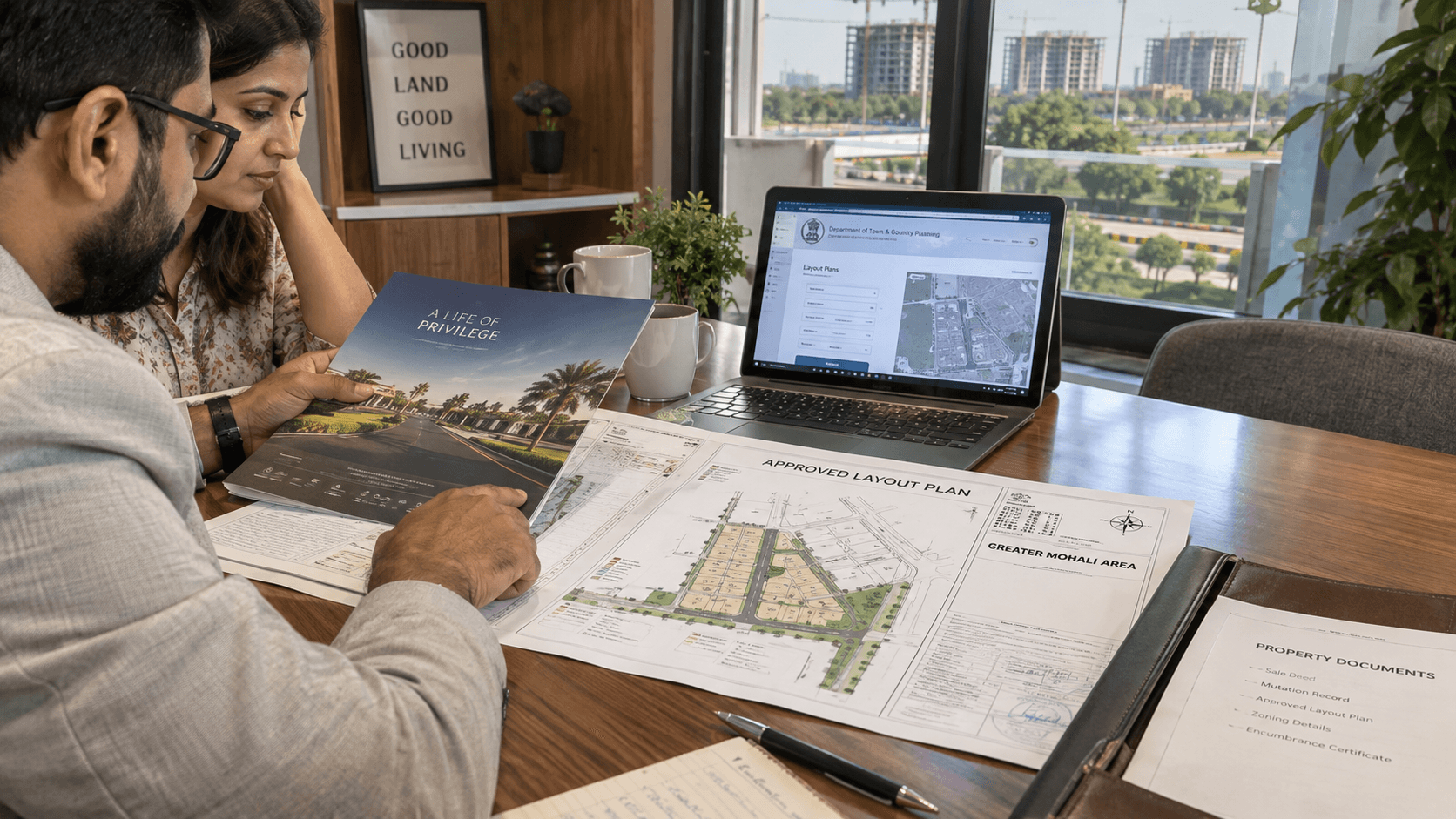
The road, park or open space shown to you may look attractive—but check what is actually approved before paying. Buying a plot is a major financial decision. A buyer may visit a private colony, speak to a salesperson, receive a colourful brochure and be shown a layout with wide roads, parks, commercial areas and other facilities. Everything may look convincing. But before paying a booking amount or token money, there is one more document worth checking: the latest approved layout plan. For private colonies falling within GMADA's jurisdiction, official records can help a buyer verify whether the colony is licensed and what approved-plan information is available. GMADA maintains an Approved Colonies database that includes details such as the colony location, licence number, date of approval, approved plan, promoter name and promoter-registration information. That makes the official record an important part of property due diligence—not just the developer's brochure.
Brochure and Approved Layout: They Are Not the Same Thing
A brochure is primarily a marketing document. It may help you understand how a developer is presenting the project, but it should not automatically be treated as proof of the final approved layout. An approved layout plan is different. It shows the planning arrangement that has received approval from the relevant authority at that stage. Depending on the project, this may include plots, internal roads, green or open areas, commercial spaces, institutional areas, parking, utility areas and other components. This is why buyers should compare what they are being shown with the latest official documents available for that colony.
Why Does the Word “Latest” Matter?
Because an approved layout can later be revised or amended. GMADA's own public-notice records include notices concerning revised layouts and amendments to previously approved plans, including private residential, mixed-use, group-housing and industrial developments. That does not mean every colony's layout will change. It means a buyer should not assume that a plan printed in an old brochure remains the latest approved version. If a brochure was printed months or years earlier, ask whether any revised layout, amendment or subsequent approval has been issued.
A Simple Example
Imagine you are considering a plot because the salesperson tells you: “Your plot faces a park.” That may be an important reason for your decision. Instead of relying only on the brochure, locate the plot on the latest approved plan and check whether the land opposite it is actually shown as a park or green space. Similarly, if you are told: “This is a 60-foot road.” Check the road width shown on the approved layout. If you are buying because a commercial market, school, parking area or other facility is shown nearby, identify that location on the approved plan as well. The purpose is not to distrust every developer. It is simply to verify an important property decision using the official record available to you.
What Can a Revised Layout Affect?
The exact changes depend on the project. A revision could concern the arrangement of plots, roads, open spaces, parking, utilities, commercial areas or other planning components. That is why even a seemingly small change on paper may be important to an individual buyer. For example, your plot itself may remain unchanged, but a nearby feature that influenced your purchase decision could be different in a revised plan. The important question is therefore not only: “Is this colony approved?” It is also: “Am I looking at the latest approved plan for this colony?”
How Can You Check a Private Colony on the GMADA Website?
GMADA provides an Approved Colonies section on its official website. The database allows users to search colony records and provides fields including the colony location, colony name, licence number, date of approval, approved plan, completion information where available, promoter name and promoter-registration details. This can be a useful starting point before making a purchase. A buyer should identify the exact colony rather than relying only on a similar project or marketing name. Names used in advertisements may sometimes be easier to remember than the legal or licensed project details, so check the promoter and location as well.
What Should You Compare Before Paying Token Money?
Before committing money, compare the information given to you with the latest official records available. A practical buyer check should cover:
- Exact colony and promoter name
- Colony licence number
- Latest approved layout available
- Exact plot number and dimensions
- Road shown in front of or beside the plot
- Road width, where relevant
- Park or green area claimed to be nearby
- Commercial or institutional area shown nearby
- Entry and access to the colony
- Utility or service areas close to the plot
- Any revised-layout or amendment notice
- Whether the document shown by the seller is the latest version
Do not simply ask the salesperson, “Is everything approved?” Ask for the document details that allow you to verify the answer.
One Important Point: Colony Approval and Individual Plot Verification Are Different
Finding a colony in an approved-colony list is useful. But that does not mean you should stop there. You still need to verify the specific plot you intend to buy. Check that its number, size and location correspond with the applicable approved plan and the property's documents. A colony-level approval should not be used as a substitute for checking the particular property involved in your transaction.
Be Careful With Words Such as “Proposed”
Brochures and sales presentations sometimes show future facilities. Pay attention to words such as: proposed, planned, future, upcoming or subject to approval**.** A proposed facility should not be treated in the same way as an existing or finally approved facility. If an attractive feature is important to your purchase decision, ask: Where is this shown in the official approved plan? If it is not shown, ask what official document supports the claim.
What If the Brochure and Approved Layout Do Not Match?
Do not rush into the transaction. Ask the promoter or seller why there is a difference. There may be a legitimate explanation—for example, you may have been given an older brochure while a revised plan has subsequently been approved. But the difference should be understood before money changes hands. Ask for the latest relevant approval or revised layout and compare it carefully. For a significant purchase, professional legal or technical verification may also be appropriate.
Why GMADA Public Notices Matter
The approved-colony database should not necessarily be the only page you check. GMADA also publishes public notices. Official GMADA records show notices concerning revised layouts and amendments to approved layouts of private developments. Therefore, if you are seriously considering a project, search for the colony and promoter name in relevant GMADA notices as well. A later notice may contain information that is not obvious from an older brochure.
Do Not Confuse a Master Plan With a Colony Layout
This is another useful distinction. A master plan covers planning at a much larger area or city level. A colony layout deals with the internal planning of a particular development. Seeing a location inside an approved master-plan area does not by itself tell you where your individual plot, park or internal road is located. For a private-colony plot, buyers should therefore understand both the broader planning context and the project-specific approved layout where applicable.
What About Nearby Future Roads and Development?
Nearby master-plan roads or future infrastructure can certainly be relevant. But buyers should be careful about claims such as: “Once this road comes, prices will double.” A planning document may show a proposed road, but that alone does not tell you when it will be built. Planning, acquisition, tendering, construction and opening are different stages. Use official planning information to understand the area—not as a guaranteed prediction of future property prices.
A Brochure Should Start Your Questions, Not End Them
A brochure can be useful. It can show you the project concept and help you decide which plots you want to examine. But it should lead to verification. A sensible sequence is:
Brochure → Identify Plot → Check Colony Record → Check Latest Approved Layout → Check Later Notices/Amendments → Verify Property Documents → Decide
That process may take a little more effort.For a purchase worth lakhs or crores of rupees, it is worth doing.
The Most Important Question to Ask
Before paying a token amount for a plot in a private colony, ask the seller or promoter: “Please show me this exact plot on the latest approved layout plan.” Then verify the document rather than relying only on the explanation given to you.
- Check the plot.
- Check the road.
- Check the park.
- Check the access.
- Check the nearby land use.
- And check whether a later revised layout or amendment exists.
Final Takeaway
The attractive map inside a property brochure may be the first layout a buyer sees. It should not automatically be the last one they check. GMADA provides official information on approved colonies, approved plans and public notices that can help buyers carry out a more informed verification. Its Approved Colonies database itself includes details such as licence numbers, approved plans and promoter information. The lesson is simple: Don't buy only what is shown in the brochure. Verify what is shown in the latest official records. A few minutes spent checking the right document before paying can help prevent much bigger questions later.
Where to Check
For official colony records, approved plans, layout/zoning information and public notices, visit the gmada.gov.in.
For simplified explanations of Greater Mohali development, GMADA notices and property-related processes, visit gmada.in.
Important Disclaimer
gmada.in is an independent information portal and is not affiliated with, endorsed by or operated by the Greater Mohali Area Development Authority (GMADA), PUDA, the Government of Punjab or any other government department.