Notices & Public Alerts
Before You Make Any Decision About Your Land, Check These GMADA Updates
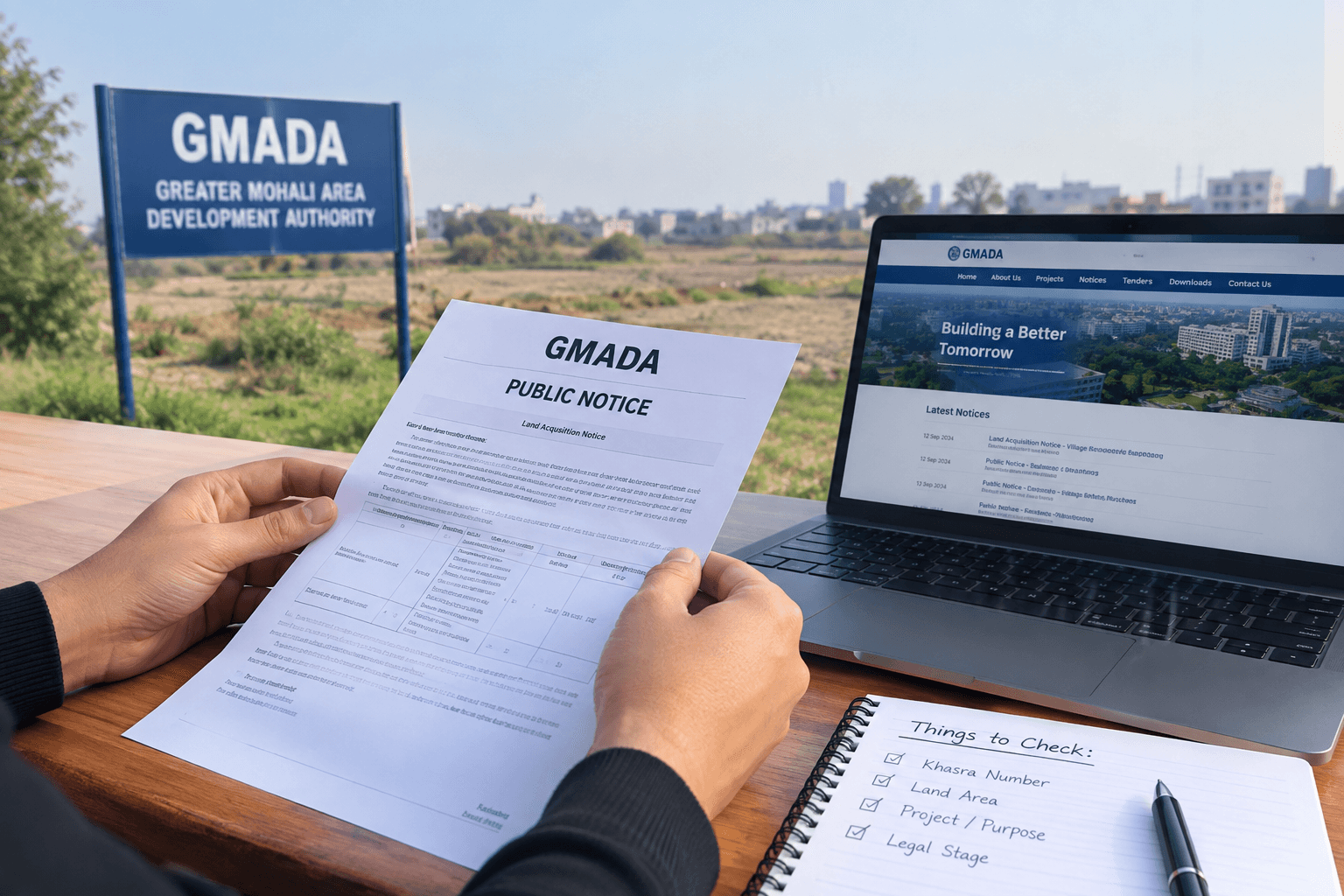
You own land in or around Greater Mohali. Your village appears in a GMADA land-related notice. You are thinking about selling the property, buying nearby land, taking a loan against it or starting construction.
But what does the notice actually mean for your land?
This is where many property owners become confused. A village name appearing in a GMADA notice does not automatically mean that every property in that village is part of the same process. The important information is usually found inside the complete notice, where the relevant land details, project information and applicable legal process are described. Understanding how to read these notices can help landowners avoid assumptions and check the position of their own property before making an important decision.
Why Are GMADA Land Notices Important?
GMADA regularly publishes public notices relating to land acquisition, planning, development projects, property matters and other activities within its jurisdiction. The current public-notice archive includes recent land acquisition notices for areas including Manakpur Kalar, Tangori, Karala, Banur, Kijargadh, Sangal Basepur, Teeda, ChadMajra, Sekhanmajra, Kurda, Rudka, Dharamgadh, Ladiaali and Safipur. Separate notices also cover land in areas such as Mullanpur Garibdass and other villages in New Chandigarh, as well as different development projects. For a landowner, the important point is not simply that a village has been mentioned.
The important question is: Does the particular land I own appear in the relevant official document?
Does the Notice Affect Your Land?
This is the first thing landowners should understand. Suppose a notice mentions your village. That does not, by itself, establish that every plot or every landowner in that village is included. Land-related notices can identify particular parcels, areas, project boundaries or other property details. That is why checking only the village name is not enough.
Think of it this way:
Village name = where to start checking
Property details = what tells you whether the notice is relevant to your land
The current GMADA notice archive itself lists separate notices for specific groups of villages and separate projects, showing why the exact document matters.
What Details Should You Check?
If your village appears in a GMADA notice, do not stop after reading the headline.
Check the Khasra Number
Your Khasra number is one of the most useful details for matching your property with the land described in the notice. Compare the Khasra number in your land records with the details given in the relevant document. A village name alone cannot give you the same level of certainty.
Check the Land Area
Look at the land area mentioned in the document and compare it with your own property records. This can help you understand whether the document relates to a particular parcel or only part of a larger holding.
Check the Project Name
Not all land-related notices are issued for the same reason. The GMADA archive contains notices connected with different development activities, including Aerotropolis-related land acquisition, Expo City and New Chandigarh development. Understanding the project mentioned in your notice gives you important context about why the land is being discussed.
Check the Legal Stage
Another common mistake is assuming that every land acquisition notice represents the same stage of the process. It does not. Some documents may concern a proposal, a statutory notice, objections, hearings, recommendations or another stage of the acquisition process. The actual legal position should therefore be taken from the wording of the specific notice rather than from a general description such as “GMADA is acquiring land.”
Does a Notice Mean Your Land Is Already Acquired?
Not necessarily. This is one of the most important points in the entire article. A public notice can be part of an ongoing legal or administrative process. It should not automatically be described as proof that ownership has already transferred, compensation has already been paid or the acquisition process has been completed.
The meaning depends on the particular document and the stage mentioned in it. So, before making a property decision, always ask:
What exactly does this notice confirm?
and
What does it not confirm?
That distinction can prevent unnecessary confusion.
What If Your Khasra Number Is Not Listed?
This also needs to be understood carefully. If your Khasra number does not appear in a particular notice, it means that the land is not identified in that particular document based on the information provided there.
It should not be treated as a permanent guarantee that the property can never be affected by any future project or a different notice. GMADA's archive contains many separate notices relating to different villages, sectors and projects. A landowner should therefore check the relevant document and continue to follow official updates where necessary.
Why Check Before Buying or Selling Land?
Property decisions often involve large amounts of money. Imagine you are about to:
- sell your land
- purchase another parcel
- apply for a loan
- mortgage the property
- start construction
- invest in land near a proposed development
In each situation, knowing whether there is an official land-related notice connected with your property can be useful. This does not mean every notice prevents a transaction. It means the information should be checked before you make an important decision. A property decision based only on a village name, broker statement, social-media post or old screenshot can give you an incomplete picture.
What Projects Can GMADA Notices Cover?
Another reason users should read the full document is that different notices may relate to different development plans. Recent GMADA records show land-related notices connected with areas including:
- Aerotropolis Extension
- Expo City
- New Chandigarh development
- Eco City-4
- and other project-specific matters.
This means two villages mentioned in GMADA notices may not necessarily be part of the same project or follow exactly the same process. The project name in the original document therefore matters.
What Should You Do If Your Land Is Included?
Do not rely on a summary alone. First, save or download the complete notice. Then compare the document with your land records. Check:
- Village
- Khasra number
- Area
- Project or purpose
- Relevant legal stage
If the details appear to match your property, keep the notice with your property records and follow any further official documents related to the matter. For a property-specific legal question, the original notice and your land documents should be reviewed together by the appropriate authority or a qualified property professional.
Where Should You Get the Information?
This is particularly important when a land issue involves ownership, acquisition or compensation. The GMADA public-notice archive provides summaries and links to the original documents, while the original government document should be treated as the authoritative source for the exact notice wording.
So the best approach is:
- Read the summary to understand the topic.
- Read the original notice to understand your property.
That small difference can be very important.
Simple Example
Imagine your village is mentioned in a GMADA land-acquisition notice.
You see the village name and immediately assume:
“My land is being acquired.”
That conclusion may be too early.
A better approach is:
Village appears in notice
↓
Find the complete notice
↓
Check Khasra number
↓
Check land area and other details
↓
Identify the project
↓
Read the legal stage mentioned in the document
↓
Check for any later official update
This gives you a much clearer picture than relying on the village name alone.
What Should You Not Assume?
A GMADA land notice should not automatically be understood as:
“Every property in this village is being acquired.”
It should also not automatically be understood as:
“The acquisition is already complete.”
And it should not automatically be understood as:
“Compensation has already been finalised.”
Those conclusions require the relevant official documents and the applicable stage of the process.
Why Is This Information Important?
For residents and property owners, the value of these notices is not simply in knowing that another government document has been published. The real value is knowing whether the document has any relevance to your own property. A few minutes spent checking the original notice can help you understand:
- whether your village is involved;
- whether your particular land is identified;
- which project the notice relates to;
- what stage the process has reached; and
- what information you should monitor next.
That is much more useful than simply knowing that “GMADA has issued a notice.”
What Should You Check Before Making a Land Decision?
Whenever you see a GMADA land-related update, ask four questions:
- What land is mentioned?
- Which project is involved?
- What exactly does the document say?
- What is the next official step?
If you can answer these four questions, you are much less likely to misunderstand the update.
Where to Check GMADA Information
For current Citizen Services, the Citizen Charter, application procedures, Single Window status and grievance facilities, visit gmada.gov.in.
For simplified explanations of GMADA procedures, public notices and Greater Mohali development, visit gmada.in.
Important Disclaimer
gmada.in is an independent information portal and is not affiliated with, endorsed by or operated by the Greater Mohali Area Development Authority (GMADA), PUDA, the Government of Punjab or any other government department.