Notices & Public Alerts
Can a Court Case Change the Course of a GMADA Development Project?
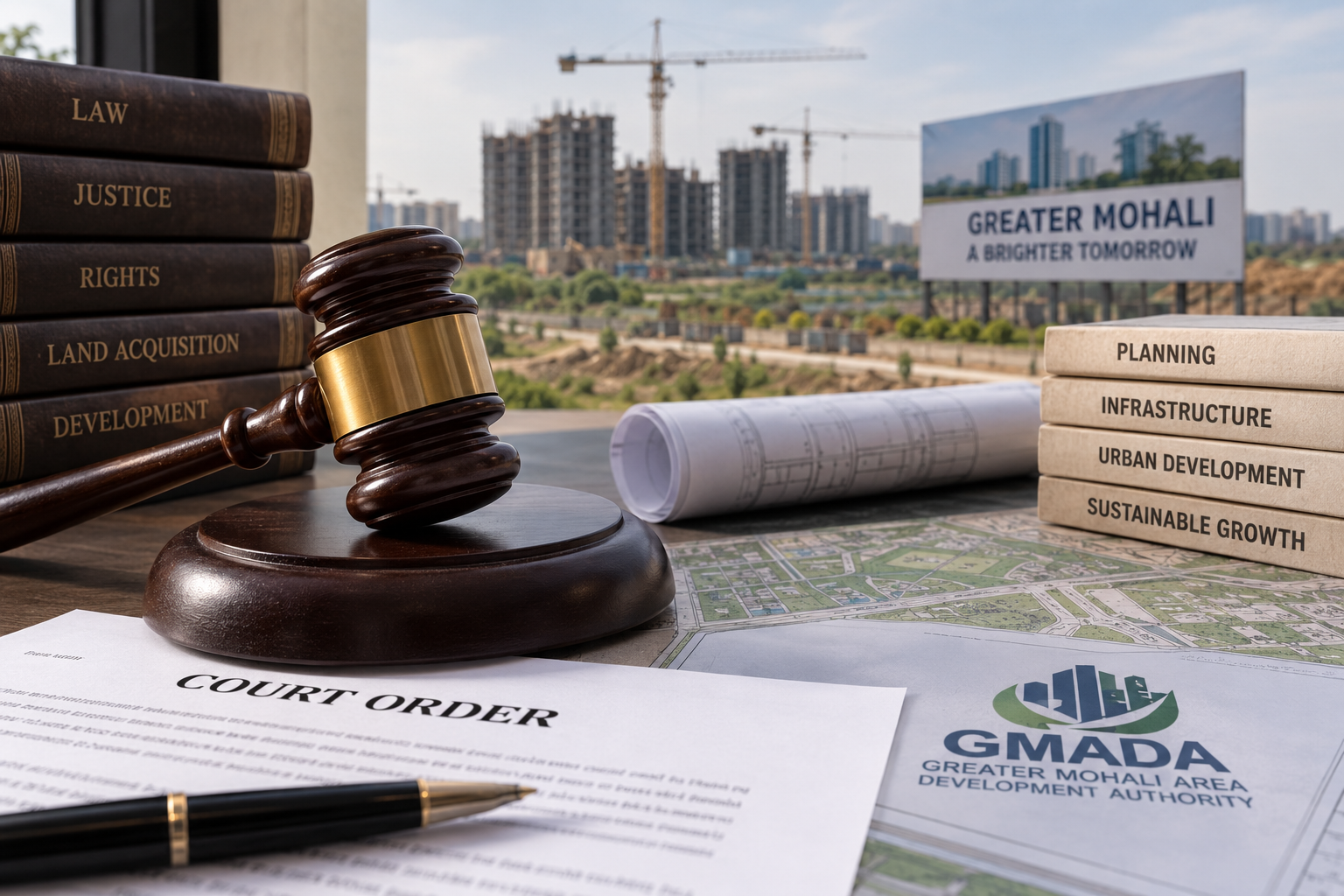
Large development projects in Greater Mohali often involve land acquisition, planning approvals, infrastructure work and several legal procedures. Sometimes, one of these matters reaches the courts. When that happens, people often assume that the entire project has been cancelled or stopped. But that is not always the case.
A court order may affect only a particular parcel of land, one stage of acquisition, possession of the land or the timing of an award. In other cases, the authority may be asked to reconsider a decision or follow a particular legal procedure before moving ahead.
For residents and landowners, the important question is therefore not simply: “Is there a court case?” The more useful question is:“What exactly has the court ordered, and which part of the project does that order affect?”
Why Do GMADA Development Matters Reach Court?
Development projects can involve several groups with different interests. These may include:
- Landowners
- Residents
- Government departments
- Development authorities
- Businesses
- Project beneficiaries
- Other affected stakeholders
Legal disputes may arise over matters such as:
- Land acquisition
- Ownership of land
- Compensation
- Possession
- Acquisition procedure
- Particular Khasra numbers
- Access to land
- Compliance with statutory requirements
- Earlier government or authority decisions
A court case does not automatically mean that the development project itself is unlawful. In many cases, the dispute may relate only to a specific part of the process.
Can a Court Stop a GMADA Project?
A court can issue directions that affect the progress of a project, but the impact depends entirely on the wording of the order. For example, a court may direct that:
- Possession should not be changed temporarily
- A particular acquisition step should not proceed
- An authority should reconsider a matter
- A hearing should be provided
- Existing conditions should be maintained
- A decision should be taken according to the applicable law
This is different from permanently cancelling an entire development project. A legal order affecting one parcel of land also does not necessarily mean that every parcel within the project is affected. That is why residents should avoid relying only on headlines such as “project stayed” or “land acquisition stopped.” The actual court order should always be checked.
Court Stay, Status Quo and Final Judgment: What Is the Difference?
These terms are often used in news reports and legal discussions, but they do not mean the same thing.
Stay Order
A stay generally pauses a particular action or proceeding until the court gives further directions. The exact effect depends on what has specifically been stayed.
Status Quo
A status-quo order generally requires the parties to maintain the existing position. For example, the court may direct that possession or the character of the land should remain unchanged for the time being.
Interim Order
An interim order is a temporary direction issued while the main case is still being considered. It should not automatically be treated as the final outcome.
Final Judgment
A final judgment decides the issues before the court more conclusively, subject to any further legal remedies that may be available. For landowners, understanding this distinction is important because an interim court order and a final judgment can have very different consequences.
A Real Example: When a Court Order Affected an Acquisition Timeline
An official Punjab Government notification provides a useful example of how court proceedings can affect a land-acquisition process. The matter involved approximately 15.625 acres of land in Bhago Majra and Manak Majra for construction of a 200-foot-wide sector-dividing road.
The land-acquisition process had already progressed through several statutory stages. However, the Punjab and Haryana High Court directed that status quo regarding possession should be maintained. Because of that court direction, the acquisition award was not announced within the earlier time period. The Punjab Government subsequently extended the time available for announcing the award.
The important lesson from this example is simple: The court case did not automatically mean that the entire road project had been cancelled. Instead, the court order affected a particular stage of the acquisition process and changed its timeline.
Can One Khasra Number Affect a Larger Project?
Yes, in some circumstances. A large project may involve hundreds of acres, but an individual parcel can still matter if it falls within an important part of the project. For example, a disputed parcel could fall within:
- A road alignment
- An access point
- A sector boundary
- A utility corridor
- A drainage route
- A development pocket
- A connecting piece of land
This is why landowners should not assume that the size of their parcel determines whether a legal dispute is important. At the same time, a dispute over one Khasra number should not automatically be interpreted as a dispute affecting the entire project. The exact land covered by the court order must be checked.
What Happens to Land Acquisition During a Court Case?
There is no single answer for every case. What happens next depends on:
- The stage of acquisition
- The land involved
- The relief sought by the petitioner
- The court's order
- Whether the order applies to possession, compensation or another step
- Any later government or court directions
Some parts of a wider project may continue while another part remains affected by litigation. In other situations, an important acquisition stage may need to wait until the court gives further directions. This is why court proceedings should always be read together with the latest government and GMADA documents.
Does a Court Case Affect the Entire Project?
Not necessarily. This is one of the most important points for residents and property buyers. Suppose a large GMADA development covers several villages and many Khasra numbers. If a petition concerns only a small number of those parcels, the court order may apply only to those parcels or to a particular action connected with them.
Therefore:One legal case does not automatically mean a stay on the whole project. Similarly:One court order does not automatically mean project cancellation. The scope of the order matters.
What Should a Landowner Check?
If you hear that a court case relates to a GMADA project affecting your area, do not rely only on social media posts, property dealers or word of mouth. Check the following information:
- Name of the case
- Case number
- Court that issued the order
- Exact wording of the latest order
- Village name
- Khasra number
- Land area involved
- Relevant acquisition notification
- Current acquisition stage
- Whether possession is affected
- Whether an award has been announced
- Any later government notification
- Any subsequent court order
Most importantly, check whether your own land is actually covered by the case or order.
What Should Property Buyers Understand?
Property buyers should also be careful when hearing about litigation involving a development project. A court case may create uncertainty, but it does not automatically mean that:
- The whole project has stopped
- The development has been cancelled
- Every property in the area is affected
- Property prices will fall
- Property prices will rise after the case ends
Property values depend on many factors, including:
- Legal status of the property
- Approved land use
- Location
- Road connectivity
- Infrastructure
- Project progress
- Market demand
- Availability of services
A court proceeding should therefore be treated as one factor to investigate, not as a complete basis for a property decision.
What About Current GMADA Land-Acquisition Projects?
GMADA continues to publish notifications connected with different development and land-acquisition projects across Greater Mohali. Recent official records include proceedings connected with projects such as Eco City-4 and Aerotropolis-related development.
However, the existence of an active land-acquisition notice does not mean that the project is involved in a court dispute. These are separate issues. A project should only be described as being affected by litigation when there is a specific court case or order connected with it. This distinction is important for accurate reporting.
Court Order vs GMADA Notice
Both documents can be important, but they serve different purposes.
Court Order
A court order tells you what the court has directed in the particular legal matter before it.
GMADA or Government Notification
An official notification may tell you what statutory or administrative action is being taken in relation to the project or land acquisition. To understand the current position properly, readers may sometimes need to look at both. For example:
Court Order → Government Response → Revised Notification → Further Acquisition Action
The latest document in the sequence can be particularly important.
Why Project Timelines Can Change
Large urban-development projects rarely move in one straight line. Their timelines may change because of:
- Court proceedings
- Land acquisition
- Objections
- Changes in planning
- Missing land parcels
- Administrative approvals
- Tendering
- Engineering issues
- Compensation proceedings
- Revised government decisions
A delay therefore does not always mean that a project has failed. Similarly, an announcement does not mean that construction will begin immediately. Understanding the actual stage of the project is more useful than relying on an expected completion date alone.
How Residents Can Follow a Court-Affected Project
A simple way to follow the situation is to build a timeline. For example:
Original Notification → Objection or Dispute → Court Order → Government or GMADA Response → Further Notification → Next Acquisition Stage
Whenever a new document appears, compare it with the earlier one.
Ask:
- What changed?
- Which land is affected?
- Has the court issued another order?
- Has GMADA or the Punjab Government taken further action?
This provides a much clearer picture than following isolated news reports.
Questions Residents Should Ask
Does a court case mean construction has stopped?
Not necessarily. The answer depends on the specific court order and what stage of the project it affects.
Does a stay affect every landowner in the project?
Not necessarily. Check which land, Khasra numbers, parties or actions are covered by the order.
Can land acquisition continue during litigation?
Possibly, depending on the court's directions and the stage of the acquisition process.
Can a court case change the project timeline?
Yes. A court order can sometimes require a particular step to pause, be reconsidered or be completed differently.
Does a court case mean the project is cancelled?
No. Cancellation should not be assumed unless the relevant legal or government decision clearly establishes it.
Where should affected landowners get legal guidance?
People whose property rights are directly affected should consider obtaining advice from a qualified legal professional who can review their specific documents and court orders.
Why Accurate Information Matters
Court-related development news can quickly create confusion. A phrase such as: “GMADA project stayed by court” may sound as though an entire township or infrastructure project has stopped. But the actual order may relate only to:
- Possession of one parcel
- Announcement of an award
- One group of petitioners
- One stage of acquisition
- A temporary status-quo direction
For residents and landowners, that difference can be extremely important. The best approach is therefore to verify the original order and the latest official project documents before drawing conclusions.
What This Means for Greater Mohali
Court proceedings are one part of the larger development process in a rapidly growing region such as Greater Mohali. They can influence how a particular acquisition or development step moves forward, but their effect should always be understood carefully.
The most important principle is: Do not ask only whether a project is “in court.” Ask what the court has actually ordered.For landowners, residents and property buyers, understanding that distinction can help separate genuine legal developments from rumours, incomplete information and unnecessary speculation.
You May Also Want to Know
For official notifications, land-acquisition documents, project information and other records related to GMADA, visit gmada.gov.in.
For simplified explanations of Greater Mohali development, land acquisition, infrastructure, master plans, court-related project updates and public notices, visit gmada.in.
Important Disclaimer
gmada.in is an independent information portal and is not affiliated with, endorsed by or operated by the Greater Mohali Area Development Authority (GMADA), PUDA, the Government of Punjab, the judiciary or any other government department.