Master Plan & Town Development
How deconcretisation can help urban trees survive and why it matters for residents
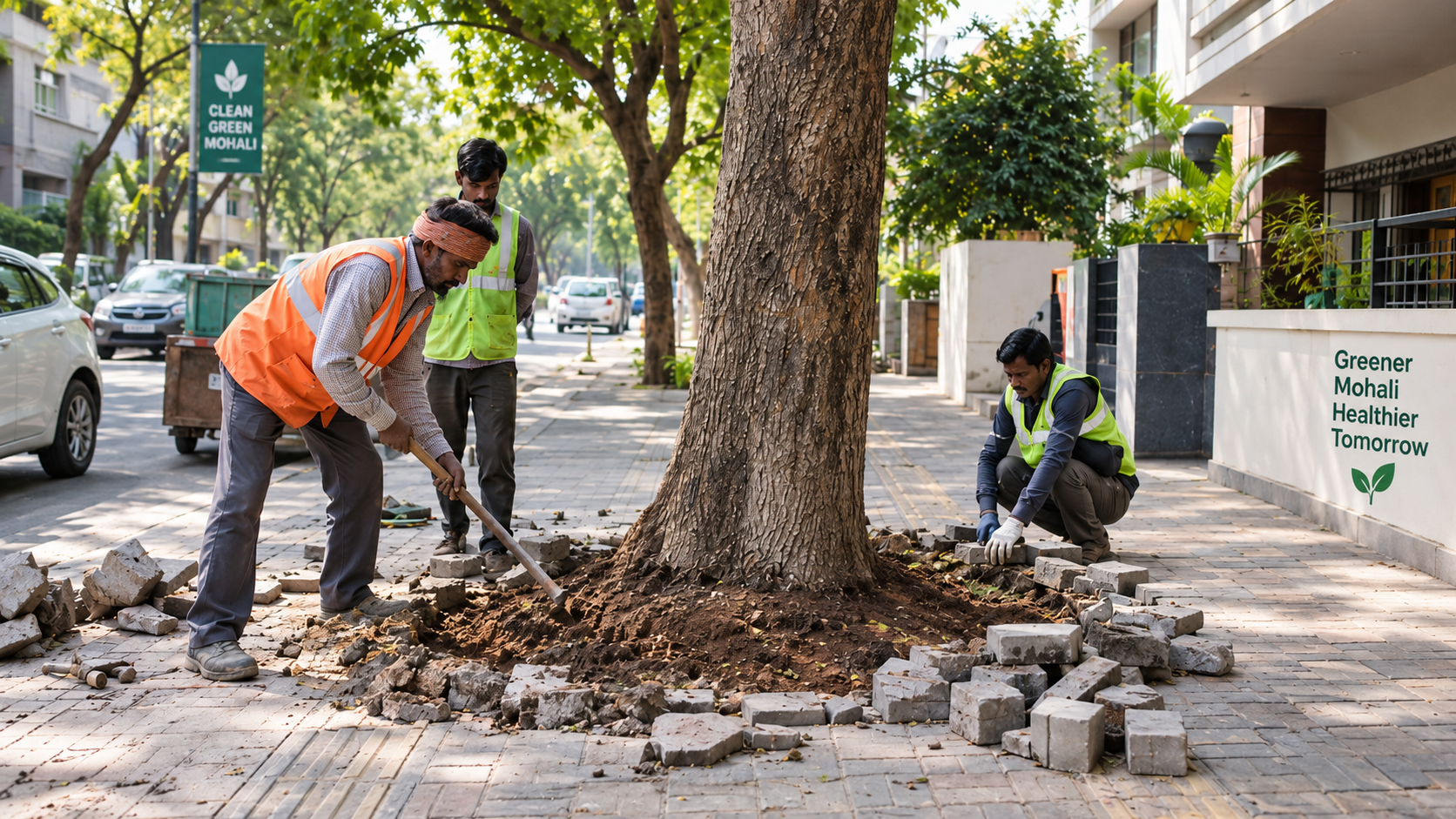
Residents walking through parts of Greater Mohali may notice something unusual around roadside trees: concrete, tiles or other hard surfaces being removed from around their trunks. At first, this may look like ordinary repair work. But there is a specific reason behind it.
GMADA has issued a tender for deconcretisation around trees in Sectors 88–89 and New Chandigarh, S.A.S. Nagar. The tender estimated the work at approximately ₹38.86 lakh and mentioned a two-month period of completion.
In simple terms, deconcretisation means removing hard concrete or paving from immediately around a tree so that more soil is exposed around its root area. This may seem like a small urban-maintenance activity, but it can matter for the long-term health of roadside trees.
Why Is Concrete Around Trees a Problem?
Trees do not need only sunlight. Their roots also need access to:
- Water
- Air
- Soil
- Nutrients
- Space to grow
When soil around a tree becomes heavily compacted or sealed beneath hard paving, movement of water and air through the soil can become restricted.Urban-tree guidance notes that soil compaction reduces pore space in the ground and can restrict root development. It can also interfere with the movement of air and water around the root system. This can make conditions around an urban tree more difficult over time.
What Does Deconcretisation Actually Do?
The basic idea is simple. Instead of allowing concrete or paving to reach right up to the tree trunk, some of the hard surface around the tree is removed. This creates an open soil area around the base. Depending on the location and design, this can help:
- Rainwater reach the soil more easily
- Improve movement of air into the soil
- Give roots more usable growing space
- Reduce pressure from tightly sealed surfaces
- Create better conditions around the tree base
However, deconcretisation is not a magic solution. The benefit depends on factors such as the size of the opening, soil condition, drainage, tree species and how carefully the work is carried out.
Where Is GMADA Carrying Out This Work?
The official GMADA tender specifically identifies:
- Sector 88
- Sector 89
- New Chandigarh
The tender describes the work as: “Deconcretization around trees at Sector 88-89 and New Chandigarh area, S.A.S Nagar.” The estimated tender value was approximately ₹38.86 lakh, with a stated completion period of two months. An important point for readers: A tender confirms that GMADA invited bids for the work. It does not by itself confirm that every identified tree has already been treated or that the entire work has been completed. The latest work status should be checked separately from subsequent official records.
What Might Residents See on the Ground?
Depending on the site, residents may notice:
- Concrete or pavers being removed from around tree trunks
- Larger open soil areas around trees
- Tree pits being reshaped
- Soil being loosened or restored
- Surrounding paving being repaired
- Work around roadside plantation or public green areas
The exact treatment may vary from one location to another. Residents should therefore not assume that every broken patch around a tree is part of the same GMADA project.
Why Does Open Soil Matter?
A tree's root system extends underground well beyond what we see at the trunk. Fine roots are particularly important because they absorb water and nutrients. Urban-tree research also shows that compacted soil can restrict root growth and create poor conditions for water movement. Opening the surface around trees can therefore help restore a more natural connection between the tree and the soil beneath it.
Can This Help During Rain?
Potentially, yes. A completely hard surface sends most rainwater away as surface runoff. An exposed soil area can allow some water to enter the ground around the tree instead. How much water actually infiltrates depends on the condition of the soil, drainage and the design of the tree pit. So it is better to say that deconcretisation can improve the opportunity for water to reach the soil, rather than claiming it will solve drainage or waterlogging problems on its own.
Why Does This Matter During Hot Weather?
Mature roadside trees can provide valuable shade. Healthy trees can make footpaths, streets and public spaces more comfortable during hot weather. This is particularly relevant in an expanding urban area where roads, buildings and paved surfaces continue to increase. Protecting existing mature trees can therefore be just as important as planting new ones. A newly planted sapling may take years to provide the shade and canopy of an established tree.
Does Deconcretisation Automatically Increase Green Cover?
No. This is an important distinction. Removing concrete from around an existing tree is mainly about improving conditions for that tree. It does not automatically mean:
- More trees are being planted
- Total green-cover area has increased
- A new park is being created
Deconcretisation should therefore be understood as a tree-health and urban-maintenance measure, rather than a tree-plantation programme.
What About Footpaths and Pedestrian Safety?
Tree health is important, but so is safe walking space. Poorly designed tree pits can create:
- Trip hazards
- Uneven paving
- Accessibility problems
- Obstacles for wheelchairs or prams
Good urban design needs to balance both needs: Healthy trees + safe footpaths
Deconcretisation should therefore leave enough usable pedestrian space while giving trees an appropriate open-soil area.
Why Tree Roots Need Care During the Work
Removing concrete should also be done carefully. Roots can themselves be damaged by excavation, cutting or construction equipment. Urban-tree guidance notes that roots can be harmed during road alterations, trenching and other construction activity. This means deconcretisation should not simply involve aggressively digging around a tree. The objective should be to improve conditions without unnecessarily damaging important roots.
What Should Residents Avoid Doing Around Street Trees?
Residents and nearby property users can also help protect urban trees. Avoid:
- Pouring fresh concrete up to the trunk
- Filling tree pits with cement
- Dumping construction material around trees
- Burning waste near trunks
- Cutting exposed roots without professional advice
- Nailing boards or advertisements into trees
- Blocking the open soil area with permanent structures
Small actions around the base of a tree can have long-term consequences.
What Should You Report?
If you notice a tree in a public area where:
- Concrete completely surrounds the trunk
- The paving is visibly damaging the tree
- Roots are being cut during construction
- A tree pit has become dangerous for pedestrians
- Construction material has been dumped around the tree
you can document the location clearly. A useful report should include:
- Sector
- Road or street
- Nearby landmark
- Photograph
- Nature of the problem
- Approximate date observed
Before reporting the issue to GMADA, it is also worth confirming whether that particular road or green area is actually maintained by GMADA.
Why This Small Project Matters
Large urban-development projects usually attract more attention. People notice:
- New sectors
- Roads
- Bridges
- Commercial centres
- Housing projects
But the quality of a city also depends on smaller maintenance decisions. A healthy roadside tree can provide benefits for many years. That is why work such as deconcretisation matters even though it may not look like a major infrastructure project. It represents a different side of city development: not only building new infrastructure, but also maintaining the living environment around it.
What Residents Should Watch Next
For this particular project, useful questions include:
- Has the tender been awarded?
- Which exact roads or locations are covered?
- How many trees are included?
- What size of open tree pit is being provided?
- How will damaged paving be restored?
- Will the work be monitored after completion?
- Will similar work be extended to other sectors?
These details are more useful than assuming that the programme already covers all of Mohali.
A Simple Way to Understand It
Think of a roadside tree like this:
Tree trunk above ground → roots below ground → roots need soil, water and air
If the soil around the tree is completely sealed by concrete, conditions for the roots can become more difficult. Deconcretisation attempts to restore some of that open ground.
What This Means for Greater Mohali
As Greater Mohali continues to develop, protecting existing trees will become increasingly important. Roads, footpaths, buildings and public infrastructure all need space. Trees need space too. Good urban planning should not force residents to choose between development and greenery. The better approach is to design streets so that both can function together.
GMADA's deconcretisation tender for Sectors 88–89 and New Chandigarh is a relatively small project compared with major roads or townships, but it raises an important question for the future of Greater Mohali: As the city grows, how can existing trees continue to grow with it?
You May Also Want to Know
For official GMADA tenders, horticulture works, infrastructure projects and public notices, visit gmada.gov.in.
For simple explanations of Greater Mohali development, infrastructure, environmental initiatives and GMADA updates, visit gmada.in.
Important Disclaimer
gmada.in is an independent information portal and is not affiliated with, endorsed by or operated by the Greater Mohali Area Development Authority (GMADA), PUDA or the Government of Punjab.