Master Plan & Town Development
Eco City-4 in New Chandigarh: Why Is Another 526-Acre Township Being Planned?
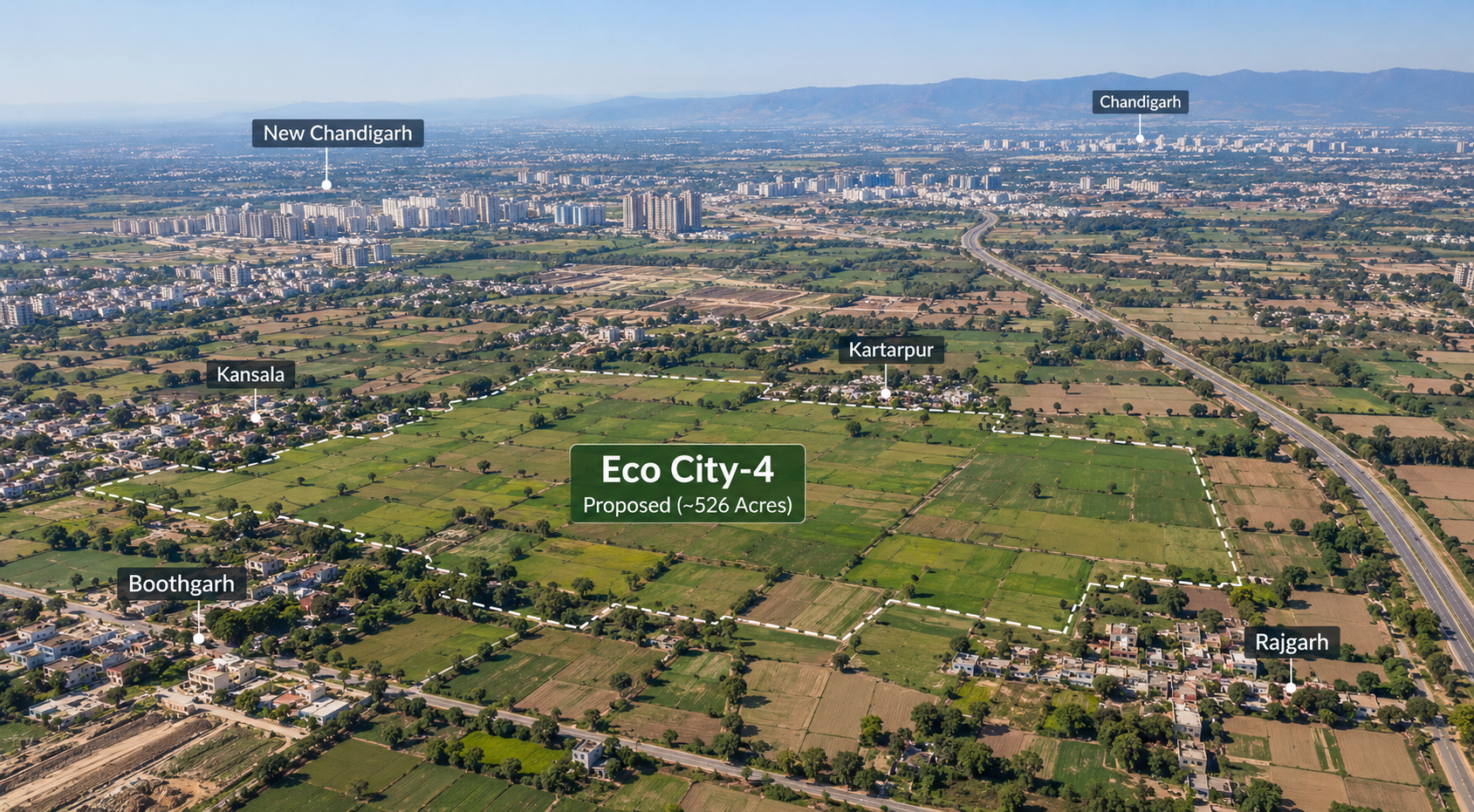
Punjab has started the statutory process for another large residential township in New Chandigarh. Eco City-4 was initially proposed across about 526 acres in four villages. But with Eco City-3 itself still progressing through acquisition and development stages, why is another Eco City already being planned—and how far has Eco City-4 actually progressed?
Eco City-4 is one of the latest additions to New Chandigarh's long-term expansion. However, there is an important distinction to understand from the beginning:
Eco City-4 is a proposed township in the land-acquisition process. It is not currently a public residential scheme where buyers can apply for plots.
There is no officially announced Eco City-4 plot price, application date, draw of lots, possession schedule or completed layout available to the general public at present. The project also experienced a fresh procedural uncertainty in October 2026, making it particularly important to distinguish between a proposed development and an immediately upcoming housing scheme.
What Is Eco City-4?
Eco City-4 is a proposed residential township in New Chandigarh under the Greater Mohali Area Development Authority's wider planning framework. GMADA's official notification portal records Notification No. 2026-6H1/835 dated June 2, 2026 for the Eco City-4 project.
The June notification initiated the Social Impact Assessment process for the proposed acquisition of approximately 526.03 acres across four villages in Majri sub-tehsil of Kharar tehsil: Kartarpur, Kansala, Rajgarh and Boothgarh.
The Tribune reported the initial village-wise area as approximately 183.59 acres in Kansala, 172.75 acres in Kartarpur, 159.79 acres in Boothgarh and 9.90 acres in Rajgarh. At this stage, therefore, the strongest officially supported description is:
Eco City-4 is a proposed residential township for which the land-acquisition process was initiated in 2026 over approximately 526 acres in New Chandigarh.
Why Do Some Reports Say 517 Acres Instead of 526 Acres?
Readers may encounter two different figures for Eco City-4: 526.03 acres and 517.7358 acres. They relate to different stages of the reported acquisition process. The June 2 notification and accompanying reporting referred to approximately 526.03 acres at the Social Impact Assessment stage.
On September 24, Amar Ujala subsequently reported that a notification under Section 11 of the Right to Fair Compensation and Transparency in Land Acquisition, Rehabilitation and Resettlement Act, 2013 covered approximately 517.7358 acres. That is roughly 8.3 acres less than the earlier proposal. The publicly available material reviewed for this article does not provide a clear parcel-by-parcel explanation for the difference.
For that reason, the two figures should not be mixed together as though they describe exactly the same stage.
The safest interpretation is:
- 526.03 acres — the initial area associated with the June SIA-stage proposal.
- 517.7358 acres — the later area reported in connection with the Section 11 stage.
Until the acquisition record is fully settled, it would be premature to describe 517.7358 acres as the unquestionable final developed area of Eco City-4.
Is Eco City-4 Already Approved for Public Plot Allotment?
No. A land-acquisition notification and a residential plot scheme are two very different things. Before a new GMADA township can reach the point where residential plots are offered to the public, several stages may still be required, including acquisition proceedings, objections, compensation or land-pooling decisions, possession of land, detailed planning, infrastructure design and execution.
At present, there is no verified official announcement specifying:
Eco City-4 plot sizes, allotment prices, number of residential plots, application dates, draw dates, public booking dates or possession timelines. Any claim presenting these details as final should therefore be checked against an official GMADA notification or scheme brochure.
Has the Eco City-4 Process Been Put on Hold?
The latest development adds an important qualification. On October 9, Hindustan Times reported that the Section 11 notification for Eco City-4 had been put on hold, as GMADA and the Housing and Urban Development Department proceeded cautiously following Enforcement Directorate searches and increased scrutiny of land and planning decisions.
The report described Eco City-4 as a proposed 517- to 526-acre residential township still at the preliminary land-acquisition and statutory-notification stage. This does not establish that Eco City-4 has been cancelled. It does, however, mean that readers should not assume that the acquisition process is currently moving ahead on an uninterrupted timetable.
As of the latest publicly available reporting reviewed for this article, the clearest position is:
Eco City-4 remains a proposed New Chandigarh township, but the immediate timeline for the next acquisition stage is uncertain.
Why Plan Eco City-4 When Eco City-3 Is Still Progressing?
This is probably the most interesting question surrounding the project. Eco City-3 itself is still progressing through planning, acquisition and land-pooling stages. An official GMADA agenda for its 41st Authority Meeting records that 713.375 acres had already been acquired for Eco City-3, with approximately another 21 acres proposed for acquisition to complete the scheme boundaries and allow integrated planning.
GMADA also continued publishing Eco City-3 land-pooling notices during 2026.So Eco City-4 is being planned before every stage of Eco City-3 is complete. That may appear unusual if each Eco City is viewed as a standalone housing colony. But New Chandigarh is planned at a much larger scale.
New Chandigarh Is Being Planned as a Complete Urban Area
GMADA describes the broader planning intention for New Chandigarh as creating a self-sustaining, medium-density urban area with residential development supported by employment, healthcare, education, recreation, commercial activity and infrastructure.
Approximately 27% of the planned area is dedicated to residential use, while other parts are allocated to uses such as Medicity, Education City, recreation, mixed development and employment-generating activities. GMADA's official material also identifies approximately 4,000 hectares of buildable land in the wider New Chandigarh area suitable for new townships and other urban activities, subject to environmental and planning restrictions.
This means New Chandigarh is not necessarily being developed in a strict sequence where one township must become completely occupied before planning begins for the next. Different stages can overlap. One project may be undergoing land acquisition while another is receiving infrastructure, another is processing land pooling and an older township is already occupied.
Does That Mean New Chandigarh Definitely Needs Eco City-4 Right Now?
Not necessarily—and this is where the distinction between planning rationale and proven housing demand becomes important. The official planning framework supports continued residential expansion in New Chandigarh. But in the public material reviewed for this article, we did not find a project-specific GMADA housing-demand study stating that Eco City-4 must be developed immediately because a particular number of households are currently waiting for plots.
That should be stated clearly. The original Eco City scheme did receive extraordinary demand when it was launched in 2011. GMADA says approximately 1.6 lakh applications were received for 836 residential plots. But demand from 2011 cannot automatically be treated as evidence of the exact level of demand for Eco City-4 in 2026.
The stronger explanation is that Eco City-4 forms part of long-term land and urban planning for New Chandigarh, rather than being proof by itself of an immediate shortage of residential plots.
Eco City-4 Is Part of a Much Larger Expansion
The project also needs to be viewed beyond its own 526 acres. When Eco City-4 entered the acquisition pipeline in June, The Tribune reported that Greater Mohali and New Chandigarh were already part of an urban expansion programme covering around 11,103 acres for multiple townships, sectors and master-plan roads.
Eco City-4 added another major residential component to that wider programme. That means the project is connected to a broader transformation involving residential development, roads, employment areas, commercial zones and infrastructure across the Greater Mohali region. From that perspective, Eco City-4 is not simply “another housing colony.” It represents another phase in the long-term urbanisation of New Chandigarh.
Why Are Kartarpur, Kansala and Rajgarh Appearing Again?
There is another interesting feature of the project. Some of the villages included in the Eco City-4 proposal—particularly Kartarpur, Kansala and Rajgarh—also appear in the Eco City-3 acquisition record.
GMADA's official Eco City-3 agenda records land acquired in villages including Rasulpur, Takipur, Rajgarh, Majra, Kartarpur, Kansala and Hoshiarpur. This does not mean the same land is necessarily being acquired twice. Village revenue estates can cover substantial areas, and different khasra numbers within the same village can fall into different schemes.
For individual landowners, therefore, the important question is not simply whether the village name appears in an Eco City notification. The specific khasra numbers and acquisition schedule are what determine whether a particular parcel is affected.
What Does Eco City-4 Mean for Landowners?
For affected landowners, Eco City-4 is currently much more about acquisition than housing. The process can involve questions around the extent of land being acquired, Social Impact Assessment findings, objections, compensation, land pooling and rehabilitation or resettlement obligations under the applicable land-acquisition framework.
The June notification began that statutory process rather than opening a property scheme for buyers. This distinction is important because the same project can mean very different things to different people. For a landowner, the immediate issue may be whether a particular parcel is being acquired and on what terms.
For a future buyer, the question may be when GMADA eventually offers developed residential plots. For an existing New Chandigarh resident, the concern may be how another township affects roads, water, sewerage, schools, healthcare and other infrastructure.
How Long Could It Take Before Eco City-4 Becomes a Developed Township?
There is no reliable official completion date available at present. The development of a township of this scale typically involves several stages between the first land notification and an area becoming ready for occupation.
The broad sequence can include land acquisition, statutory objections, compensation or land pooling, possession, preparation of the detailed layout, infrastructure planning, tendering, construction of roads and utilities and finally any future allotment or auction of developed sites. Eco City-3 itself demonstrates why the first land notification should not be confused with a completed township.
Therefore, no responsible estimate should be given for Eco City-4's public launch or completion until GMADA publishes a clearer project programme.
What Should Potential Buyers Watch Next?
For someone interested in Eco City-4 as a future property opportunity, the most meaningful milestones will be official ones. The key developments to watch are the resumption or clarification of the Section 11 process, the final acquisition area, compensation and land-pooling decisions, GMADA taking possession of the required land, approval of a detailed township layout, infrastructure tenders and finally an official residential scheme or auction notice.
Until those stages are reached, advertisements or private claims quoting “Eco City-4 prices” or promising guaranteed future plots should not be treated as official GMADA information.
What Is Confirmed—and What Is Still Unclear?
What is confirmed is that GMADA's official records contain an Eco City-4 notification dated June 2, 2026; the initial SIA-stage proposal involved approximately 526.03 acres across Kartarpur, Kansala, Rajgarh and Boothgarh; and later reporting referred to 517.7358 acres at the Section 11 stage.
What remains uncertain is the final acquisition area, the timetable for the currently affected statutory stage, the final Eco City-4 layout, the number and sizes of residential plots, public allotment prices, application dates and the eventual completion schedule. Those distinctions matter because the existence of a proposed project does not mean that every later stage has already been approved or scheduled.
So Why Is Another Eco City Being Planned?
The available evidence points to a long-term planning answer rather than a simple immediate-demand answer.
New Chandigarh is intended to become a larger, self-sustaining urban area rather than remain a collection of isolated housing schemes. GMADA's planning framework provides for substantial residential development alongside healthcare, education, employment, recreation and supporting infrastructure.
Eco City-4 therefore appears to be part of preparing land for the next stages of that planned expansion. But that should not be overstated. The material reviewed for this article does not establish that Eco City-4 must be developed immediately because New Chandigarh has already exhausted its existing residential capacity. And with the latest reporting indicating that the Section 11 step has been put on hold, there is currently uncertainty around how quickly the project will progress.
Final Takeaway
Eco City-4 represents another proposed phase in the expansion of New Chandigarh. The project began with a June 2026 Social Impact Assessment-stage proposal covering approximately 526.03 acres across four villages. A later report referred to approximately 517.7358 acres at the Section 11 stage, but subsequent October reporting said that stage had been put on hold.
So Eco City-4 should currently be understood as:
a planned residential township in the early land-acquisition process—not an already launched GMADA residential scheme.
Its broader significance is that GMADA continues to prepare New Chandigarh for expansion even while earlier projects such as Eco City-3 are still progressing. The next meaningful developments will therefore not be property prices or booking dates, but clarity on the acquisition process, final project area, land possession and detailed planning.
Until those are officially available, the most accurate conclusion is simple:
Eco City-4 is part of New Chandigarh's future plan, but how quickly that future arrives is still uncertain.
Where to Check
Source: This report is based on official GMADA records and reporting by The Tribune, published on June 5, 2026, which reported the initial proposal to acquire approximately 526.03 acres across Kartarpur, Kansala, Rajgarh and Boothgarh for the Eco City-4 project.
The latest status referenced in this article is based on Hindustan Times reporting from October 9, 2026, which reported that the Section 11 notification for Eco City-4 had been put on hold.
For official GMADA notifications, project information, land-acquisition records and statutory information, visit gmada.gov.in.
For simplified explanations of GMADA projects, Greater Mohali development and important public information, visit gmada.in.
Important Disclaimer
gmada.in is an independent information portal and is not affiliated with, endorsed by or operated by the Greater Mohali Area Development Authority (GMADA), PUDA, the Government of Punjab or any other government department.