GMADA News & Updates
GMADA Auction Postponed: What Happens to Your Bid, Deposit and Property Next?
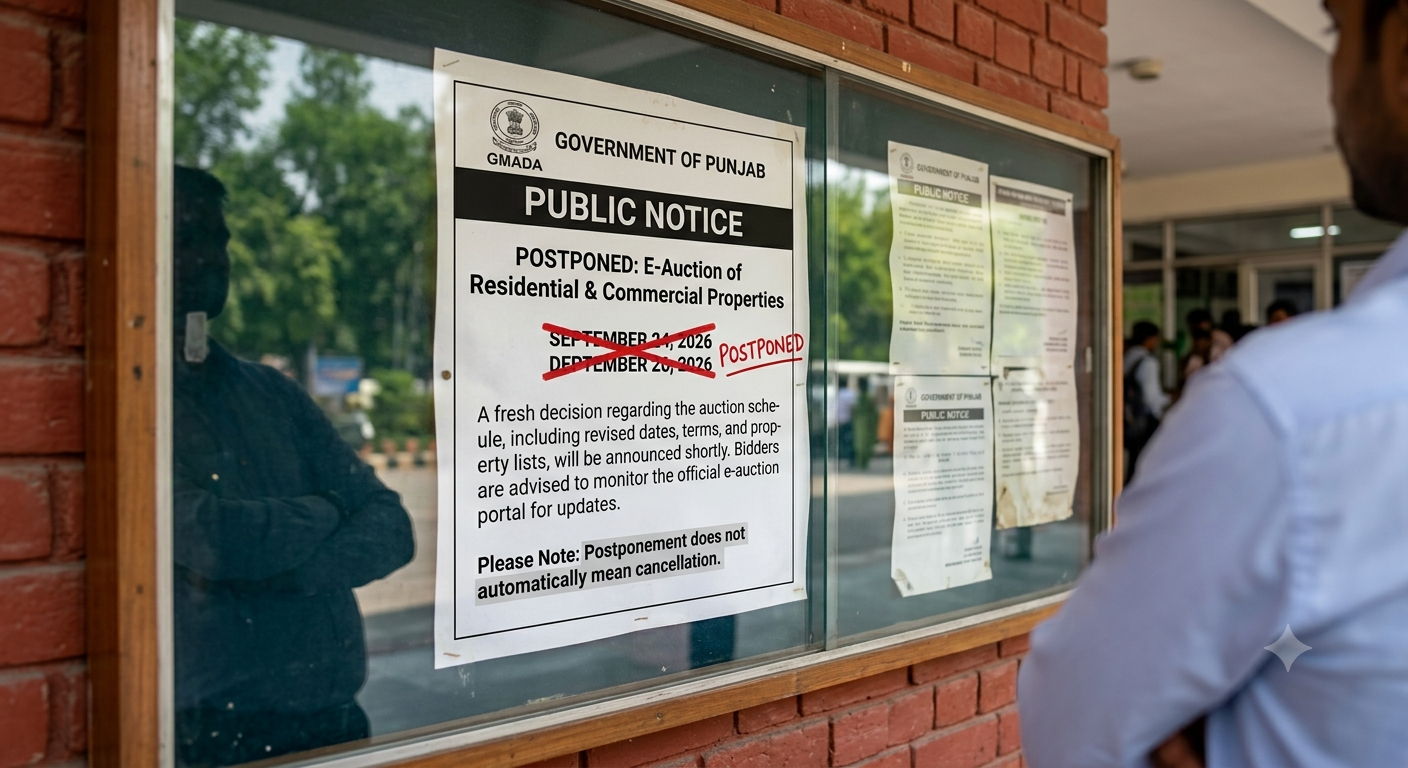
Postponed does not automatically mean cancelled. But it also does not guarantee that the same properties, dates or auction terms will simply continue later.
Last verified: 14 October 2026
A property auction you were preparing for has been postponed. You may already have checked the properties, reserve prices and bidding requirements. You may even have registered or deposited the required eligibility fee.
So what happens now?
Does the property remain available?
Will your registration still be valid?
What happens to the eligibility fee?
And when will bidding reopen?
These questions became particularly relevant after Hindustan Times reported that a state-wide auction of residential and commercial properties originally scheduled for September 24, 2026 was postponed. The report said a fresh decision on the auction would be taken later.
For people following GMADA and other Punjab development-authority property auctions, the most important point is simple:
A postponed auction is not automatically a cancelled auction.
But bidders should also not assume that the original property list, registration, reserve prices or payment instructions will remain unchanged.
What Has Actually Been Confirmed?
The recent report concerns a state-wide auction of residential and commercial properties under Punjab's housing and urban-development system, rather than establishing that a standalone GMADA-only auction was postponed. The auction was originally scheduled for September 24, 2026 and was reported as postponed. A fresh decision was to be taken later. That means there was no confirmed replacement date in the report.
So the accurate position is:
The original auction did not proceed as scheduled.
What happens next should be established through the next official auction notice or other authorised communication.
What Does “Postponed” Mean?
A postponement means the auction will not proceed according to the original schedule. It should not automatically be interpreted as cancellation. But postponement also does not guarantee that:
- The auction will return on a particular date
- Every original property will remain included
- Reserve prices will stay unchanged
- Previous registrations will automatically carry forward
- Earlier payment instructions will continue without modification
Those details should be checked when the competent authority publishes its next instructions.
Will the Same Properties Still Be Available?
They may be, but bidders should not assume so. When a revised or fresh auction is announced, a property from the original list could:
- Remain available
- Appear with a new bidding schedule
- Be offered under revised conditions
- Have a revised reserve price
- No longer form part of that particular auction
If you were interested in a specific plot, SCO, booth, commercial site, institutional site or other property, save its original details. When the next auction notice appears, compare the property number, location, size, reserve price and applicable conditions again. An old advertisement should not be treated as the final document for a later auction.
What Happens to the Eligibility Fee?
Punjab's e-auction policy notified on February 20, 2025 applies to PUDA and Special Development Authorities. The policy says intending bidders are required to deposit an eligibility fee specified for the relevant type of property and describes the eligibility fee as refundable/adjustable under the policy. It also states that auctions covered by the policy are to be conducted through e-auction.
However, that does not by itself tell a bidder exactly how an eligibility fee will be handled when a particular auction is postponed.
For a postponed auction, bidders should check:
- Whether the existing eligibility fee remains valid
- Whether it will be adjusted against a rescheduled or fresh auction
- Whether a refund will be processed
- Whether any action is required from the bidder
- Whether fresh registration or payment is necessary
The answer should come from the specific revised auction notice, authorised e-auction portal or official authority instructions. Do not make another payment merely because a new date appears until you have checked what happened to the earlier transaction.
What If You Have Already Registered?
Keep your complete record.
Save:
- Registration details
- Acknowledgement
- Payment receipt
- Eligibility-fee transaction details
- Property details
- Emails or SMS messages
- The original auction notice
If a fresh or revised auction is announced, first check whether your earlier registration remains usable. Do not automatically create another registration or deposit the eligibility fee again.
What If Bidding Had Not Started?
If bidding had not opened before the postponement, you should generally wait for fresh instructions rather than assuming the old bidding window has simply shifted. When a new notice appears, check again for:
- Opening and closing dates
- List of properties
- Reserve prices
- Eligibility requirements
- Eligibility fee
- Payment schedule
- Documentation requirements
- Latest terms and conditions
A postponement may give prospective bidders more preparation time, but it does not mean previous registration or submission deadlines automatically remain open.
What If You Had Already Submitted a Bid?
This needs greater caution. Punjab's 2025 e-auction policy states that once a bid has been placed, the bidder is not permitted to withdraw or surrender it merely at will; the policy provides consequences for withdrawal, including forfeiture of the eligibility fee.
However, where an auction itself has been postponed or interrupted by the authority, bidders should not assume on their own whether an existing bid:
- Remains active
- Becomes invalid
- Will be carried forward
- Must be submitted again
That situation should be governed by the official instructions issued for that particular auction. If money or an existing bid is involved, rely on written instructions rather than verbal information.
Does Postponement Mean the Property Has Been Allotted?
No. Planning to participate, registering for an auction or depositing an eligibility fee is not the same as receiving an allotment. Under the applicable e-auction process, further obligations arise once bidding is completed and a successful bid is accepted according to the auction policy and terms. The 2025 policy also provides for payment and possession requirements applicable to successful bidders.
If an auction does not proceed as originally scheduled, a prospective bidder should not assume that post-auction payment obligations have arisen merely because the original auction date has passed.
Can the Reserve Price Change?
It can if the authority issues a new or revised auction notice with different terms. This does not mean the reserve price will change every time an auction is postponed. It simply means bidders should verify it again. Do not base your bidding budget on an old screenshot, broker message or previous advertisement. The latest official auction document should be treated as the relevant reference.
Should You Still Prepare Your Finances?
Yes, if you remain interested in participating—but use the time to understand the complete financial commitment. The winning bid amount is not necessarily the only financial consideration. Depending on the applicable property and auction conditions, a successful bidder may have to account for:
- The required initial payment
- Subsequent balance payments or instalments
- Applicable interest
- Statutory charges or cess
- Other government charges
- Property-specific conditions
The February 2025 e-auction policy contains rules governing payments and possession for successful bidders, so bidders should read the policy together with the specific auction notice applicable to the property they intend to bid for.
Could the Auction Return With Different Terms?
Yes. Authorities can issue fresh advertisements, corrigenda, amendments or revised conditions. GMADA's own policy section maintains e-auction terms and amendments, while its website also lists the February 2025 e-auction policy and subsequent auction-related material. Therefore, an old copy of the auction conditions should not automatically be used for a later auction. Always check the latest version.
What If There Is Still No New Auction Date?
Then there may simply be no officially confirmed new date yet. The recent report about the September 24 auction said that a fresh decision would be taken later. Until a competent authority publishes the revised schedule, avoid relying on dates circulated through:
- Brokers
- WhatsApp groups
- Social media posts
- Property advertisements
- Informal conversations
A useful rule is:
No official revised notice = no confirmed revised auction date.
Should You Immediately Ask for a Refund?
Not simply because you read that an auction has been postponed. The February 2025 policy describes eligibility fees as refundable/adjustable, but how an already-paid fee is handled in a specific postponed auction should be confirmed through the instructions applicable to that auction.
If you no longer want to participate, check the authorised portal or contact the relevant authority regarding the applicable refund procedure. Do not assume the amount will automatically return immediately.
What If the Auction Is Eventually Cancelled?
Cancellation and postponement are different. If the authority later formally cancels an auction, read the cancellation notice carefully. It should be checked for information about:
- Bidder registrations
- Eligibility fees
- Submitted bids
- Refund or adjustment arrangements
- Whether the properties may be offered again
A property included in a cancelled auction may also appear in another auction later.
Therefore:
Postponed ≠ Cancelled
and
Cancelled ≠ Property permanently unavailable
The latest official document determines the position.
Why Was the September Auction Reportedly Postponed?
Hindustan Times reported that the September 24 state-wide auction was postponed during a period in which Punjab's housing and urban development department was proceeding cautiously following Enforcement Directorate searches at GMADA and heightened scrutiny of land transactions and policy decisions.
That is the context reported for this particular situation.It should not be assumed that every postponed auction has the same reason. Auctions can be postponed for different administrative, legal, policy or operational reasons.
What Should a Bidder Do Now?
If you were preparing to participate, there is no need to guess what will happen next. Keep your previous documents and transaction records. Then, when a fresh notice appears:
- Confirm the new auction date.
- Check whether your property is still included.
- Recheck the reserve price.
- Confirm whether the previous registration remains valid.
- Check how the earlier eligibility fee will be treated.
- Read the current payment terms.
- Check for amendments or corrigenda.
- Only then make another payment or submit a bid.
This reduces the risk of acting on outdated information.
The Simplest Way to Understand a Postponed Auction
If an auction is described as postponed, do not automatically read that as:
“The auction has been cancelled.”
But do not read it as:
“Everything remains exactly the same and only the date will change.”
Neither conclusion is safe without the next official notice. The more accurate interpretation is:
The original auction will not proceed according to its scheduled date. Bidders should wait for official instructions to know whether the properties, registration, eligibility fee, reserve prices and bidding schedule will continue or change.
Final Takeaway
The recent September 24 development concerned a state-wide residential and commercial property auction that was reported as postponed, with a further decision to be taken later. For GMADA users and other prospective development-authority bidders, postponement should be treated as a reason to recheck—not assume.
Keep your:
- Registration record
- Payment proof
- Eligibility-fee details
- Property information
- Original auction notice
Then compare them with the next official communication. Until that communication appears, there may be no confirmed revised auction date or final answer on how a specific bidder's previous registration or payment will be handled.
The next official notice—not the old auction calendar or an unofficial message—is what matters.
Where to Check
For GMADA notifications, auction policies, property information and current updates, visit gmada.gov.in.
For simplified explanations of GMADA projects, notices, auctions and Greater Mohali development, visit gmada.in.
Important Disclaimer
gmada.in is an independent information portal and is not affiliated with, endorsed by or operated by the Greater Mohali Area Development Authority (GMADA), PUDA, the Government of Punjab or any other government department.