GMADA News & Updates
GMADA, Mohali MC or Punjab Government — Who Actually Decides What Happens in Greater Mohali?
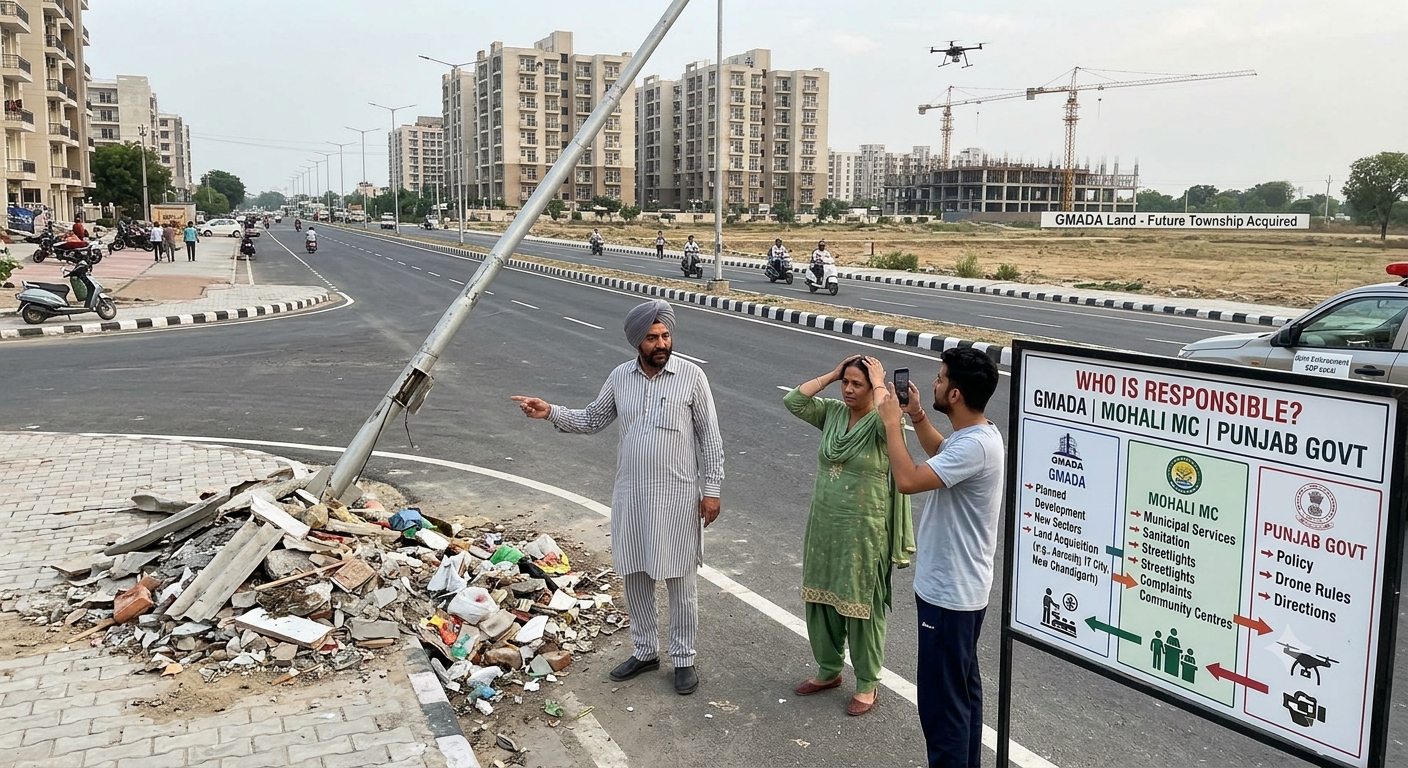
A new sector is planned.
A road is redesigned.
A colony is brought inside municipal limits.
Residents complain about garbage or streetlights.
A master plan is changed.
Land is acquired for a new township.
And almost every time, the same question appears:
Who is actually responsible — GMADA, Mohali Municipal Corporation or the Punjab Government?
The confusion is understandable because all three can be involved in the same part of Greater Mohali, but they do very different jobs. The simplest way to understand it is this:
GMADA mainly plans and develops.
Mohali MC mainly runs municipal services inside its municipal limits.
The Punjab Government sets the wider policy, legal and administrative framework and can direct GMADA.
But Greater Mohali is complicated because these responsibilities can overlap — particularly when a newly developed area is being transferred from GMADA to municipal management. That is where residents often get stuck between two offices.
First: GMADA Is Not the Municipal Corporation
GMADA — the Greater Mohali Area Development Authority — was constituted by the Punjab Government in 2006 under the Punjab Regional and Town Planning and Development Act, 1995. Its jurisdiction is much wider than Mohali city alone.
GMADA's official record lists areas including Mohali, Banur, Zirakpur, Dera Bassi, Kharar, Mullanpur/New Chandigarh, Fatehgarh Sahib, Mandi Gobindgarh and Rupnagar within its development jurisdiction.
Its core purpose is planned development and redevelopment.
The law gives the authority powers relating to land, planning, development, new townships, urban estates, housing and infrastructure. That is why GMADA is associated with projects such as:
- Aerocity
- IT City
- Eco City
- New Chandigarh
- New sectors
- Land acquisition
- Master-plan implementation
- Sector layouts
- Commercial and institutional sites
- Major development works
So if the question is:
“Who planned this new sector?”
GMADA may be central to the answer.
But if the question is:
“Who should remove garbage outside my house tomorrow?”
GMADA may not be the authority you need.
Mohali MC Runs the City at the Municipal Level
The Municipal Corporation of Sahibzada Ajit Singh Nagar is the city's urban local body under the Punjab Municipal Corporation framework. Its role is much closer to the everyday functioning of the city. The Corporation's official portal provides municipal services including:
- Trade licences
- Municipal complaints
- Community-centre services
- Water and sewer connections
- Sanitation-related services
- Solid-waste matters
- Street-vending regulation
- Other local civic functions
Its statutory duties also include municipal services such as cleaning, waste disposal, public conveniences and local civic administration. So when an area is fully within Mohali MC's operational responsibility, residents normally look to the Corporation for many day-to-day municipal issues. That creates a useful distinction:
GMADA may create the urban area.
Mohali MC may eventually operate and maintain many of its municipal functions.
These are not the same job.
Then Why Do Residents Sometimes See Both GMADA and MC in the Same Sector?
Because development and municipal management do not always change hands on the same day. A newly developed sector may be inside the Municipal Corporation's geographical limits but still have unfinished development works that remain with GMADA or a private developer.
That distinction became particularly visible after Mohali's municipal limits were expanded. Reporting on the expanded areas in late 2025 noted that the Municipal Corporation said full maintenance responsibility would begin after development was completed and the areas were formally handed over by GMADA or the concerned private developer.
A joint committee involving MC, GMADA and other stakeholders was also formed to inspect infrastructure before takeover.
This explains something residents often find frustrating:
Being inside MC limits and being fully handed over to MC for maintenance are not necessarily the same thing.
What Does “Handover” Actually Change?
Imagine GMADA develops a new sector. It creates the layout, roads, utilities and other planned infrastructure. Eventually, the area reaches a stage where municipal functions can move to the Corporation. That handover matters because the authority responsible for everyday maintenance can change.
Before handover, a defect in unfinished development may still be GMADA's responsibility. After formal transfer, routine municipal maintenance may fall to MC. And sometimes a problem can involve both. This is why two residents living only a few kilometres apart may receive very different answers to the same complaint. One sector may already be under MC maintenance. Another may still be under GMADA's development responsibility.
There Are Even Issues Where GMADA and MC Work Together
The division is not always clean. For example, Mohali MC's current notice board includes an SOP for joint enforcement by GMADA and the Municipal Corporation concerning violations of landscaping and road-berm policy.
That alone shows why saying “this is always GMADA's job” or “this is always MC's job” can be misleading. Joint enforcement can happen because:
- The planning rule may originate from one authority
- The land or sector may have been developed by another
- Municipal enforcement may now involve the local body
So Greater Mohali is often governed through layers, not one single authority.
What Does the Punjab Government Decide?
The Punjab Government sits at a different level. It is not normally the office a resident approaches because a streetlight outside the house is not working. Its role is broader.
The Department of Housing and Urban Development is the state department under which GMADA operates. GMADA itself was constituted by the State Government, and the Punjab Government's official department page lists GMADA among the organisations under Housing and Urban Development.
More importantly, GMADA's own statutory disclosure says that under Section 40 of the Punjab Regional and Town Planning and Development Act, GMADA must carry out directions issued by the State Government for administration of the Act. That means major policy decisions can come from above GMADA. Examples can include:
- Land-acquisition policy
- Land-pooling policy
- Development rules
- Planning directions
- Administrative instructions
- Major project approvals
- Changes to the regulatory framework
A useful way to think about it is:
Punjab Government decides the wider rules and policy direction. GMADA operates within that framework to plan and develop.
GMADA Itself Is Also Connected Directly to the State Government
GMADA is not an independent city government. Its official constitution includes senior state-level officeholders and officials, including representatives from Housing and Urban Development, Finance, Local Government and Town Planning.
Its own decision-making disclosure also states that where powers have not been delegated to individual officers, decisions can be taken by the Authority itself, and that decisions are based on regulations, government rules and Punjab Government instructions. That is important because a headline saying:
“GMADA decides…”
- can sometimes simplify a much larger decision chain.
- Some decisions are taken by GMADA officers.
- Some go through committees.
- Some require Authority-level approval.
- Some operate under Punjab Government policy or direction.
- And certain planning matters may involve other statutory approval stages.
Who Decides the Master Plan?
This is another area where people often assume one authority has complete control. GMADA publishes the approved master plans for areas including SAS Nagar, Kharar, Zirakpur, Dera Bassi, Banur and Mullanpur/New Chandigarh.
But GMADA's own institutional disclosure says its Planning & Design Committee scrutinises proposals relating to planning areas, regional plans, master plans and town-development schemes and makes recommendations through the statutory approval process.
GMADA may also be required by the State Government or Board to undertake preparation and implementation of master plans and new township plans. So the accurate conclusion is not:
“GMADA alone can change the Master Plan whenever it wants.”
The planning process operates under the state planning law and can involve committees, the statutory authority, the Board and government-level decisions depending on the matter.
What About a New GMADA Sector?
Here GMADA's role is much more visible. Its Executive Committee has powers connected with approval of urban estates, development areas, new townships, housing projects and other urban-development programmes, subject to the Authority's institutional framework.
GMADA can also undertake land acquisition, land development and major engineering works as part of its statutory functions. That is why new sector development normally appears as a GMADA story rather than a Mohali MC story. MC is not the agency acquiring thousands of acres to create a new GMADA township.
But Once People Start Living There, the Question Changes
At the planning stage, the important question may be:
“When will GMADA finish this sector?”
After occupation increases, residents begin asking:
- Who cleans it?
- Who maintains public areas?
- Who handles municipal complaints?
- Who regulates local civic activity?
- Who collects municipal taxes?
- Who repairs something after the development period ends?
That is where the transition from development authority to municipal authority becomes important. This is also why residents should not keep using “GMADA area” as if it automatically identifies the authority responsible for every civic service. A sector can be developed by GMADA but later be maintained by Mohali MC.
Why Can a Sector Be Inside MC but Still Need GMADA Money?
This situation has already caused debate inside the Municipal Corporation. In January 2026, Mohali councillors sought a separate ₹1,000-crore fund from GMADA for sectors transferred to the Corporation, arguing that newly transferred areas required substantial civic expenditure.
The important point is not the political demand itself.
It is what it reveals about the system:
Transfer of responsibility also creates a question of who pays for the transition.
A municipal corporation can inherit responsibility for a large new area, but that area may still need significant spending before it functions like an older, fully established part of the city.
The Punjab Government Can Also Change the Rules Midway
A third layer becomes visible when the State Government issues new directions. For example, in 2026 the Housing and Urban Development Department directed GMADA to use external drone surveys at multiple stages of land acquisition and also instructed it to integrate existing village infrastructure with new development schemes.
That was not simply an internal GMADA engineering decision. It came from the Punjab Government department that supervises the wider housing and urban-development framework.
This is a good example of the hierarchy:
State Government sets a direction → GMADA implements it in its projects.
So Who Should a Resident Contact?
A useful rule is to start with the type of decision, not simply the name of your sector.
If the issue concerns:
A new sector, township, master-plan implementation, land acquisition, sector layout or unfinished GMADA development work:
GMADA is usually the first authority to examine.
If the issue concerns:
routine municipal services within Mohali MC's operational jurisdiction — such as sanitation, local municipal complaints, trade licences, community-centre matters or municipal regulation:
Mohali MC is generally the relevant starting point. Its current portal specifically provides these municipal services.
If the issue concerns:
state policy, rules governing development authorities, major government directions or a policy applicable across Punjab:
The Punjab Government's Housing and Urban Development or Local Government framework may be involved.
If the area has recently been added or transferred, the safest question is:
“Has this particular service actually been handed over yet?”
That one question can save a resident from being sent repeatedly between offices.
And Sometimes the Answer Is: None of These Three
Greater Mohali also involves other agencies.
- Electricity may involve PSPCL.
- Pollution matters can involve the Punjab Pollution Control Board.
- Certain state roads may involve PWD. National highways involve national-level road authorities. Water-supply responsibilities can vary by area and stage.
So “Who is responsible?” should never be answered from the area's name alone.
The correct authority depends on:
where the problem is, what type of infrastructure it concerns, and whether the area has been formally handed over.
The Most Important Distinction
The easiest way to understand Greater Mohali governance is to separate three words:
- Plan
- Develop
- Maintain
The authority that plans something may not permanently maintain it. GMADA can plan and develop a sector. The Punjab Government can set the policy under which that development happens. Mohali MC can later become responsible for municipal management. And during the transition, two or more of them may still be involved. That is why the answer to:
“Is this a GMADA area?”
does not necessarily answer:
“Who should fix my problem?”
What This Means for Greater Mohali Residents
The next time a civic issue arises, do not start with:
“GMADA built my sector, so GMADA must fix everything.”
And do not assume:
“My sector is inside MC limits, so GMADA has nothing to do with it anymore.”
Instead check:
- Who developed the area?
- Has it been formally handed over?
- Who currently maintains the specific service?
- Is the issue municipal, developmental or policy-related?
Those four questions usually reveal the correct authority much faster.
The Bottom Line
Greater Mohali does not have one single authority deciding everything. GMADA is primarily the planning and development authority for a much wider region.
Mohali Municipal Corporation is the municipal government responsible for civic administration within its jurisdiction and for services formally under its control.
The Punjab Government sits above the system, creating policy, rules and directions and exercising statutory control over development authorities such as GMADA.
The confusion appears in the spaces between them — especially when a newly developed area is being transferred from one stage of governance to another.
So the most useful question for residents is not:
“Is this GMADA or MC?”
It is:
“Who currently controls this specific service in this specific area?”
That is the question that usually gets you to the right office.
You May Also Want to Know
GMADA publishes its organisational functions, master plans, development plans, public notices and project information on gmada.gov.in.
For easy-to-understand updates, local development information and helpful context related to Greater Mohali, visit gmada.in.
Important Disclaimer
gmada.in is an independent information portal. It is not affiliated with, endorsed by, or operated by GMADA, Mohali Municipal Corporation, PUDA, the Government of Punjab or any other government authority.