Policies & Regulations
Key Documents Every GMADA Plot Buyer Must Verify
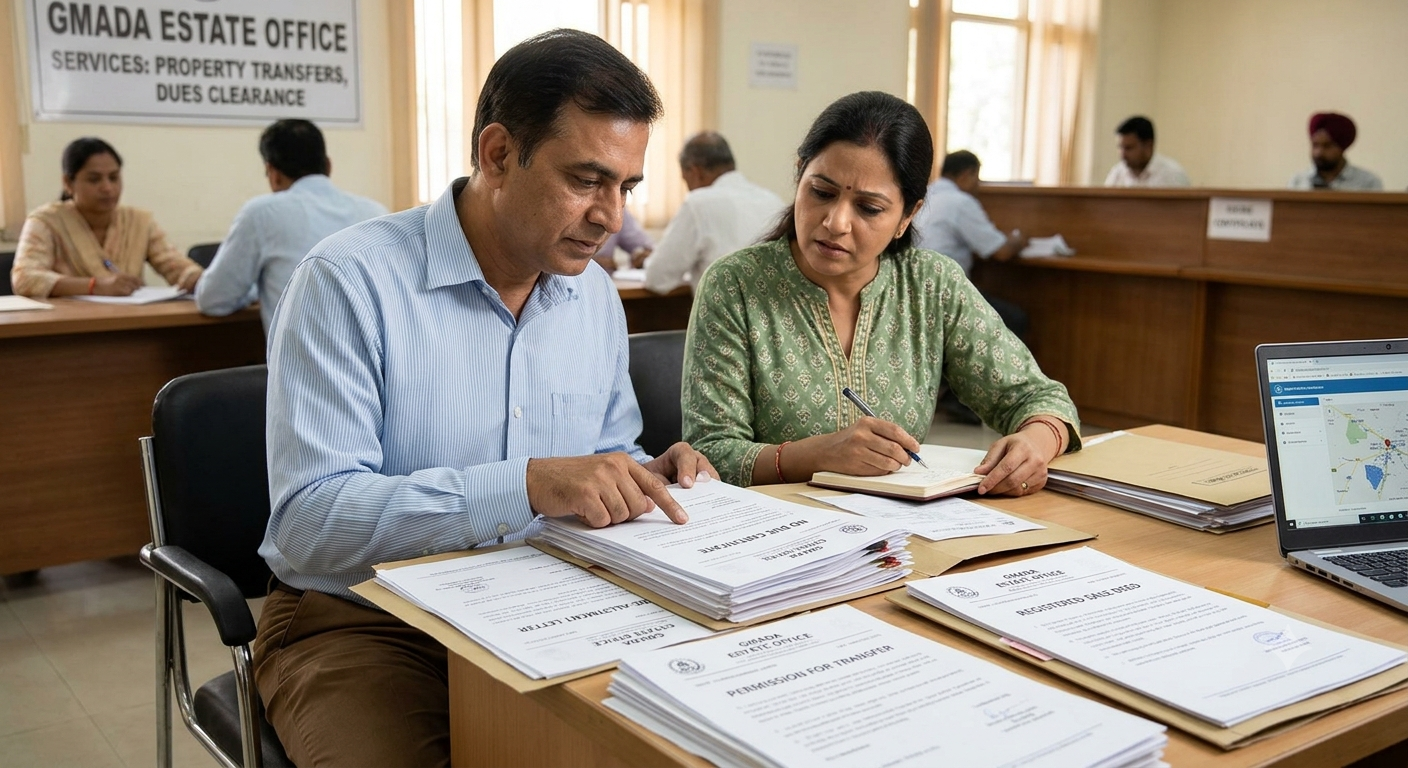
Buying a GMADA plot can look straightforward. You see the plot, agree on the price, check the seller's registry and prepare for payment. But a GMADA property can have several documents connected to the same plot — allotment, re-allotment, conveyance, transfer permission, dues, mortgage permission, possession and, where construction already exists, building approvals. These documents do not all prove the same thing. That is where a buyer can make an expensive mistake.
Before paying a substantial token amount or completing a resale transaction, the important question is not simply:
“Does the seller have a registry?”
It is:
“Does the complete GMADA record of this plot match what I am being sold?”
Here are the documents worth checking.
1. Allotment, Re-Allotment or Latest Change-of-Ownership Letter
Start with the document that connects the property with GMADA's own estate record. Depending on the history of the plot, this may be an original allotment letter, a re-allotment letter or a later change-of-ownership document. Check basic details carefully:
- Plot number
- Sector or scheme
- Plot size
- Name of the allottee/owner
- Category of property
- Payment terms
- Any important conditions attached to the allotment
This is especially important where the property has changed hands before. A seller may show you the original allotment letter bearing someone else's name. That document proves part of the property's history, but it does not by itself tell you whether GMADA subsequently recognised later ownership changes. GMADA's own Estate Office functions include transfer of allotment, issue of re-allotment letters and transfer of ownership.
The buyer should therefore follow the chain to the latest relevant GMADA record, not stop at the oldest document in the file.
2. Conveyance Deed
The conveyance deed deserves particular attention because it is different from the original allotment letter. GMADA's current procedure for execution of a conveyance deed requires, among other documents, the allotment/re-allotment letter and a No Due Certificate.
For the buyer, the practical question is:
Has the conveyance deed for this plot already been executed?
If yes, examine the registered deed carefully and match:
- Owner name
- Property number
- Area
- Property description
- Registration particulars
If the conveyance deed has not yet been executed, do not simply assume that the property has exactly the same documentation status as one where conveyance has already taken place. The seller should be able to explain the current GMADA status of the property and the documents under which the proposed transfer will take place.
3. No Due Certificate — And the Current Property Account
This may be one of the most financially important checks. GMADA has a specific service for issuing a No Due Certificate. Its official procedure tells applicants to check the property account statement and deposit outstanding amounts; if the account contains a discrepancy, supporting documents can be submitted for correction.
For a buyer, that means the sale price should not be the only number being checked.
Ask for the latest available GMADA dues position. Look for any outstanding amount connected with the property and understand what it relates to before completing the deal. A useful question for the seller is:
“Can you show me the latest GMADA account statement and No Due Certificate?”
Do not rely only on a verbal statement that “everything is clear.” A property can look completely normal at the site while its financial record requires attention.
4. Permission for Sale, Gift or Transfer — Where Applicable
GMADA maintains a separate procedure for permission relating to sale or transfer of property. Its current citizen-services system specifically lists permission for sale/gift/transfer as an Estate Office service.
That matters because a buyer should not assume that every GMADA property is at exactly the same stage of transferability. The property's allotment terms, conveyance status and transaction history can affect which document or permission is relevant.
If the seller says:
“No GMADA permission is required.”
do not treat that as established simply because the seller or property dealer says so.Ask what document establishes the property's present transfer status. The objective is not to collect unnecessary paperwork. It is to ensure that the transaction route being used matches the actual status of the plot.
5. Registered Sale Deed — And GMADA Re-Transfer Record
This distinction is particularly important for resale buyers. After a registered sale, GMADA has a separate re-transfer/change-of-ownership process. Its current procedure for re-transfer on the basis of a registered Sale Deed, Gift Deed or Transfer Deed requires a certified copy of the registered deed and the relevant transfer permission. GMADA currently lists a five-working-day service time for this process.
That means a registered deed and GMADA's own ownership record are related but distinct records. If the seller acquired the plot through an earlier resale, ask:
Was that previous transaction also reflected in GMADA's records?
This becomes particularly important where a property has changed hands several times. The cleanest file is one where the ownership trail can be followed logically from:
allotment → subsequent transfer(s) → registered deed(s) → latest GMADA ownership record.
If one link is missing, it deserves explanation before payment.
6. Mortgage Permission and Loan-Clearance Documents
A plot may also have been used to secure a loan. GMADA has a formal process for granting permission to mortgage a property. Its current procedure requires, among other documents, the bank's consent and a copy of the allotment/re-allotment/change-of-ownership document. So buyers should ask another direct question:
“Has this property ever been mortgaged?”
If the answer is yes, check the documentary trail showing that the loan or charge has been properly cleared where required. This is not something to establish from appearance. There is no visible difference between a plot that has never been mortgaged and one connected with a loan. The difference is in the documents.
GMADA's own procedures in property-transfer situations also recognise the importance of clearance of previous mortgages or loans.
7. Possession Document
Ownership paperwork and physical possession are related but different issues. Ask for the document showing how and when possession of the plot was offered or taken. Why does this matter?
Because the date of possession can be relevant to obligations connected with the plot, including construction conditions under the applicable allotment terms. GMADA allotment conditions can specify when possession is offered and can also link construction obligations to possession or allotment dates depending on the scheme.
For the buyer, possession documentation also helps answer a very basic question:
Is the physical plot being shown to me the same property described in the GMADA file?
That sounds obvious, but it should never be assumed.
8. If a Building Already Exists: Approved Building Plan
A vacant plot and a constructed house should not be verified in exactly the same way. If construction already exists, ask for the sanctioned building plan.
GMADA has a formal building-plan approval framework. For residential plots up to 500 square yards, its current system provides for either self-certification through empanelled architects in eligible cases or sanction by GMADA; other categories follow the applicable sanction procedure.
The buyer should compare what is actually built with the documents being provided.
Do not automatically assume:
“The house exists, therefore the construction must have been approved.”
Construction on the ground and approval on paper are different things. Any significant discrepancy deserves professional verification before purchase.
9. Completion / Occupation Certificate for a Constructed Property
If you are buying a constructed house rather than an empty plot, ask whether the building has the applicable Completion or Occupation Certificate. GMADA has a separate procedure for permission to occupy completed premises. Its current requirements include completion documentation from an empanelled architect and photographs of the completed building. This document should not be treated as a minor formality.
The key buyer-side distinction is:
Approved building plan = permission relating to what is proposed to be built. Completion/Occupation Certificate = documentation relating to the completed building and permission to occupy it under the applicable process.
For a built-up GMADA property, both stages can matter.
10. Demarcation and Exact Plot Identity — Where Needed
For a vacant plot, particularly one where boundaries are not obvious on the ground, buyers should be careful about relying only on:
- Boundary walls
- Neighbouring construction
- Broker markings
- Temporary pegs
- A verbal indication of where the plot begins and ends
GMADA has a formal Demarcation Certificate procedure connected with proof of ownership and sanctioned building-plan records. A demarcation certificate is not necessarily a document every resale file will already contain. But where the exact site boundary is uncertain, demarcation becomes much more important than simply standing at the location and being told:
“This is your plot.”
Do Not Verify Each Document Separately — Make Them Match
This is the most important part of the entire exercise. Ten documents that contradict one another are not better than five documents that form a clear chain.
The buyer should compare the same basic details across the file:
- Owner name
Does the seller's identity correspond with the latest ownership/transfer records?
- Plot number
Is the same plot number appearing consistently?
- Area
Does the plot size match across the allotment, conveyance and sale documents?
- Sector/Scheme
Is the property description consistent?
- Mortgage status
Does anything indicate an existing or previous loan that still requires clearance?
- Dues
Does GMADA's current account position agree with the seller's claim that nothing remains payable?
- Construction
If a house exists, does the building documentation correspond with the property being sold? The objective is to make the documents tell one consistent story about one property.
A Registry Should Not End Your Verification
One of the most useful habits for a GMADA plot buyer is to stop thinking of the registry as the entire property file. A registered sale deed is obviously important. But GMADA itself separately deals with:
- Allotment and re-allotment;
- Ownership changes;
- No Due Certificates;
- Conveyance deeds;
- Sale/transfer permissions;
- Mortgage permissions;
- Re-transfer after registered deeds;
- Sanctioned building plans;
- Occupation/completion certificates.
That is why the buyer's question should not be:
“Is there a registry?”
It should be:
“Does the registry agree with the complete GMADA record?”
What to Check Before Paying a Large Token Amount
Ideally, serious document verification should happen before a buyer becomes financially committed to a transaction. At minimum, establish:
- Who GMADA currently recognises in relation to the property
- The allotment/re-allotment history
- Conveyance status
- Current dues position
- Transfer status
- Whether any mortgage or loan requires clearance
- For a constructed property, the applicable building and occupation documents
If something is missing, that does not automatically mean the property cannot be purchased. But the missing document should be understood and resolved rather than ignored. There is an important difference between:
“This document does not apply to this property.”
and
“This document should exist, but nobody can produce it.”
A buyer should know which situation they are dealing with.
The One Question Every GMADA Plot Buyer Should Ask
A property dealer may show you the location. The seller may show you the registry. A bank may be willing to finance the purchase. None of those checks should replace verification of the property's complete authority record.
Before paying, ask:
“If I put every document connected with this plot in chronological order, does the ownership, payment, transfer and construction history make sense from beginning to end?”
If the answer is yes, you understand far more about what you are buying. If the answer is unclear, that is the point to investigate — before the money moves, not afterwards.
You May Also Want to Know
For official property services, transfer procedures, No Due Certificates, conveyance deeds, mortgage permissions, building approvals and other GMADA-related services, readers can visit gmada.gov.in.
For simpler explanations of GMADA property procedures, notices, buyer-related information and Greater Mohali updates, readers can explore gmada.in.
Important Disclaimer
gmada.in is an independent information portal. It is not affiliated with, endorsed by, or operated by the Greater Mohali Area Development Authority (GMADA), PUDA, the Government of Punjab, or any other government department.