GMADA News & Updates
Land Pooling Explained: What Landowners Should Know
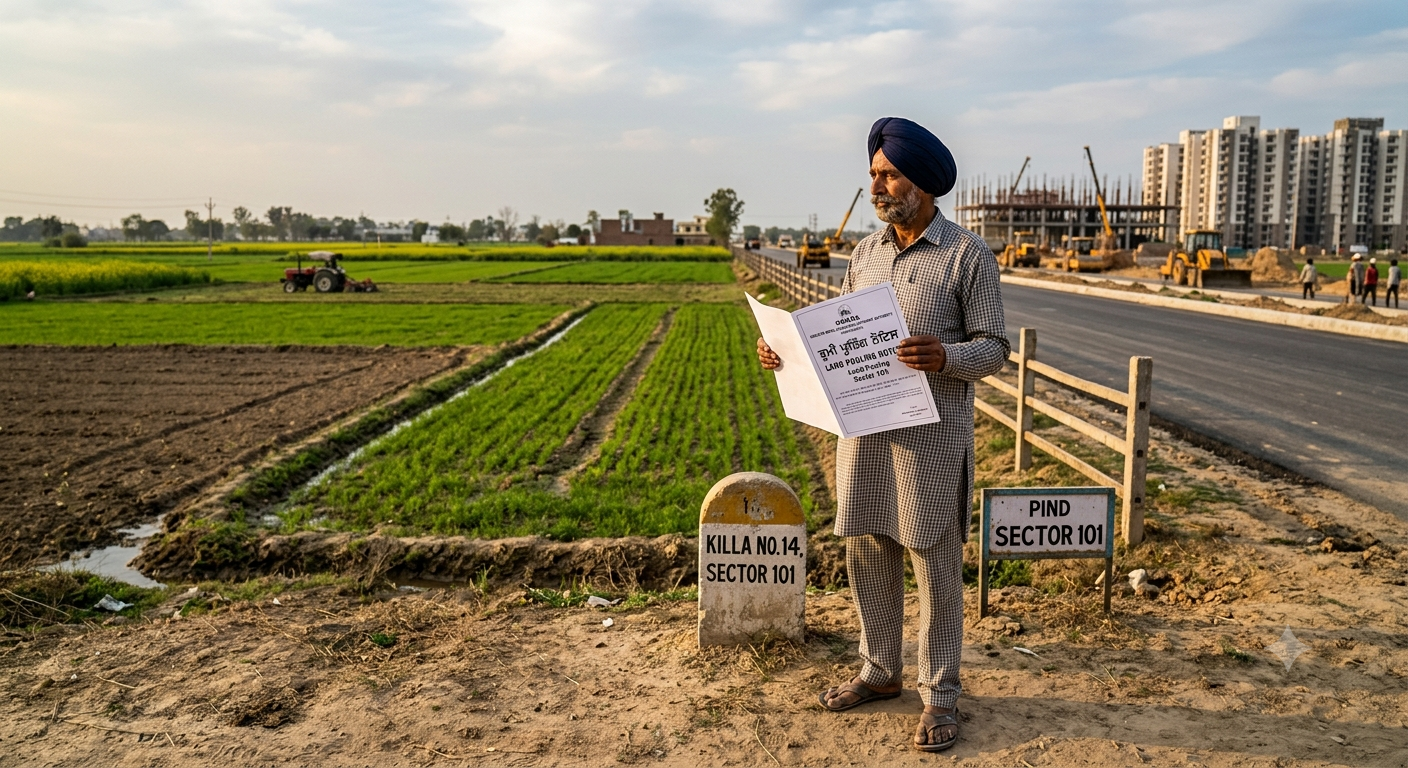
You have a piece of land. You know where it is, what it is being used for and what surrounds it. Then the area starts changing. A larger development is planned. New sectors are proposed. Roads and other infrastructure have to be planned across a much wider area. And somewhere in the middle of all this, you may come across a notice mentioning land pooling.
For a landowner, that can immediately raise an important question:
What does this actually mean for my land?
Land pooling is not simply about putting different pieces of land together. It is a way of bringing landowners and planned urban development into the same process. Under Punjab's 2025 Land Pooling Policy, the stated objectives include developing planned urban estates, consolidating fragmented land parcels, avoiding compulsory acquisition and allowing landowners to share in the developed land.
That sounds straightforward on paper. But when it is your land being included, the details matter much more.
Will your original parcel remain where it is?
What happens to the land you give under the scheme?
What kind of developed land can you receive?
Are there financial benefits during the transition?
What documents do you need?
And what happens if you do not understand or agree with something in the notice?
These are the questions worth looking at.
First, What Is Land Pooling?
Think about a large area that has developed over many years. Instead of having one large planned layout, it may contain hundreds of separate land parcels owned by different people. Each parcel has its own boundaries, access and existing use.
Trying to build a properly connected urban area around all those existing boundaries can be difficult. Land pooling provides a way to bring eligible land into a common development framework. The authority can then plan the larger area for different requirements—such as residential development, commercial uses, roads, open spaces, public facilities and infrastructure—rather than trying to develop every individual parcel separately.
The important point is that land pooling is connected to a particular policy or scheme. The exact rules are not the same for every project.
Why Would an Authority Use Land Pooling?
There is a practical reason behind the idea. When an urban area expands, development needs more than individual plots. It needs a connected layout. Imagine trying to fit roads, public facilities and different land uses around hundreds of existing parcels without planning the area as a whole. Some connections may become difficult, and the final development may be less organised.
Land pooling allows the authority to look at the larger area first and then plan how different parts will fit together. Punjab's 2025 policy specifically identifies the consolidation of fragmented land parcels and planned urban development among its objectives. So the focus is not only on your individual piece of land. It is also on what the entire area needs to become a functioning urban development.
What Happens to Your Original Land?
This is where most landowners naturally become concerned. You may have a particular field or parcel today. You know its exact location and boundaries. After the land becomes part of a planned development, the final layout may be different.
The reason is simple: the area has to be reorganised to accommodate the planned development. Your original parcel may therefore not remain as the same-shaped piece of land in the same location. That does not automatically mean that the landowner receives nothing in return. The applicable policy determines what an eligible landowner can receive and what conditions apply.
For example, GMADA's current land-pooling information under the 2025 policy provides specified developed residential and commercial entitlements based on the area offered.
So instead of asking only:
“Where is my original land?”
a landowner also needs to ask:
“What entitlement does the applicable scheme provide for my land?”
What Can a Landowner Receive?
This is one of the most important parts of land pooling—and also one of the areas where people can easily get confused. Under GMADA's current presentation of the 2025 policy, for 1 acre (8 kanal), the listed entitlement is 1,000 square yards of developed residential land and 200 square yards of developed commercial land, subject to the policy's provisions. GMADA also lists different entitlement arrangements for smaller areas, including 7 kanal.
The policy also provides options concerning the form of entitlement. GMADA's current page states that landowners can opt to receive only residential plots, with a provision to take three times the residential area in lieu of commercial entitlement.
But this is exactly why a landowner should not calculate their own entitlement simply by reading one line from an article.
The actual scheme, applicable notification, area, eligibility and later amendments all matter. The article can help you understand the idea. Your official documents determine your actual case.
There Can Also Be Financial Support During the Process
Land pooling is not only about the developed land that may eventually be allotted. GMADA's current information also lists financial provisions during the transition. It states that a subsistence allowance of ₹50,000 per acre per year is payable from the issue of the Letter of Intent until possession of the land is taken by the Authority, followed by ₹1,00,000 per acre per year, with a 10% annual increase, from possession until the developed land is offered to the landowners.
The applicability and conditions of these provisions should be checked against the relevant scheme and documents. That is an important detail because the period between giving land and receiving developed land can be a major concern for a landowner.
What About Stamp Duty?
There are also provisions relating to stamp duty. GMADA's current land-pooling page lists two options: one concerning registration of developed plots based on the collector rate, and another concerning exemption for registration of a property purchased elsewhere in Punjab, subject to the applicable conditions.
These kinds of provisions are easy to miss if you only look at the basic definition of land pooling. For a landowner, however, they can be important when considering the overall implications of the scheme.
Does Land Pooling Mean Your Land Is Simply Taken?
This is one of the biggest misunderstandings that needs to be cleared up. Land pooling and compulsory land acquisition are not identical processes.
In fact, the 2025 Punjab policy itself describes avoiding compulsory acquisition as one of its objectives and refers to making landowners stakeholders in urban development. At the same time, land-pooling arrangements can be connected with land acquisition processes, depending on the particular project and scheme.
That is why the safest approach is not to rely on a general statement such as “land pooling means the government is taking your land.” Instead, check the exact notification and policy applicable to your area.
What Happens to Roads, Open Spaces and Other Facilities?
When you look at your own land, it is easy to think only about your parcel. But the authority has to plan the entire development. Part of the overall planning may include:
- roads and access
- residential areas
- commercial areas
- public and institutional facilities
- open spaces
- utilities
- other infrastructure
This is why the final layout may look completely different from the original arrangement of fields and parcels. The purpose is to create a connected development rather than simply return everyone's land in exactly the same shape and location.
Will You Get the Developed Land in the Same Place?
Not necessarily. The location and size of the developed plots depend on the applicable scheme and planning of the concerned area.
For example, an earlier GMADA land-pooling document states that plots are preferably allotted in the same sector from which the land is taken, but may be allotted within the same zone according to the planning of that zone. This is an important distinction.
Land pooling does not necessarily mean getting back the same piece of land in the same spot. The entitlement and the location of the developed plot are matters to be checked under the applicable scheme.
What If You Have a Smaller Land Holding?
This is another reason not to assume that every landowner will receive exactly the same thing. The 2025 policy includes specific provisions for smaller landholders and provides different entitlement arrangements based on the area offered. GMADA's current information, for example, separately lists provisions for 1 acre and 0.875 acre (7 kanal).
So if your land holding is smaller than one acre, don't simply take the one-acre figures and divide them yourself. Check the provision that actually applies to your land.
What If Your Land Is Already Mentioned in a Notice?
This is where you should move from general information to your own documents.
Start by checking:
Is my land actually included?
Which village, sector or area is covered?
Which scheme or policy applies?
What is the area recorded for my land?
What entitlement is mentioned?
What documents do I need to submit?
Is there a consent or application deadline?
Has the original notice been amended or corrected?
GMADA's website currently publishes land-pooling notices for specific areas, including Sector 101, Sector 103, Sector 87 and the New Chandigarh low-density project. That shows why the specific notice matters. Two projects may both use the words “land pooling” while having different project-specific details.
Don't Depend Only on What Someone Tells You
Land pooling can become a topic of discussion among landowners, neighbours and local communities.
Someone may tell you what they heard.
Someone else may show you an old policy.
Another person may quote an entitlement from a completely different project.
This is where confusion starts. Policies can change. Project conditions can differ. Amendments and corrigenda can also change how a provision applies. GMADA currently lists the 2025 Land Pooling Policy and notes that it was amended on 25 July 2025. So before making an important decision, always check the latest official information.
The Map Shows Where. The Scheme Explains What.
A map is useful because it lets you see where your land falls within the larger plan. You may be able to see proposed roads, sectors, land uses and other planned features. But the map alone may not answer your most important questions.
It may not tell you your exact entitlement.
It may not explain your eligibility.
It may not tell you what form you need to submit or by what date.
For that, you need to read the relevant notification, scheme, policy, amendments and other official documents. The map helps you understand the layout. The documents help you understand your position.
What Should You Keep With You?
If your land is involved in a land-pooling process, keep your important records together. These may include your ownership and land records, copies of relevant notices, applications or consent forms, acknowledgement receipts and official correspondence.
Also keep track of deadlines. A notice may contain a date by which a response, consent, application or other document has to be submitted. Missing that information can create unnecessary problems.
Land Pooling Is Easier to Understand When You Look at Your Own Case
You don't need to become an expert in urban planning to understand land pooling.
- Start with your own land.
- Find out whether it is included.
- Then identify the exact scheme.
- Read what the scheme says about eligibility.
- Check what entitlement is provided.
- Look at the conditions, financial provisions and important dates.
- Then check whether there have been any amendments or later notices.
- Once you do that, the term “land pooling” becomes much less confusing.
It stops being just a phrase in a government notice and becomes something you can actually understand in relation to your own land.
Before You Take the Next Step, Know What Applies to You
Land pooling can be an important part of planned urban development, but the impact on an individual landowner depends on the applicable policy, scheme and project documents. So don't stop at the headline. Don't rely only on a map.
And don't make a decision based on what someone else says happened in another project.
- Check your land.
- Check the scheme.
- Check the entitlement.
- Check the latest notification.
Because when it comes to your land, the most useful question is not simply:
“What is land pooling?”
It is:
“What does this particular land-pooling scheme mean for me?”
You May Also Want to Know
For official information about GMADA land-pooling schemes, applicable policies, notices, landowner entitlements and related updates, visit gmada.gov.in.
For simple explanations, local development information and useful updates about Greater Mohali, visit gmada.in.
Important Disclaimer
gmada.in is an independent information portal and is not affiliated with, endorsed by or operated by the Greater Mohali Area Development Authority (GMADA), PUDA, the Government of Punjab or any other government department.