GMADA News & Updates
LOI, Allotment Letter, Re-Allotment Letter and Conveyance Deed — What Is the Difference?
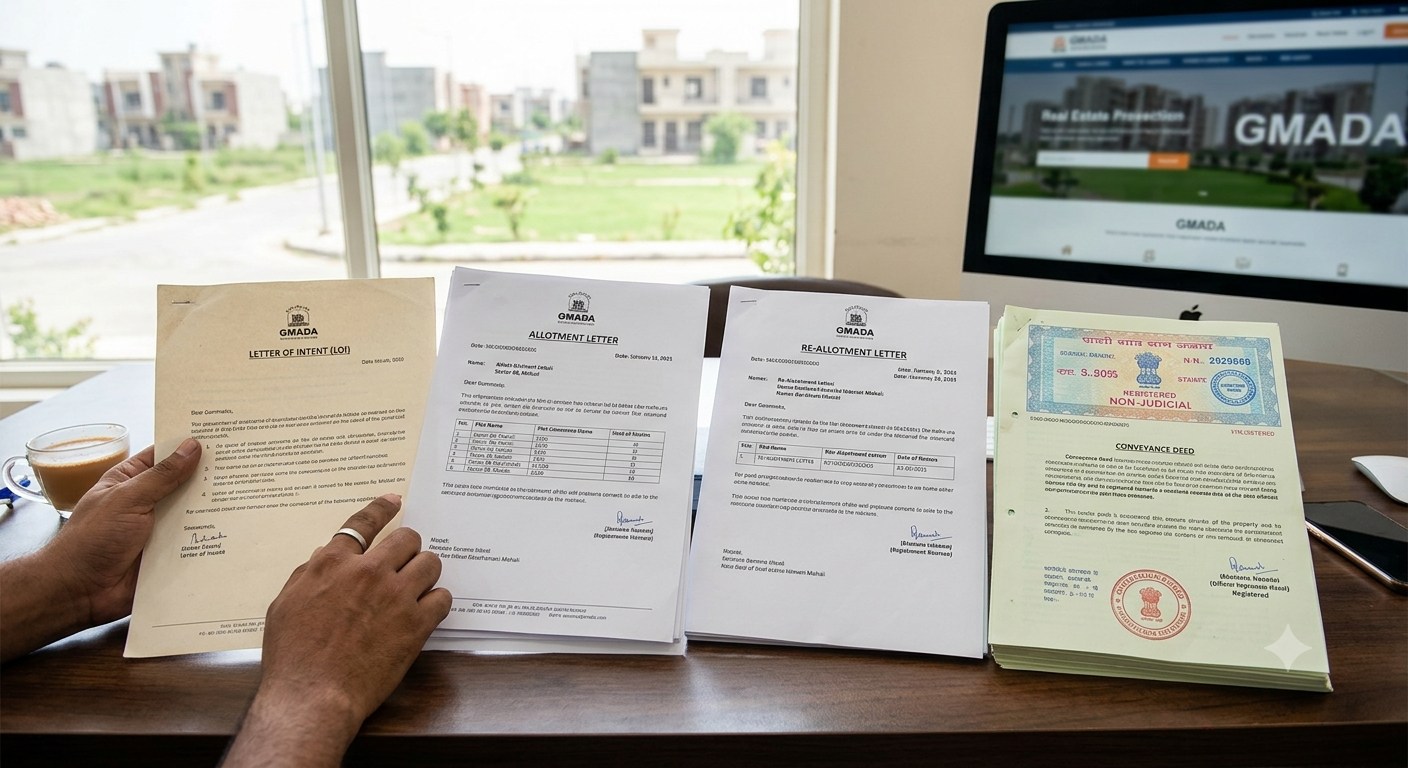
If you are dealing with a GMADA property, you may come across several documents carrying very different names:
Letter of Intent (LOI), Allotment Letter, Re-Allotment Letter and Conveyance Deed.
They can all relate to the same plot or property, but they do not mean the same thing. This distinction becomes especially important when you are buying an older GMADA property, checking somebody's ownership documents, applying for a loan, transferring a property or trying to understand how far an allotment has progressed.
A person may show you an LOI and call it an allotment. Another property may have a re-allotment letter instead of the original allotment letter in the current owner's name. A third property may already have a registered conveyance deed. So what does each document actually tell you?
First, Do Not Assume Every GMADA Property Will Have the Same Document Sequence
A simple way of imagining the process is:
LOI → Allotment Letter → Conveyance Deed
If the property changes hands before or during this process, a re-allotment or other change-of-ownership document may also become relevant. But this should not be treated as a universal sequence for every GMADA property.
Different schemes can have different conditions. For example, some GMADA schemes provide for an LOI first and an allotment letter after the required formalities are completed. In auction cases, GMADA's published procedure provides for an allotment letter to the successful bidder after the required payment.
The documents in the particular property file therefore matter more than assuming that every GMADA property must have followed exactly the same route.
1. What Is a Letter of Intent or LOI?
The Letter of Intent is generally an earlier stage in the allotment process. In GMADA schemes using an LOI system, it communicates the authority's intention to allot the property subject to the applicant fulfilling the conditions stated in the letter.
Those conditions can include matters such as payment of the required amount, submission of documents and completion of other formalities within the stipulated period. For example, GMADA scheme documents state that an allotment letter is issued after the allottee completes the required formalities contained in the LOI. That distinction is important.
An LOI should therefore not automatically be treated as the final allotment document or as a registered title deed.
Think of it this way:
The LOI tells you that the allotment process has reached an important stage, but there may still be conditions that must be completed before the final allotment letter is issued. GMADA even maintains a separate service for the transfer of a Letter of Intent/Allocation, which further shows that an LOI has its own legal and administrative position within the property process.
What should you check in an LOI?
Do not look only at the plot number and the person's name. Also check:
- The scheme under which it was issued
- The date of issue
- Payment conditions
- Deadlines mentioned in the document
- Restrictions on transfer (if any)
- Whether all subsequent payments were made
- Whether an allotment letter was eventually issued
An old LOI by itself may not tell you what happened to the property afterwards.
2. What Is an Allotment Letter?
The Allotment Letter is a much more important stage. GMADA's published scheme material explains that once the required formalities specified in the LOI are completed, an allotment letter can be issued setting out the detailed terms and conditions of allotment. The allotment letter can contain important information such as:
- Identification of the allotted property
- Allottee's name
- Price and payment terms
- Possession-related conditions
- Construction requirements
- Permitted use
- Deadlines
- Restrictions
- Other terms governing the allotment
This is why merely asking, “Do you have the allotment letter?” is not enough. You also need to know whether the allotment remains in the same person's name, whether the property was transferred later and whether a conveyance deed has subsequently been executed.
Does an allotment letter mean the property is already fully owned like a registered sale deed?
Not necessarily. An allotment letter and a conveyance deed perform different functions. For example, one current GMADA allotment document expressly provides that ownership continues to vest in GMADA until the full price is paid and the conveyance deed is executed. The specific terms of the applicable scheme and property documents should therefore always be checked.
3. What Is a Re-Allotment Letter?
This is where many property buyers become confused. Suppose GMADA originally allotted a property to Person A.
Later, the property is transferred through the procedure applicable to that case, and GMADA's records recognise Person B in place of the earlier allottee. The property has not necessarily been “allotted for the first time” again. Instead, the authority may issue a re-allotment letter or process the corresponding change in its ownership/allotment records.
GMADA itself lists transfer of allotment, issue of re-allotment letters and transfer/change of ownership among the functions handled by its Estate Office. That makes a re-allotment letter particularly important when dealing with a property that has changed hands after its original allotment.
Why does this matter to a buyer?
Imagine someone shows you an allotment letter issued 15 years ago. The name on it is not the name of the person selling the property today. That does not automatically mean something is wrong. There may have been an approved transfer, sale, gift, succession or another recognised change in between.
But you need to see the documents that connect those two names. A re-allotment or change-of-ownership document can form part of that chain. In simple terms:
Original allotment tells you who GMADA originally recognised. Re-allotment/change-of-ownership records can tell you how the authority later recognised another person. The precise document issued will depend on the nature and stage of the transfer.
4. What Is a Conveyance Deed?
The Conveyance Deed is fundamentally different from the earlier administrative letters. It is the formal deed used for conveyance of the property and is executed on the applicable stamp paper and registered through the registration process. GMADA's current procedure for execution of a conveyance deed requires, among other things:
- A copy of the allotment or re-allotment letter
- A No Due Certificate
- Applicable authority documents where relevant
- Copies of the conveyance deed, including the copy on stamp paper
GMADA currently states a service time limit of 15 working days for execution of the conveyance deed once the application is complete as required. Notice something important here:
GMADA itself asks for the allotment/re-allotment letter when processing the conveyance deed. That shows clearly that the allotment letter and conveyance deed are not interchangeable documents. One leads into the other at a later stage of the property process.
Why Does the Conveyance Deed Matter So Much?
For a buyer checking an old GMADA property, the conveyance deed can be one of the most important documents because it moves beyond the administrative history of allotment and into the formal registered conveyance of the property. But even here, do not check only whether somebody has produced a document titled “Conveyance Deed.” Check:
- Whose name appears on it
- Which property it covers
- Whether it is registered
- Whether the property description matches the property being sold
- What transfers occurred after its execution
If a registered conveyance deed was later followed by another registered sale, gift or transfer deed, GMADA also has a procedure for updating/re-transferring the property on the basis of such registered documents. So the conveyance deed may be a major document in the property's title chain without necessarily being the last transaction that ever occurred.
One of the Biggest Mistakes: Treating All Four as Proof of the Same Thing
These documents answer different questions. An LOI may answer:
Has GMADA expressed its intention to allot the property subject to specified conditions?
An Allotment Letter may answer:
To whom was the property allotted and on what terms?
A Re-Allotment Letter or subsequent authority record may help answer:
Has GMADA recognised a later change in the allottee/owner's records?
A Conveyance Deed answers a different and more advanced question concerning the formal conveyance of the property. That distinction is far more useful than simply asking whether a seller has “GMADA papers.”
What Should You Check When Buying an Older GMADA Property?
Instead of requesting one particular paper and stopping there, try to understand the property's document history. Start with the earliest available allotment document. Then establish whether:
- An LOI was issued
- Its conditions were fulfilled
- An allotment letter followed
- The original allottee ever transferred the property
- GMADA recognised subsequent transfers or ownership changes
- Dues remained outstanding at any stage
- A conveyance deed was executed
- Any registered sale, gift, succession or later transfer occurred afterwards
GMADA separately provides services for LOI transfer, property transfer, change of ownership, re-allotment-related documents, No Due Certificates and conveyance deeds. That itself demonstrates why one paper rarely tells the complete story of an older property.
Important: A Photocopy Is Not the Same as Verification
If someone gives you a photocopy or PDF of an old GMADA letter, do not assume that the document alone establishes the property's current position. GMADA provides facilities relating to duplicate documents, property records and various ownership/transfer services.
Where a transaction is significant, the current status should be checked through the appropriate official records and documents rather than relying only on papers supplied by the seller. This becomes particularly important where:
- The allottee's name and seller's name are different
- The property has changed hands several times
- The conveyance deed has not yet been executed
- There are outstanding dues
- Original documents are missing
- Different documents show different names
The Most Important Thing to Remember
LOI, Allotment Letter, Re-Allotment Letter and Conveyance Deed are not four versions of the same document. They can represent different stages in the life of a GMADA property.
An LOI can come before final allotment under schemes that use the LOI process.
An allotment letter records the allotment and its conditions.
A re-allotment or change-of-ownership document may become relevant when the recognised allottee changes.
And the conveyance deed is the formal deed executed at a later stage under the applicable conditions and registration process.
So if you are checking a GMADA property, do not ask only:
“Does the owner have an allotment letter?”
A better question is:
“Can the documents show a complete and consistent chain from the original GMADA allotment to the person dealing with the property today?”
That one question can reveal far more about the property than the name of any single document.
You May Also Want to Know
GMADA publishes official property procedures, citizen services, allotment-related information, transfer procedures, conveyance deed requirements and other authority-related updates on gmada.gov.in.
For easy-to-understand information about GMADA properties, documents, procedures, notices, projects and Greater Mohali development, visit gmada.in.
Important Disclaimer
gmada.in is an independent information portal. It is not affiliated with, endorsed by, or operated by GMADA, Mohali Municipal Corporation, PUDA, the Government of Punjab or any other government authority.