GMADA News & Updates
Mohali, New Chandigarh, Kharar or Banur — Which GMADA Master Plan Applies to Your Area?
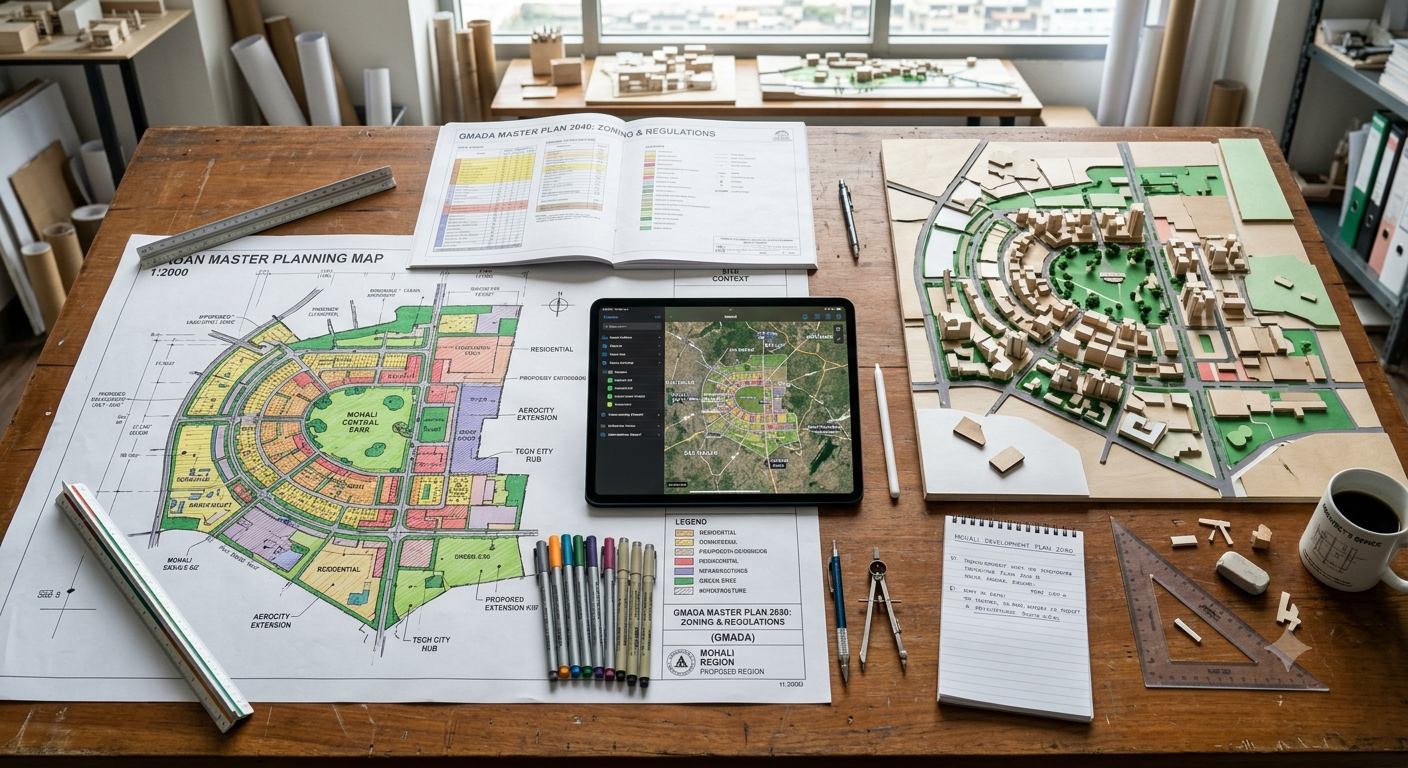
A property may have S.A.S. Nagar in its address, be advertised as being “near Mohali” and still fall under a different GMADA master plan. That can be confusing when you are trying to check what is planned around a property, whether nearby land is residential or commercial, where a future road is proposed, or which official planning document you should rely on.
The reason is simple: Greater Mohali is not covered by one single master plan.
GMADA publishes separate planning documents for different Local Planning Areas, including S.A.S. Nagar, New Chandigarh, Kharar, Banur, Dera Bassi and Zirakpur, along with a broader regional plan. The applicable plan therefore depends on the actual planning area in which the land falls, not simply the town name people use in conversation or advertisements.
First, What Is a Local Planning Area?
A Local Planning Area, or LPA, is the geographical area for which a particular master plan has been prepared. A master plan provides the larger planning framework for that area. Depending on the plan, it can show proposed:
- Residential areas
- Commercial areas
- Industrial areas
- Institutional uses
- Green and open spaces
- Major road networks
- Transport facilities
- Existing settlements
- Other planned land uses
This is why the correct question is not simply:
“Is my property in Mohali?”
A better question is:
“Which Local Planning Area contains my property?”
That tells you which master plan you should check.
If Your Property Is in Mohali, Check the S.A.S. Nagar Planning Area
For the main Mohali urban area, the relevant planning framework is the S.A.S. Nagar Local Planning Area Master Plan 2006–2031. GMADA's official master-plan report identifies it as the SAS Nagar Local Planning Area and sets out the planning framework up to 2031. The plan covers the larger development structure of S.A.S. Nagar rather than only the older established Mohali sectors. This distinction matters because “Mohali” is commonly used in a much broader geographical sense today.
A property advertisement may describe a location as Mohali because it falls within S.A.S. Nagar district or is close to the city. That description alone does not prove that the property falls within the S.A.S. Nagar Local Planning Area. You need to check its actual location against the approved planning boundary.
New Chandigarh Has Its Own Master Plan
New Chandigarh should not simply be treated as an extension of the Mohali master plan. GMADA publishes a separate New Chandigarh Master Plan 2008–2031. There is an important historical detail here.
The area was originally known as the Mullanpur Local Planning Area. An official GMADA-linked Social Impact Assessment document records that the Mullanpur LPA was renamed the New Chandigarh LPA through a notification dated February 21, 2014. GMADA describes New Chandigarh as an approximately 15,000-acre planning area containing 32 villages, with Mullanpur as its largest historic settlement. This explains why people may still encounter both names:
Mullanpur and New Chandigarh
in older documents, property descriptions and planning references. GMADA's current website also retains entries for both Mullanpur and New Chandigarh in its master-plan section. Therefore, when checking a particular property, the safest approach is to use the latest applicable official planning document, revenue plan and subsequent notification for that exact location, rather than assuming that an older reference to “Mullanpur” is a separate modern planning area.
Kharar Has a Separate Master Plan Too
Kharar is another separate Local Planning Area. GMADA publishes the Kharar Master Plan 2031, along with a plan and a Revenue Master Plan. That means land falling within the Kharar planning area should be checked against the Kharar plan even if the location is marketed as:
- “Greater Mohali,”
- “Mohali extension,”
- “near Airport Road,”
or another nearby-area description. Marketing terminology does not determine the statutory planning area. This becomes particularly important when checking proposed roads or future land use. Something shown in the S.A.S. Nagar plan should not automatically be assumed to apply to a parcel located inside the Kharar LPA.
Banur Also Has Its Own 2031 Master Plan
GMADA separately publishes the Banur Master Plan 2031. The official plan identifies a distinct Banur Planning Area and includes proposed residential, mixed-use, industrial, institutional, green, transport and road-network land uses. Banur provides one of the clearest examples of why checking only the postal or administrative address can be misleading.
Recent GMADA proceedings for the Aerotropolis Extension identify the project as falling under the Banur Master Plan, even though the affected villages are described within S.A.S. Nagar district and the acquisition proceedings involve areas in Mohali and Banur tehsils.
So:
S.A.S. Nagar district does not automatically mean S.A.S. Nagar Master Plan. The Local Planning Area is what matters.
Then What Is the GMADA Regional Plan?
This is another common source of confusion. GMADA also publishes a Regional Plan for the wider Greater Mohali region. The Regional Plan provides the broader planning framework across the region. It should not be confused with the more specific master plan for an individual Local Planning Area.
Think of it this way:
The Regional Plan looks at the larger Greater Mohali region. The Local Planning Area Master Plan looks at the planned structure of a particular area such as S.A.S. Nagar, Kharar, Banur or New Chandigarh. And an individual layout or zoning plan can provide much more detailed information for a particular sector, colony or scheme. They serve different purposes.
Master Plan, Revenue Master Plan and Layout Plan Are Not the Same Thing
When checking a property, you may come across several different types of official maps.
Master Plan
This gives the wider planning framework. It may show broad land-use categories, major roads, development areas, existing villages and other planning features across an entire Local Planning Area.
Revenue Master Plan
GMADA publishes Revenue Master Plans for some areas, including Kharar, Banur and New Chandigarh. These can be particularly useful when you are starting with revenue-based information such as a village or land record and need to relate it to the larger planning framework.
Layout or Zoning Plan
This is much more specific. If you are checking an individual GMADA sector, plotted development, housing scheme or colony, the applicable layout or zoning plan may contain details that cannot be understood from the larger master plan alone. So finding your area in the master plan is only the first step when conducting property-level verification.
How Do You Find Which Master Plan Applies to Your Property?
Start with the most precise information you have.
1. Identify the exact location
Do not rely only on terms such as:
“Mohali”
“New Chandigarh side”
“Airport Road area”
“Kharar side”
Instead, identify the exact:
- Village
- Sector
- Scheme
- Plot location
- Revenue details, where relevant
2. Open GMADA's Approved Master Plans
GMADA currently provides separate approved-plan entries for areas including Banur, Kharar and New Chandigarh, along with other planning areas and the GMADA Regional Plan.
3. Check the planning boundary
Locate the property or village within the relevant master-plan boundary. Do not simply choose whichever town appears geographically closest.
4. Use the Revenue Master Plan where available
If your starting information comes from village or revenue records, the Revenue Master Plan can provide additional context.
5. Check for later amendments
A master plan is not necessarily frozen forever. Government notifications can modify particular parts of a notified master plan. For example, official Punjab planning records show later modification proceedings relating to the notified S.A.S. Nagar Master Plan. Therefore, an old copy of a master plan should not automatically be treated as the final answer for every present-day property question.
6. Check the relevant layout or zoning plan
If the property lies inside a particular sector, scheme or licensed development, check the latest applicable detailed plan as well. The master plan tells you the larger planning context. It does not necessarily tell you every detail about an individual plot.
Why This Matters Before Buying Property
Suppose you are considering land because someone tells you:
“A commercial area is coming nearby.”
Or:
“A 200-foot GMADA road will pass here.”
Or:
“This property will become part of New Chandigarh.”
Those claims should be checked against the correct planning area first. Looking at the wrong master plan could lead you to mistake:
- A road in another planning area for a road near your property
- Proposed commercial land for your property's permitted land use
- A regional proposal for a detailed sector plan
- An old planning document for the latest approved position
- A nearby development for development covering your actual land
That is why the first task should always be to establish which Local Planning Area the property actually falls within.
A Simple Rule to Remember
If your property is in or around Greater Mohali, do not assume there is one single “GMADA Master Plan.” There are multiple planning areas.
- For Mohali, look at the applicable S.A.S. Nagar Local Planning Area documents.
- For New Chandigarh, check the New Chandigarh 2008–2031 planning documents, keeping in mind its earlier Mullanpur LPA name.
- For Kharar, check the Kharar 2031 Master Plan.
- For Banur, check the Banur 2031 Master Plan.
And if your property sits near the edge of two planning areas or its position is unclear, verify the exact village/revenue location against the official planning boundary rather than choosing a master plan from the address alone.
You May Also Want to Know
For master plans, planning reports, revenue master plans, layout/zoning plans and related official documents visit gmada.gov.in.
For an easier overview, gmada.in also provides a Master Plans by Town section that links users back to the corresponding official GMADA documents.
Important Disclaimer
gmada.in is an independent information portal. It is not affiliated with, endorsed by, or operated by the Greater Mohali Area Development Authority (GMADA), PUDA, the Government of Punjab, or any other government department.