GMADA News & Updates
Purab Premium Apartments Were Declared Complete — Why Has NCDRC Asked GMADA to Check Again?
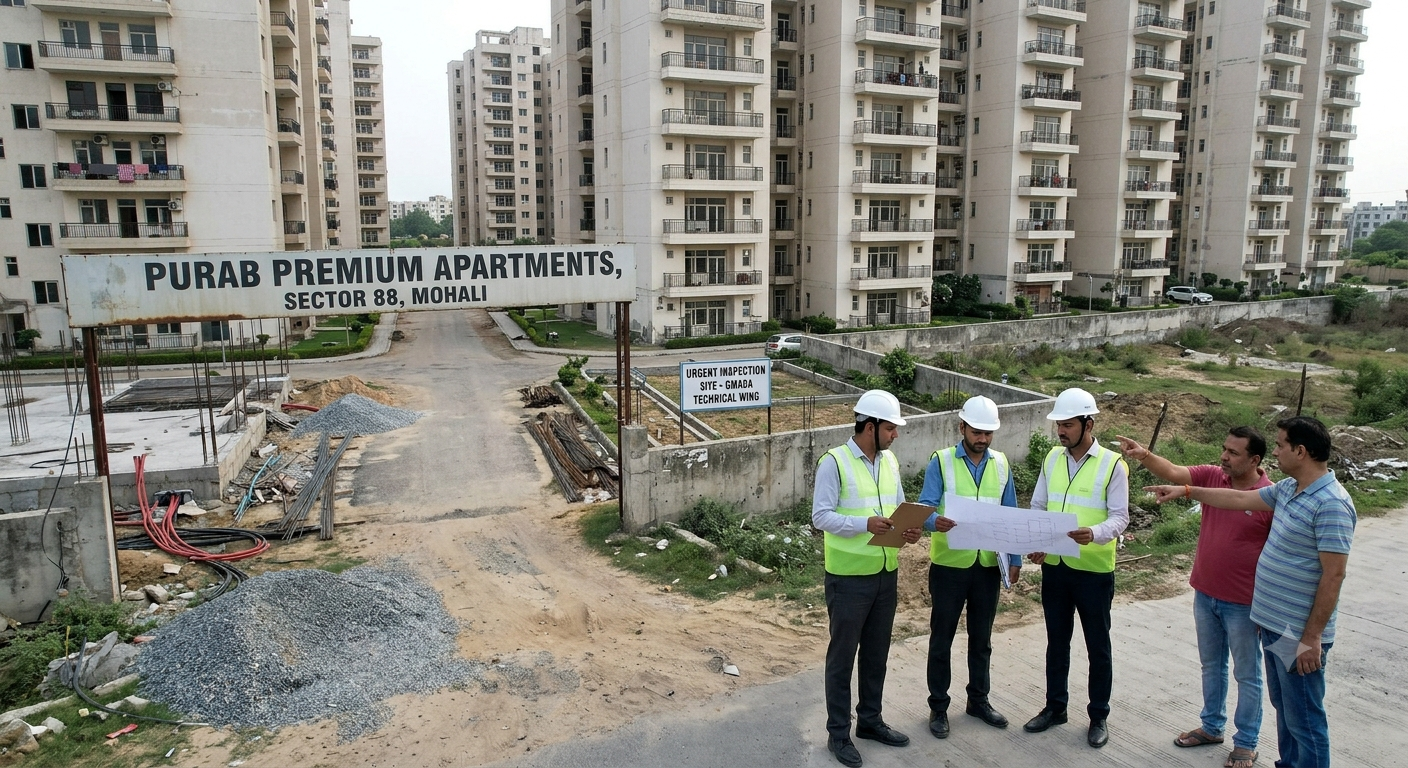
Purab Premium Apartments in Sector 88, Mohali already had completion certificates issued by GMADA.
Yet the National Consumer Disputes Redressal Commission (NCDRC) has now directed GMADA to reconsider those certificates, examine whether all promised works and facilities were actually completed, determine the real date of completion and issue fresh completion certificates.
At first, that may sound contradictory.
If a completion certificate already existed, why was another examination required?
The answer lies in an important distinction:
The dispute was not simply about whether GMADA had issued a document called a completion certificate. It was about whether that certificate properly established that the entire project—including promised works and common facilities—was actually complete, and from what date.
That date matters because it can affect residents' rights relating to delay compensation and maintenance charges.
What Has NCDRC Ordered?
The NCDRC order was pronounced on October 8, 2026, in execution proceedings involving the Purab Premium Apartment Allottees Association and the Greater Mohali Area Development Authority. The Commission directed the Chief Administrator of GMADA to reconsider the available technical reports and project records and reach a clear conclusion on whether all the promised works, amenities and facilities had actually been completed.
If the project is found complete, the fresh certificate must also state the date on which the last required work was completed. GMADA has been directed to issue fresh completion certificate or certificates within 30 days of receiving a certified copy of the order.
The fresh certificates are also to be provided to the Allottees Association, RWA office-bearers and other concerned authorities, and placed on GMADA's website. That makes this more than a paperwork correction.
The Commission wants GMADA to establish a clear and verifiable answer to two questions:
Was everything that was required actually completed? and If yes, when was the project truly complete?
Why Were Fresh Certificates Needed?
The dispute goes back several years. In an earlier judgment dated May 4, 2023, the NCDRC had directed GMADA to obtain a completion certificate signed by the competent authority. That certificate was required to certify that the works, amenities and facilities in the apartments as well as the common areas promised under the project documents had been fully completed.
The completion date was particularly important because the Commission had linked it to compensation for delay. GMADA subsequently issued two completion certificates on October 18, 2024—one relating to 19 towers and another relating to eight towers. But those certificates did not end the dispute.
The Allottees Association challenged them during execution proceedings. The NCDRC ultimately concluded that the two certificates did not fully comply with its 2023 judgment.
What Was Wrong With the 2024 Certificates?
This is the most important part of the case. The Commission noted that the certificates had been issued on the basis of reports prepared by GMADA's technical wings. There is nothing unusual in a competent authority relying on technical officers. Engineers and specialist departments are expected to inspect and report on civil works, public health systems, electrical infrastructure, horticulture and other parts of a development.
The problem, according to the NCDRC, was what happened after those reports reached the competent authority. The certificates stated that they had been issued “administratively purely on the basis of report of Technical Wing.” The Commission found that the Chief Administrator needed to do more than simply reproduce or rely on those technical reports.
The competent authority had to critically examine the material, satisfy itself that the entire scope of promised work had actually been completed and take responsibility for the conclusion recorded in the completion certificate. One of the certificates also did not clearly state the specific date on which all the required work had been completed. That date is central to the dispute.
Why Does the Actual Completion Date Matter So Much?
For an ordinary reader, the difference between June 2016, 2017, 2018 or 2024 may appear to be only an administrative detail. For an allottee, it can have financial consequences. The NCDRC's 2023 decision provided for delay compensation at 6% simple interest on amounts paid by eligible allottees from the committed possession date up to the relevant completion point.
If a valid completion certificate establishes that all required works and amenities were complete when possession was offered, the compensation calculation may stop at that point. But if the project was actually completed later, compensation may remain payable up to that later completion date. The fresh certificate can therefore help determine the period for which GMADA may remain liable for delay compensation.
That explains why merely having a completion certificate is not enough. The date certified inside it matters.
Maintenance Charges Are Connected Too
The completion date also has implications for maintenance charges. In its earlier clarification, the NCDRC linked maintenance liability to possession and the existence of a valid completion or occupation certificate.
In the October 2026 order, the Commission further addressed how maintenance should operate once the Residents Welfare Association is involved. Broadly, for the period when maintenance remained with GMADA, maintenance charges become relevant on or after the later of physical possession or the completion date eventually certified.
For maintenance handled by the RWA, the Commission laid down a framework involving the date on which the RWA actually began maintenance, physical possession and the certified completion date, while also dealing separately with situations where residents were already receiving RWA services. So determining the proper completion date is not merely a historical exercise. It can affect who owes maintenance, to whom, and from what date.
Why Couldn't NCDRC Simply Decide Whether the Project Was Complete?
Because determining whether a large housing project is physically complete requires technical verification. The Commission expressly recognised this. Whether every promised work, amenity and facility has been completed—and the exact date on which the last required work was finished—is essentially a question of fact.
That can require inspection by civil, electrical, public-health and other technical officers. The NCDRC said that an execution forum was not the appropriate body to carry out that technical exercise in the first instance. Instead, it placed that responsibility back on GMADA's competent authority.
In other words:
NCDRC has not declared that Purab Premium Apartments are incomplete.
Nor has it declared that the earlier completion dates claimed by GMADA are necessarily wrong. It has said that the existing certificates did not sufficiently establish the answer and that GMADA must properly verify and certify it. That distinction is important.
What Must GMADA Check Now?
The Chief Administrator has been directed to consider the technical material and the objections raised during the execution proceedings before issuing fresh certificates. The exercise is expected to address not just the individual residential towers but also the promised common facilities and project-level works.
If necessary, fresh reports can be sought from GMADA's technical officers. But the fresh certificate should not be issued merely because technical reports exist. The competent authority must be satisfied that the required work is actually complete. It must then record the completion date clearly and unambiguously.
Towers Versus the Entire Project
Another important aspect of the dispute is the difference between completing individual towers and completing the project promised to allottees. A residential development is not necessarily complete simply because apartments can be occupied.
The project can also include common infrastructure and amenities promised in its brochure, Letter of Intent, sanctioned plans or other project documents. During the proceedings, the allottees raised issues concerning various common facilities and project works. The NCDRC therefore focused on whether all works, amenities and facilities contemplated for the project had been completed—not simply whether the apartment towers were standing.
This distinction is useful far beyond Purab Premium Apartments. For any large housing project, three questions can produce different answers:
Is the flat complete?
Is the tower complete?
Is the entire project, including promised common infrastructure and amenities, complete?
A completion certificate intended to establish project completion has to address the relevant legal and project requirements, not merely physical occupation of individual apartments.
What Happens to the Existing Completion Certificates?
The October 2026 order does not simply ask GMADA to change a date on the existing documents. It directs GMADA to issue fresh completion certificates after reconsidering the records and carrying out the verification required. The earlier October 18, 2024 certificates were held not to be in full compliance with the NCDRC's previous directions.
The fresh exercise therefore has to result in a clearer determination. That determination could confirm an earlier completion date, establish a later date, or require GMADA to complete remaining work before a fresh certificate can properly be issued. The outcome depends on GMADA's technical verification.
What Does This Mean for Purab Premium Residents?
Residents should watch for the fresh certificate rather than assume that the NCDRC order itself establishes a new completion date. The most important details will be:
- Whether GMADA certifies the entire required scope as complete
- The exact completion date recorded
- Whether any works are found to remain incomplete
- How the date affects eligible delay-compensation calculations
- How the maintenance-charge framework applies
- Whether the fresh certificate addresses objections raised by the allottees
The NCDRC has also directed that the fresh certificate be made available to the concerned associations and authorities and uploaded on GMADA's website. That should make the eventual determination publicly verifiable.
Why This Case Matters Beyond Purab Premium Apartments
The case raises a broader question relevant to housing buyers:
What does a completion certificate actually prove?
For most buyers, the words “completion certificate issued” can sound final. But the Purab Premium dispute demonstrates that the legal significance of a certificate depends on more than the heading printed at the top. Questions can arise over:
- Who issued it
- What was inspected
- Which parts of the project it covers
- Whether common facilities were included
- Which technical reports were considered
- Whether the competent authority independently applied its mind
- What completion date the certificate actually establishes
For buyers and allottees, that means a completion certificate should be read along with the approved plans, project promises and the scope it expressly certifies.
Does This Mean Every GMADA Completion Certificate Can Be Challenged?
No. The Purab Premium order arises from a specific set of consumer proceedings, earlier NCDRC directions, subsequent completion certificates and objections raised by the allottees. It should not be interpreted as a finding that GMADA completion certificates generally are invalid. Nor does it automatically reopen completion certificates issued for unrelated projects.
The lesson is narrower:
where a competent authority has been specifically directed to certify completion of defined works and facilities, the resulting certificate must clearly demonstrate that the required verification has been carried out.
What Should Residents Watch Next?
The next important development is the fresh completion certificate itself. Once issued, it should answer a question that has remained central to the dispute:
On what date were all the works, amenities and facilities required for Purab Premium
Apartments actually completed?
That date could influence the calculation of delay compensation and the treatment of maintenance charges. It could also clarify whether any promised project-level work still remained outstanding after possession had been offered.
Until that exercise is complete, it would be inaccurate to say that the NCDRC has either declared Purab Premium Apartments incomplete or fixed a new completion date. It has done something different. It has directed GMADA to verify the facts properly and certify them clearly.
What This Means for Allottees
The Purab Premium Apartments case shows why the difference between “possession offered,” “tower completed” and “project completed” can matter.
GMADA had already issued completion certificates in October 2024. But the NCDRC found that those certificates did not fully satisfy its earlier directions because the competent authority had not adequately established whether all promised project works and facilities had been completed and when that completion occurred. GMADA must now reconsider the technical record and issue fresh certificates within the period prescribed by the Commission.
For residents, the most important development will therefore not be another argument over whether the project “looks complete.” It will be the actual completion date and scope formally certified after GMADA's fresh verification. That is the finding that could determine what happens next.
Where to Check
Source: This report is based on the NCDRC order dated October 8, 2026 concerning Purab Premium Apartments, along with subsequent reporting on the case. A secondary report explaining the October 2026 order was also published by LiveLaw on October 18, 2026.
For official GMADA records and any fresh completion certificate or project update, visit gmada.gov.in.
For simplified updates and local development coverage related to Greater Mohali, visit gmada.in.
Important Disclaimer
gmada.in is an independent information portal. It is not affiliated with, endorsed by, or operated by the Greater Mohali Area Development Authority (GMADA), PUDA, the Government of Punjab, the National Consumer Disputes Redressal Commission (NCDRC), or any other government or judicial authority.