Master Plan & Town Development
The Same GMADA Tender Appears Again — What Does That Actually Mean?
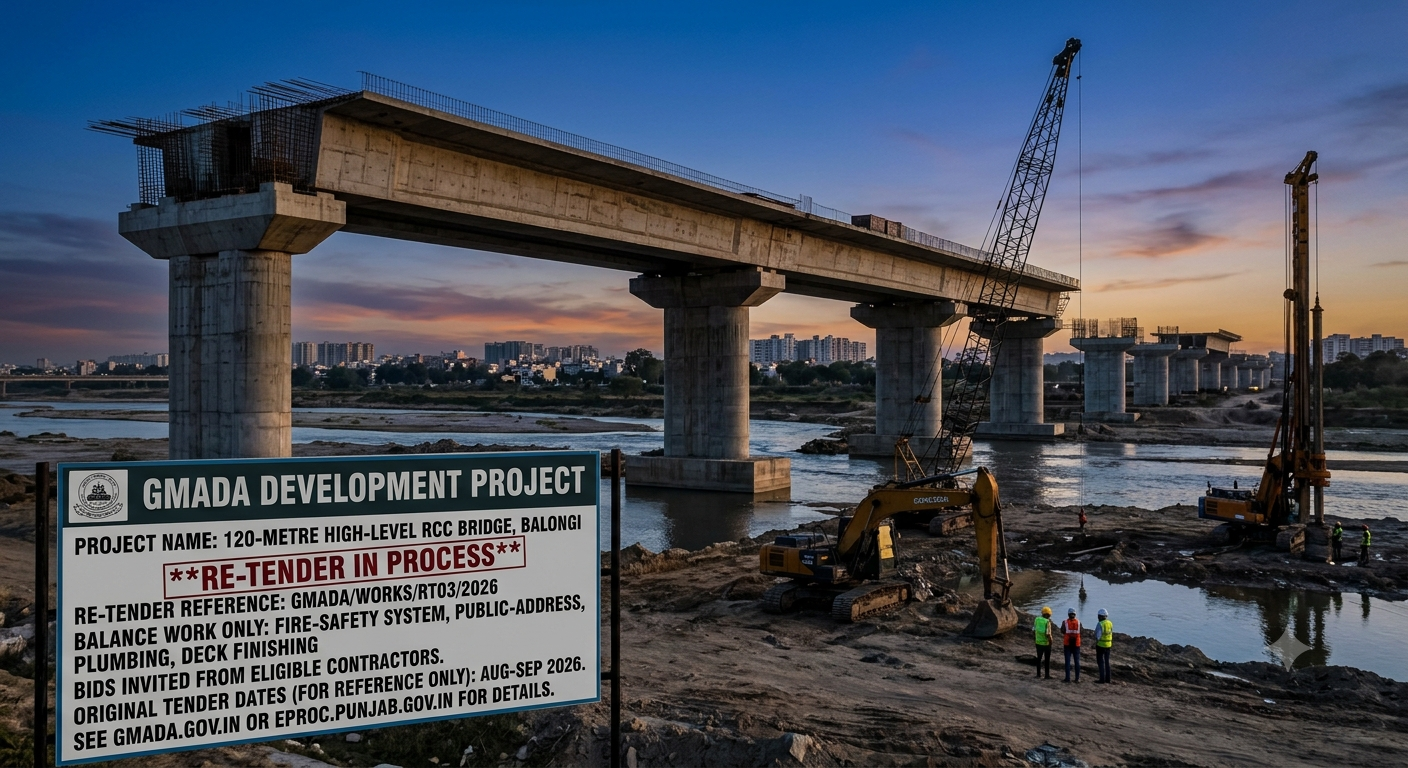
If you regularly check GMADA tenders, you may notice something unusual. A road, bridge, fire-safety system or other project appears as a tender. The last date passes. Then, a few weeks or months later, a tender with almost the same name appears again.
So what happened?
Did nobody take the work? Was the earlier tender cancelled? Did GMADA change the project? Were the bids rejected? Or has the work already started and GMADA is simply tendering another part of it?
The important thing to understand is that seeing the same tender again does not automatically give you the answer.
A government tender is part of a procurement process. Publication of the tender does not itself mean that a contractor has been selected or that construction has started. And when a similar tender appears again, there can be several possible reasons. Recent GMADA records provide some useful real examples.
First, What Does a GMADA Tender Actually Mean?
When GMADA publishes a tender, it is essentially inviting eligible contractors or agencies to submit bids for a specified work. The tender normally gives information such as:
- The work to be carried out
- Eligibility requirements
- Bid submission dates
- Technical conditions
- Financial requirements
- Specifications
- Quantities or scope of work
- Other contractual conditions
Punjab's government e-procurement system covers the process from publication and submission of bids through evaluation and award of contract.
That distinction matters.
Tender published does not mean contract awarded.
And:
Contract awarded does not necessarily mean physical work has already started on the site.
There can still be steps between these stages. So if residents see a tender for a bridge, road or other facility, they should treat it as evidence that the work has entered a procurement stage — not as confirmation that construction is underway.
Why Can the Same Tender Appear Again?
There is no single answer. A tender can return for several reasons depending on what happened during the earlier bidding process.
1. There May Not Be Enough Suitable Bids
A tender may attract fewer bidders than required, or the bids received may not satisfy the conditions needed to proceed. Punjab's e-procurement system provides for extensions, cancellations and re-tendering in different situations. That does not necessarily mean there is something wrong with the project itself. It may simply mean that the procurement process could not move forward in its existing form.
2. Bids Can Fail Technical Requirements
Submitting the lowest price is not always enough to win a government contract. A contractor may first need to satisfy technical qualifications, provide required certificates, meet experience conditions and submit all required documents. If the bidding process does not produce an acceptable result, another procurement round may become necessary.
3. The Tender Conditions May Need to Change
Sometimes the problem is not the physical project but the way the contract has been structured. The scope, specifications, payment conditions, eligibility requirements or other tender conditions may need revision before bids are invited again. A fresh tender can therefore sometimes represent an attempt to revise the procurement process rather than abandon the project.
4. The Tender May Be Extended Instead of Fully Reissued
Not every change means there is a completely new tender. Government procurement portals also publish corrigenda. A corrigendum may:
- Extend the last date
- Revise a condition
- Correct information
- Change a tender schedule
- Provide clarification
Therefore, when a deadline changes, users should first check whether they are looking at a date extension or corrigendum rather than assuming that GMADA has started the entire process again.
A Real Example: The Balongi Bridge Tender Appeared Again
One recent GMADA example is the proposed 120-metre high-level RCC bridge on a 100-foot-wide road near Balongi. GMADA's tender records show a tender for this work beginning on August 26, 2026, with September 8 as the last date. A tender carrying the same project description later appeared again with an October 27, 2026 start date and November 3 as its last date.
For someone simply reading the tender list, the natural question is:
Why was the bridge tendered again?
But this is exactly where readers need to be careful. The appearance of the project again tells us that another tender notice was issued. It does not, by itself, prove why the earlier procurement did not lead to the next stage. Unless a cancellation notice, corrigendum, tender result or another official record gives the reason, it would be unsafe to assume that:
- No contractor was interested
- GMADA rejected every bid
- The project was cancelled
- There was a financial problem
- Construction had already started and stopped
The correct conclusion is narrower:
The same bridge work returned to the tender process. To understand why, the related tender documents and subsequent procurement records have to be checked.
Another Example: Purab Premium Apartments
Another useful example can be found at Purab Premium Apartments, Sector 88. GMADA records show a tender for the balance work of fire alarms, public-address and firefighting systems in 19 towers, the Community Centre and Sports Stadium beginning in August 2026.
A tender with the same work description appeared again in September. Another was listed in November. Multiple appearances naturally raise questions. But again, the tender list alone should not be used to invent the answer. What can safely be said is that GMADA repeatedly invited bids during 2026 for the identified balance work.
To determine exactly what happened in each earlier procurement round, the corresponding tender records, corrigenda, cancellation notices or award information would need to be checked.
“Balance Work” Is Also Important
Readers should pay particular attention when the words “balance work” appear in a tender. Balance work generally refers to work that remains to be completed rather than a completely new project.
That still does not tell us why the work remains. Remaining work could arise from several circumstances, including an earlier contract, incomplete execution, a revised scope or another procurement situation. The tender title alone should therefore not be used to decide what went wrong. But from a resident's point of view, it does tell you something important:
some identified portion of the work still requires execution.
Does a Repeated Tender Mean the Project Is Delayed?
Possibly — but not automatically. If the procurement process has to be repeated, it can consume additional time before a contractor is selected. But the word “delay” should be used carefully. To establish an actual project delay, you would ideally need to know:
- The original project timeline
- Whether a previous contract was awarded
- The scheduled commencement date
- The scheduled completion date
- Whether work had already begun
- The reason for any fresh tender
Without this information, a repeated tender is better treated as a signal to investigate the project's procurement status, rather than automatic proof that the construction schedule has failed.
A Tender Can Also Be Cancelled
Another point residents often miss is that a tender can be cancelled before the contract is awarded. The Punjab e-procurement system separately identifies cancelled and re-tendered procurements. The important point for a user is simple:
The first tender notice may not be the final status of the project.
If you saw a tender months ago and nothing appears to have happened on the ground, it is worth checking what happened after that tender instead of assuming the work order was issued.
What Should You Check When a Tender Appears Again?
You do not need to understand every page of a technical tender document. Start with a few basic checks.
Check the Tender Dates
Compare the start date and last date of the earlier notice with the later one. If the work appears months apart under new dates, there may have been another procurement round. If only the deadline has moved, it may instead be a date extension.
Check Whether the Work Description Is Exactly the Same
Two titles can look similar while covering different portions of a project. Look for words such as:
- balance work
- repair
- maintenance
- strengthening
- additional work
- Phase 1 or Phase 2
- annual maintenance
- consultancy
- construction
Check for a Corrigendum
A revised deadline or condition may be recorded through a corrigendum instead of a fresh tender. This can explain why dates or conditions appear different.
Check for Cancellation or Re-Tender Information
If the earlier procurement was cancelled and subsequently invited again, this is much more meaningful than simply finding two similar titles.
Check Whether a Contract Was Actually Awarded
This is one of the most important distinctions. A tender notice tells you that bids were invited. An award tells you that the procurement process has moved further and a successful bidder has been identified. Without checking the later stages, it is risky to say that “GMADA has started the project” merely because a tender appeared.
Why This Matters to Residents
Tender information may look technical, but it can answer very practical questions. Suppose you live near a road that GMADA proposes to improve. You may see the tender and expect construction to start shortly. Several months pass. Nothing happens. Then the same work appears again. Knowing how tenders work helps you ask a better question.
Instead of:
“Why hasn't GMADA completed the road?”
the first question may actually be:
“Did the earlier tender ever result in an awarded contract?”
That distinction can completely change how you understand the project's status.
What a Repeated Tender Does Not Automatically Prove
A repeated tender should not immediately be treated as evidence of:
- corruption
- contractor failure
- lack of funds
- project abandonment
- administrative negligence
- construction failure
Any of those claims would require separate evidence. The repeated tender itself proves something much simpler:
The work has appeared in the procurement process again.
The reason must be established from the accompanying official records.
Tender Published, Contract Awarded and Work Started Are Different Stages
This is perhaps the most useful takeaway for anyone following GMADA projects. Think of the process broadly as:
Tender published → bids received → bids evaluated → successful bidder selected → contract/work order → work begins → work progresses → work completes
Not every procurement follows a perfectly straight path. A tender can be extended, corrected, cancelled or invited again before the process reaches an award. That is why tracking only the first tender notice can create a misleading picture of what is happening.
You May Also Want to Know
GMADA publishes official tenders, corrigenda, public notices, project information, master plans and other authority-related updates on gmada.gov.in.
For tender-related procurement details, bid status and e-procurement information, users can also refer to the official Punjab Government e-procurement portal.
For easy-to-understand updates, Greater Mohali development information and helpful context around GMADA notices, tenders and projects, visit gmada.in.
Important Disclaimer
gmada.in is an independent information portal. It is not affiliated with, endorsed by, or operated by GMADA, Mohali Municipal Corporation, PUDA, the Government of Punjab or any other government authority.