Notices & Public Alerts
What Happens to a GMADA Property When the Owner Dies Without a Will?
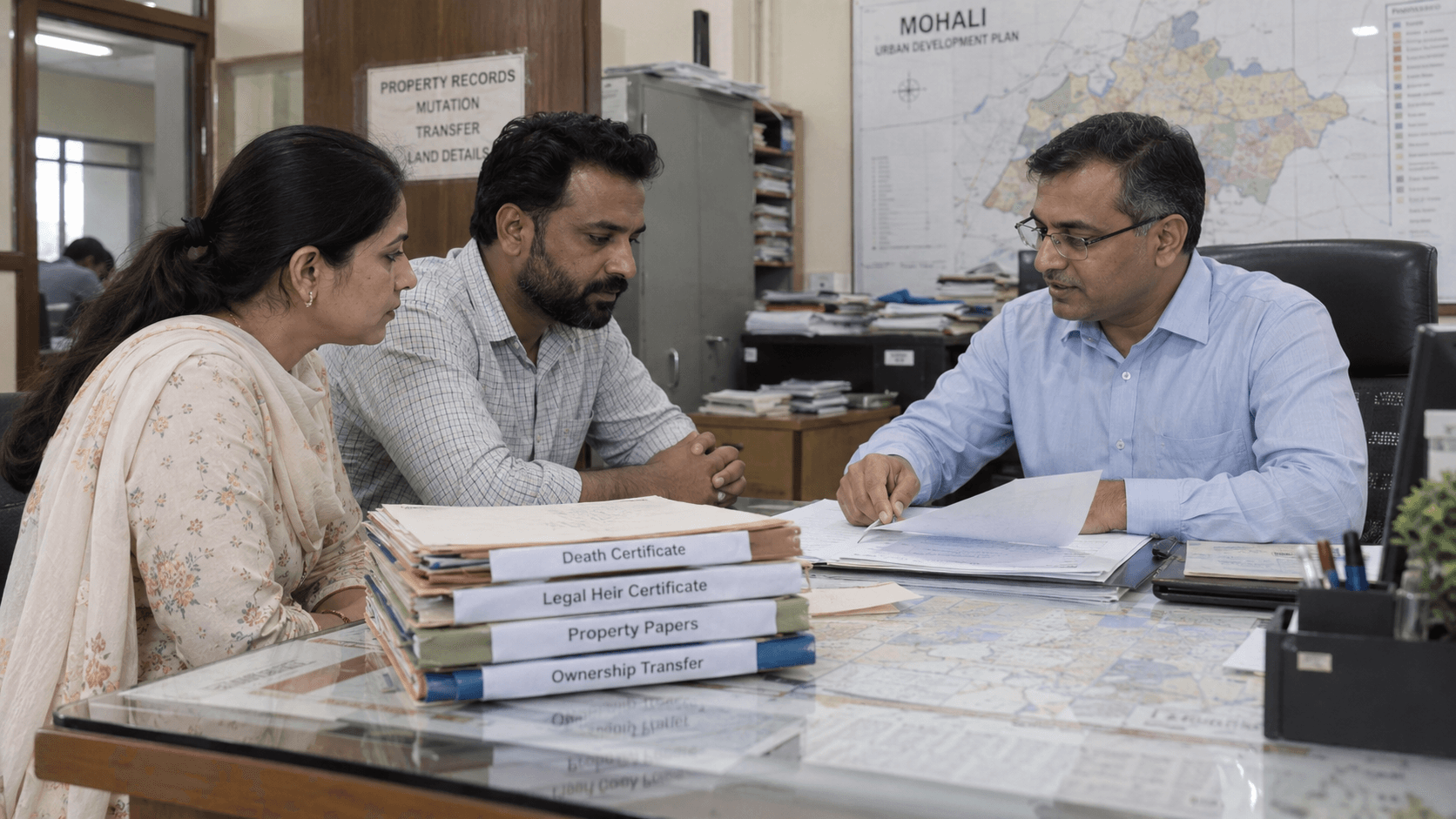
When the owner of a GMADA property dies without making a will, the property does not automatically disappear from the family—and it does not automatically get updated in GMADA's records either. The legal heirs have to complete a formal ownership-transfer process.
GMADA describes this service as: “Transfer Property on the basis of Inte-State Death (Natural Succession)”
In simple words, this is the procedure used when a property owner dies without leaving a will and the legal heirs want GMADA's ownership records changed accordingly.For a family already dealing with the death of a parent, spouse or other relative, the terminology can seem complicated. The process becomes much easier to understand when broken into a few clear steps.
First: What Does “Died Without a Will” Mean?
A person who dies without leaving a valid will is commonly said to have died intestate. In that situation, the question of who inherits the deceased person's property is determined by the applicable succession law.For example, the Hindu Succession Act, 1956 applies to Hindus as well as Sikhs, Buddhists and Jains. Other communities may be governed by other succession rules. But there is an important distinction: Inheritance law determines who is legally entitled to inherit. GMADA's procedure deals with updating its property records on the basis of that entitlement. The two should not be confused.
Does the Property Automatically Move to the Children?
No. Even where the legal heirs are clear, GMADA's records do not update automatically after the owner's death. The heirs have to apply for transfer under the natural-succession procedure and provide the documents required by GMADA. So the practical sequence is:
Owner dies → Legal heirs are identified → Required documents are prepared → Application is submitted to GMADA → Documents are verified → GMADA ownership record is changed
This is why families should not simply leave the property indefinitely in the name of the deceased owner.
What Does GMADA Currently Require?
GMADA's current natural-succession procedure lists the following documents:
- Prescribed application form
- Original death certificate
- Liability affidavit from all legal heirs
- Photo identity proofs of all legal heirs
- Clearance of any previous mortgage or loan, or the relevant redemption deed
- Proof identifying the legal heirs
- Additional court documentation where the transfer is based on a succession certificate issued by a court.
If there are more than four legal heirs, GMADA specifically says an additional affidavit should be used. This is a useful detail that families can easily miss.
How Do You Prove Who the Legal Heirs Are?
This is one of the most important parts of the process. GMADA's current procedure says an original Legal Heir Certificate can be issued by the:
- Sub-Divisional Magistrate (SDM)
- Tehsildar
of the concerned tehsil where the deceased person was a resident. However, GMADA's published procedure also provides alternatives. Instead of the Legal Heir Certificate, it refers to an affidavit identifying the legal heirs from:
- the Area Councillor in an urban area
- the Sarpanch of the concerned village in a rural area
- a Group-A officer of the State/Central Government or its autonomous bodies
subject to the requirements stated by GMADA. The document should specify the names and relationships of the legal heirs left by the deceased allottee. Because documentary requirements can be important in individual cases, applicants should check the latest GMADA checklist before arranging affidavits.
What Is the Liability Affidavit?
GMADA asks for a Liability Affidavit from all legal heirs. In practical terms, this means the application is not simply being made by one family member without accounting for the other identified legal heirs. If several heirs are involved, make sure all of them are properly included in the documentation. Do not assume that only the person who is physically visiting the GMADA office needs to appear in the paperwork.
What If There Are Five or More Legal Heirs?
GMADA specifically addresses this situation. If there are more than four legal heirs, an additional affidavit is required to accommodate the remaining heirs. This small detail can help avoid an incomplete application.
What If the Property Is Mortgaged?
This is another important point missing from many general inheritance guides. GMADA requires:
clearance of the previous mortgage/loan or the relevant Redemption Deed.
So if the deceased owner had mortgaged the property to a bank or financial institution, the family should not assume that natural-succession transfer can be handled without addressing the mortgage documentation. Before submitting the transfer application, check whether GMADA's property record shows any existing mortgage permission or related charge.
What If the Family Has a Court-Issued Succession Certificate?
GMADA's procedure also recognises cases where transfer is being sought on the basis of a Succession Certificate issued by a court. The current checklist says a certified copy of the decree of the court should be attached where applicable. This can become particularly relevant where inheritance is not straightforward or court proceedings have already taken place.
What If Family Members Disagree About the Property?
This is where families should distinguish an administrative transfer from an inheritance dispute. GMADA can process the documents prescribed under its transfer procedure. But if family members dispute:
- who is a legal heir
- whether someone has been wrongly excluded
- the share of a particular heir
- ownership itself
- the validity of another document
- competing claims over the property
the matter may require legal advice or adjudication by the appropriate court. A routine GMADA transfer application should not be treated as a substitute for resolving a genuine succession dispute.
Is an NOC From Every Heir Required?
Do not automatically assume so. For natural succession without a will, GMADA's currently published checklist specifically asks for a Liability Affidavit from all legal heirs. It does not list a generic “NOC from every heir” as a standalone requirement on the current natural-succession page. This is different from GMADA's separate procedure for transfer on the basis of a will, where no-objection affidavits from left-out legal heirs can arise in specified circumstances. This distinction is important.
No Will vs Will: Do Not Use the Wrong GMADA Procedure
GMADA maintains separate procedures for:
1. Natural succession
When the owner dies without a will.
2. Registered or unregistered will
When the deceased owner left a will. The documents are different. For example, the will-based procedure can require:
- a certified or attested copy of the will
- liability affidavits from beneficiaries
- no-objection affidavits from certain left-out heirs
- and, for an unregistered will, affidavits from attesting witnesses
Therefore, first establish which situation applies before downloading forms or preparing affidavits.
How Long Should the GMADA Transfer Take?
This needs careful explanation because GMADA's own website currently shows two different timelines.
The dedicated natural-succession service page gives a: Time Limit: 45 days.
However, GMADA's Citizen Charter currently lists: 10 working days for change of ownership after death where a Legal Heir Certificate is produced, while it lists 45 working days for death-related transfers based on a registered or unregistered will.
Because these two official pages are not fully consistent, applicants should confirm the applicable timeline when submitting the application rather than relying on one figure alone. Keep your receipt or application acknowledgement so that you can track when the prescribed period begins.
What Property Documents Should the Family Keep Ready?
The current GMADA natural-succession checklist focuses on the application, death certificate, heir documentation, IDs, affidavits and mortgage clearance. However, as a practical precaution, families should also keep available any existing records relating to the property, such as:
- Allotment or re-allotment letter
- Conveyance deed, if executed
- Property number and sector details
- Previous GMADA correspondence
- Mortgage permission, where applicable
- Existing ownership records
- Payment or dues-related documents
These can help identify the property correctly and resolve discrepancies if they arise. They should not, however, be confused with the mandatory documents in GMADA's current published checklist.
Should Outstanding Dues Be Checked?
Yes, as a practical step. Before beginning any important property-record change, it is sensible to confirm whether there are outstanding dues, mortgage entries or other issues reflected against the property. Do not wait until the final stage of the transfer to discover a record mismatch. Families can also use GMADA's citizen-service facilities such as Know My Property Details and Know My Single Window Status, where applicable.
A Simple Checklist for the Family
If your father, mother, spouse or another GMADA property owner has died without a will, start with this sequence:
- Obtain the official death certificate.
- Identify all legal heirs.
- Obtain the required Legal Heir Certificate or other acceptable heir-identification documentation.
- Collect photo ID proofs of all legal heirs.
- Prepare the liability affidavit required by GMADA.
- If there are more than four legal heirs, prepare the additional affidavit.
- Check whether the property is mortgaged.
- Obtain mortgage/loan clearance or Redemption Deed where required.
- Check the property's GMADA details and any outstanding issues.
- Download/use the prescribed natural-succession application.
- Submit the complete application and retain an acknowledgement.
- Track the application until the ownership record is updated.
Common Mistakes That Can Delay the Process
Families should particularly avoid:
Leaving Out a Legal Heir
The official procedure asks for documentation covering all legal heirs.
Using the Will Procedure When There Is No Will
GMADA has separate procedures. Use the correct one.
Forgetting an Existing Mortgage
Mortgage clearance is specifically included in the natural-succession checklist.
Submitting Only Photocopies Where the Original Is Required
GMADA currently asks for the original death certificate and refers to the original Legal Heir Certificate where that route is used.
Assuming the Record Changes Automatically
The heirs must initiate the transfer process.
Ignoring a Family Dispute
A disputed inheritance may need legal resolution before an administrative record change can be completed safely.
Where Can Applicants Contact GMADA?
GMADA currently lists its helpdesk at:
PUDA Bhawan, Sector 62, S.A.S. Nagar, Punjab
Email: helpdesk@gmada.gov.in
Helpdesk mobile: 78886-96869
Landline: 0172-2215202
GMADA lists working hours as 9:00 AM to 5:00 PM on working days. Applicants should verify the latest contact details and submission method before visiting.
The Most Important Thing to Remember
A death in the family is already difficult. Property paperwork should not become more confusing than necessary. For a GMADA property where the owner dies without a will, remember:
No will → identify all legal heirs → prepare GMADA's natural-succession documents → deal with any mortgage or dispute → apply for the ownership record to be changed.
The process is different from a transfer based on a registered or unregistered will. And most importantly: Do not decide inheritance shares merely from informal family understanding or assumptions. The applicable succession law determines legal entitlement; GMADA's procedure is used to update its property records on the basis of the required proof.
Where to Find More Information
For the latest application form, document checklist and official procedure, visit gmada.gov.in.
For simplified explanations of GMADA procedures, Greater Mohali development and property-related public information, visit gmada.in.
Important Disclaimer
gmada.in is an independent information portal and is not affiliated with, endorsed by or operated by the Greater Mohali Area Development Authority (GMADA), PUDA, the Government of Punjab or any other government department.