GMADA News & Updates
What Is a Public Hearing — And Why Should Residents Pay Attention?
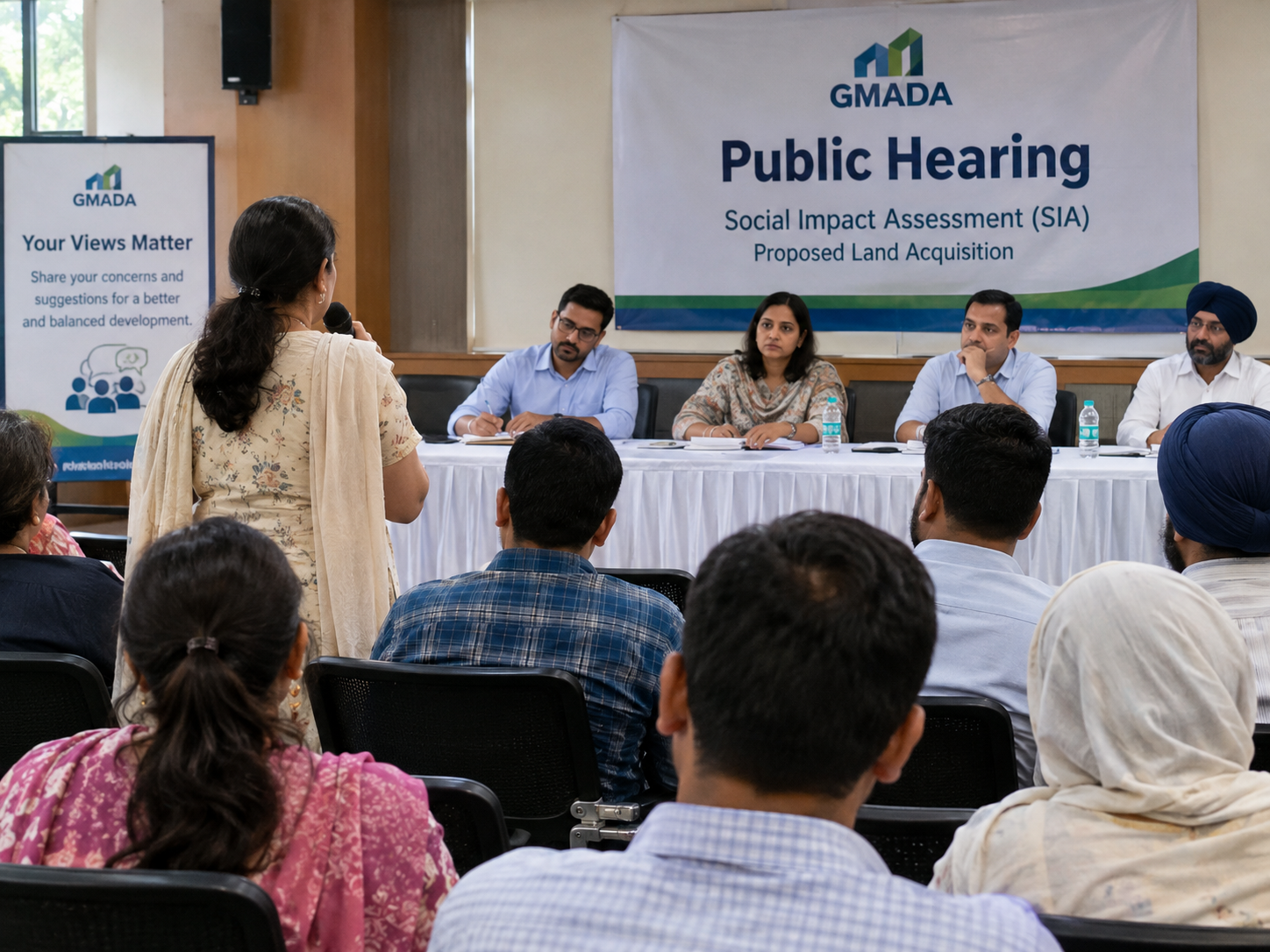
If you regularly check GMADA notices, you may have come across the term “Public Hearing.”
What is Public Hearing
A public hearing is held in connection with a particular matter or process. Depending on that process, people concerned may get an opportunity to share their views, concerns or objections, and those views may become part of the official record.
So, what actually happens at a public hearing?
There is no single format for every public hearing. The procedure depends on the matter and the rules applicable to it. GMADA's own Social Impact Assessment reports give some useful examples. In one hearing related to proposed land acquisition in Baliali, affected family members, GMADA representatives, Revenue officials and the Social Impact Assessment team were present.
The participants were asked to give their views so that they could be included in the final Social Impact Assessment report. The proceedings were also video-recorded. In another GMADA SIA report concerning land acquisition for the Expo City project, affected families raised concerns about compensation and how the compensation should be paid. Their views were recorded as part of the hearing process.
These examples also show something practical: people do not necessarily speak only about the main proposal. They can raise concerns about how a proposal may affect everyday life.
What if you have something to say?
Read the notice carefully before doing anything. Look at the subject, the location or area mentioned, the purpose of the hearing and the people or properties concerned. If the notice gives instructions about objections, representations or documents, follow those instructions rather than relying on information from another notice or an old document.
Pay attention to the date, time and venue as well. If you are submitting something in writing, keep a copy of what you submitted and any acknowledgement or proof of submission, where applicable. It can make it easier to keep track of what you have actually placed before the concerned authority. Most importantly, make sure your concern relates to the matter mentioned in the notice. A public hearing is not a general complaint meeting.
Does speaking at a hearing mean the decision will change?
No. A public hearing provides an opportunity for views to be considered and recorded. It does not mean that every suggestion will automatically be accepted or that a proposal will necessarily be changed.
What happens afterwards depends on the particular matter and the process that applies to it. That is also why it is better to look at the complete notice instead of assuming what a hearing means from the title alone.
Why should you care?
You may never need to attend a public hearing yourself. But knowing what the term means can help when you come across one in a GMADA notice. Instead of skipping it because it sounds like a technical government term, you can check what the hearing relates to and whether it concerns you. A public hearing is, in simple terms, a formal opportunity for relevant people to have their views heard as part of a particular process.
So when you see “Public Hearing” in a GMADA notice, don't stop at the heading. Read what the hearing is about. That is where you will find out whether it has anything to do with you.
Public notice and public hearing are not the same thing
These two terms can easily be mixed up. A public notice provides information about a particular matter and may invite people to take a specified action, such as submitting objections or representations.
A public hearing, on the other hand, is an opportunity within a particular process for relevant people to present their views. Sometimes you may see both connected with the same matter. That is why reading only the heading is not enough. The details in the notice tell you what is being proposed, who is concerned and what you are expected to do, if anything.
What should you check when you find one?
Before closing the notice, take a minute to check:
- What is the hearing about?
- Which area, village, sector or project is mentioned?
- Does the matter affect you or someone you represent?
- Who is invited or considered affected?
- Are objections or representations being invited?
- Is there a specific way to submit them?
- What are the date, time and venue?
- Are any supporting documents or other requirements mentioned?
These may sound like small details, but they are often the difference between simply knowing that a hearing is happening and actually understanding whether you need to do something about it.
You May Also Want to Know
For official information about GMADA property sale, transfer, No Due Certificate, conveyance deed and other property-related services, visit gmada.gov.in.
For simple explanations, local development information and useful updates about Greater Mohali, visit gmada.in.
Important Disclaimer
gmada.in is an independent information portal and is not affiliated with, endorsed by or operated by the Greater Mohali Area Development Authority (GMADA), PUDA, the Government of Punjab or any other government department.