Notices & Public Alerts
Who to Contact at GMADA for Problem Resolution
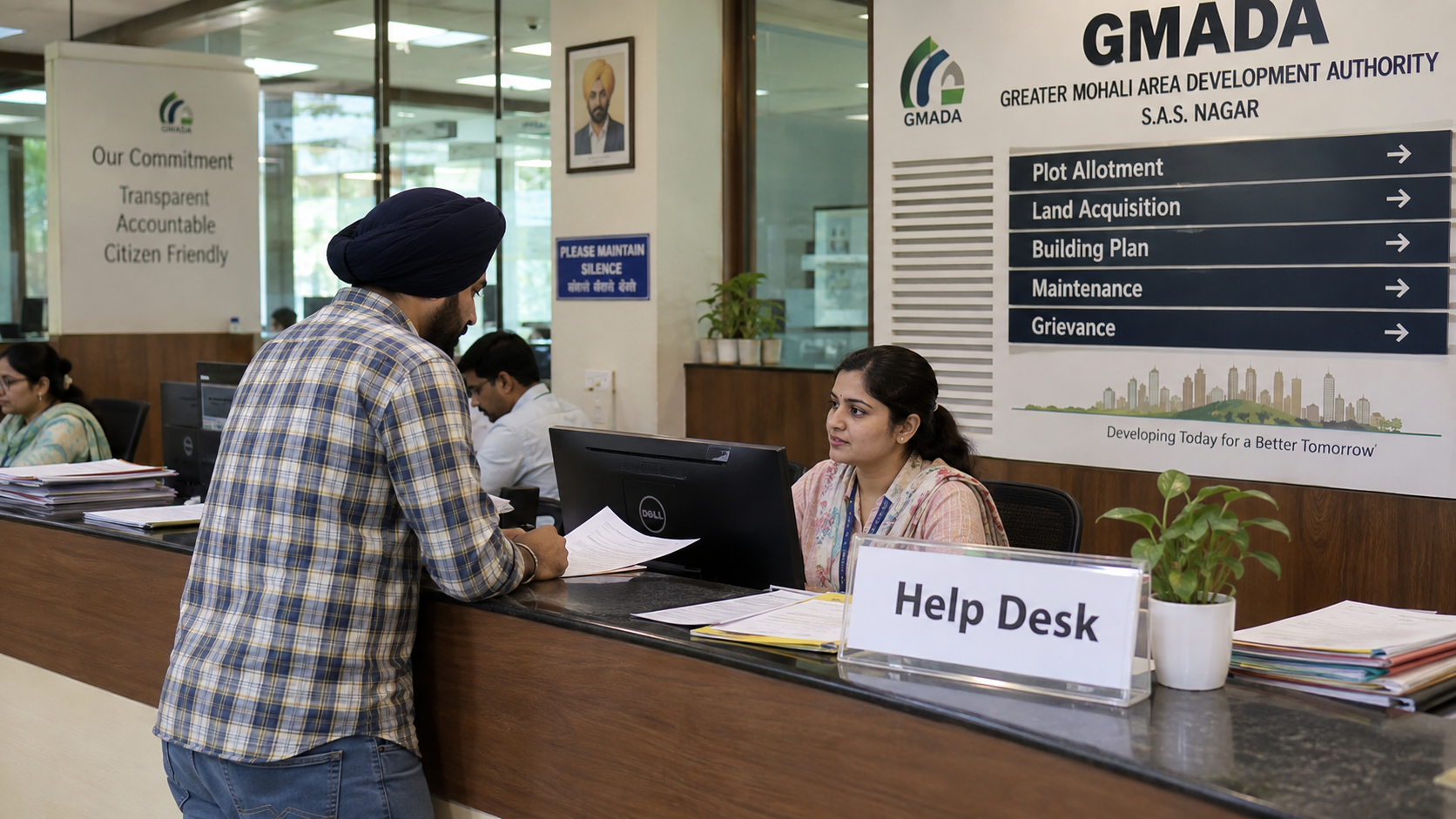
A road is damaged outside your home. Your property transfer is delayed. You need information about land acquisition. Your building-plan application is pending.
The first question is usually the same:
Who at GMADA should you contact?
The Greater Mohali Area Development Authority handles many different types of work, and not every complaint goes to the same branch. Contacting the wrong office can mean unnecessary visits, repeated explanations and delays. This simple guide explains where residents, property owners, landowners and other users should generally start for different GMADA-related problems.
Start Here: GMADA Helpdesk
If you are not sure which branch handles your problem, the GMADA Helpdesk is a useful starting point. GMADA currently lists the following general contact details:
Office: PUDA Bhawan, Sector 62, S.A.S. Nagar, Punjab
Email: helpdesk@gmada.gov.in
Helpdesk Mobile: 78886-96869
Landline: 0172-2215202, 0172-2215204, 0172-2215206 and 0172-5027180
Working hours: 9:00 AM to 5:00 PM on working days.
If your issue is specialised, however, contacting the relevant branch directly can be more effective.
Quick Guide: Which GMADA Branch Should You Contact?
| Your issue | Where to start |
|---|---|
| Plot allotment, transfer, re-transfer or property records | Estate Office / Citizen Services |
| Conveyance deed or No Due Certificate | Estate Office / Single Window |
| Building plan, DPC or occupancy certificate | Building Branch |
| Land acquisition, award or compensation | Land Acquisition Collector Wing |
| Road, drainage, sewerage or infrastructure work | Engineering Wing |
| Parks, green belts or horticulture | Horticulture Wing |
| Master plan, layout or zoning-related matter | Planning Wing |
| Unauthorised colony or regulatory matter | Regulatory Wing |
| Need information or official records | Concerned branch / RTI |
| Complaint not being resolved | GMADA Grievance System |
| Not sure where your problem belongs | GMADA Helpdesk |
The exact officer dealing with a matter can change, so users should check GMADA's latest telephone directory before contacting an individual officer.
1. Plot Allotment, Transfer or Property Record Problems
For matters involving a GMADA-allotted plot, house or commercial property, the Estate Office is usually one of the most important branches. Typical issues may include:
- Plot allotment
- Re-allotment
- Sale or transfer permission
- Change of ownership
- Re-transfer after a registered sale deed
- Transfer through inheritance or Will
- No Due Certificate
- Conveyance deed
- Duplicate property documents
- Mortgage permission
GMADA's official procedures specifically list these property-related services under its Estate Office and Citizen Services system.
Before contacting the Estate Office
Keep details such as:
- Property number
- Sector
- Allottee's name
- Allotment or re-allotment letter
- Application/reference number
- Registered deed, if relevant
- Previous correspondence
- Payment or dues details
Providing the property number and application reference at the beginning can make it easier for staff to identify the case.
2. Your Property Application Is Pending
If you have already submitted an application through GMADA's Single Window System, do not immediately file another application. First check its status. GMADA provides a Know My Single Window Status facility, allowing applicants to track an application using the relevant reference or application details. GMADA's Citizen Charter also publishes indicative time limits for several Single Window services. Examples currently listed include:
- No Due Certificate — 7 working days
- Copies of documents — 5 working days
- Change of ownership after sale deed — 5 working days
- Permission to mortgage — 10 working days
- Certain sale/transfer permissions — 15 working days
Different services have different timelines and conditions, so users should check the current Citizen Charter for the service concerned. If the published period has passed and the application remains unresolved, keep the application/reference number ready when following up.
3. Building Plan, DPC or Occupancy Problems
For construction-related approvals, look for the Building Branch or the relevant building service. GMADA currently provides services for:
- Sanction of building plans
- Plinth-level/DPC certificate
- Completion certificate
- Occupation/occupancy certification
These are separate stages, so saying simply “my building approval is pending” may not be enough. Tell the department exactly which stage is pending.
For example:
“My building plan sanction application is pending.”
is much clearer than:
“There is a problem with my house file.”
Keep your plot number, sector, application number and submission documents ready.
4. Road, Drainage, Sewerage or Infrastructure Problems
For infrastructure-related issues in areas maintained by GMADA, the Engineering Wing may be relevant. Examples can include:
- Damaged roads
- Drainage problems
- Sewerage infrastructure
- Civil works
- Bridges
- Infrastructure under construction
- Certain road-related maintenance issues
GMADA's current telephone directory separately identifies an Engineering Wing. When reporting an infrastructure problem, location is extremely important. Instead of saying:
“Road is broken in Sector 88.”
provide:
“There is a large damaged section on the road near [landmark], Sector 88, on the side towards [location].” Where possible, include:
- Sector
- Road
- Nearby landmark
- Exact problem
- Photo
- Date noticed
- Whether it creates an immediate safety problem
This makes the complaint much more useful.
5. Parks, Green Belts and Horticulture
Problems involving parks, plantation, green belts or horticulture maintained by GMADA may belong to the Horticulture Wing, which is separately listed in GMADA's current directory. Examples could include:
- Maintenance of a GMADA park
- Damaged plantation
- Green-belt maintenance
- Horticulture work along GMADA-maintained roads
Again, first confirm that the location is actually maintained by GMADA.
6. Land Acquisition, Compensation or Award Issues
If your issue concerns land being acquired for a GMADA development project, the relevant starting point is usually the Land Acquisition Collector (LAC) Wing.
Typical matters include:
- Land-acquisition notifications
- Khasra details
- Acquisition awards
- Compensation
- Land pooling
- Hearings
- Land included in a particular acquisition
- Acquisition-stage clarification
GMADA's current directory identifies a separate LAC Wing at PUDA Bhawan. Landowners should carry or quote:
- Village name
- Khasra number
- Hadbast number, where applicable
- Notification number
- Award number, if already announced
- Ownership documents
- Previous notices
- Application or objection details
Do not simply say:
“My village is under acquisition.”
A village can contain many Khasra numbers, and every parcel may not necessarily be part of the same proceeding.
7. Master Plan, Layout or Zoning Questions
If the question relates to planning rather than ownership, the Planning Wing may be the appropriate branch.
This could include matters relating to:
- Master plans
- Layout plans
- Zoning plans
- Planned sector structure
- Development planning
GMADA's current directory separately identifies its Planning Wing.
However, a planning map should not be treated as individual legal advice about a particular property. Where a transaction is involved, property and revenue records should also be checked.
8. Unauthorised Colonies or Regulatory Issues
GMADA also has a Regulatory Wing. This may be relevant for regulatory matters involving development activity, promoters or colonies, depending on the exact issue. GMADA also publishes separate information relating to licensed and unauthorised colonies through its Citizen Services portal.
Before buying in a private colony, users should not rely only on a developer or broker's statement about approval status.Check the latest official record.
9. Need Information Rather Than Action? Consider RTI
Sometimes a person does not need GMADA to fix something. They need information or a copy of a record. For example:
“Please provide a copy of this order.” “What action was taken on this file?” “Please provide the relevant approval.” “I need information recorded by the authority.”
For such cases, the Right to Information (RTI) route may be relevant. GMADA provides an online facility for users to check RTI application status. But RTI and grievance are different.
RTI = you are asking for information or records.
Grievance = you are asking for a problem to be addressed.
Choosing the right route can save time.
10. If Your Complaint Is Not Being Resolved
GMADA provides a Grievance Redressal and Management System through which the public can lodge grievances relating to office matters and check their status. GMADA's current website also provides separate options to lodge a grievance and check grievance status. When escalating a complaint, avoid simply submitting the same message repeatedly.
Instead, include:
- Your original complaint/application number
- Date of first submission
- Branch contacted
- What response you received
- What remains unresolved
- Supporting documents or photographs
A clear escalation is more useful than starting the case from zero every time.
10. Not Every Greater Mohali Problem Belongs to GMADA
This is one of the most important things residents should understand. A location may be in Greater Mohali, but that does not automatically mean GMADA is responsible for every service there. Depending on the location and issue, responsibility may lie with another authority or utility. For example, certain matters may belong to:
- Municipal Corporation or Municipal Council
- PUDA
- Punjab PWD
- Revenue authorities
- Electricity utility
- Water or sewerage authority
- Another government department
Before filing repeated complaints with GMADA, first check who actually maintains the road, park, street light or service involved.
How to Write a Complaint That Is Easier to Act On
A useful complaint should answer five basic questions:
- What is wrong? Describe the problem clearly.
- Where is it? Give sector, road, property number or landmark.
- When did you notice it? Add a date where relevant.
- What have you already done? Mention previous complaint/reference numbers.
- What action are you requesting? State clearly what you want the department to check or resolve.
For example:
Instead of:
“Street light not working. Please fix.”
write:
“The street light opposite House No. ___ on ___ Road, Sector ___ has not been working. Please arrange inspection and repair. Photo attached.”
That makes the complaint much easier to understand.
Keep Proof of Every Submission
Whether you submit an application, email, grievance or written complaint, keep a record.
Save:
- Reference number
- Receipt
- Screenshot
- Acknowledgement
- Date of submission
- Copies of attached documents
GMADA's online systems allow users to track several types of applications and grievances using reference information, so keeping the acknowledgement number is particularly important.
Before Visiting PUDA Bhawan
A physical visit can sometimes be necessary, but preparing beforehand can save time.
Carry:
- Original identification, where required
- Photocopies of relevant documents
- Property or Khasra details
- Application/reference number
- Previous letters or emails
- Payment receipts
- A short written explanation of the issue
If possible, first use the official helpdesk or telephone directory to confirm which office or branch handles the matter.
Where Is GMADA Located?
GMADA's main contact address is:
PUDA Bhawan Sector 62 S.A.S. Nagar, Punjab
The official helpdesk operates between 9 AM and 5 PM on working days. Because officers and individual contact details can change, users should check the latest GMADA Telephone Directory instead of relying on old phone numbers circulated through WhatsApp or older documents.
A Simple Rule to Remember
The fastest way to deal with a GMADA problem is often:
Identify the problem → Find the correct branch → Keep your reference details ready → Submit clearly → Track the complaint → Escalate with the original reference if necessary
The more specific your information is, the easier it becomes for the concerned office to understand the issue.
Quick Checklist Before Contacting GMADA
Before you call, email or visit, check whether you have:
- Exact property or location details
- Sector/village
- Plot or Khasra number, where relevant
- Application or complaint number
- Relevant official notice
- Supporting documents
- Photos, if it is an infrastructure complaint
- Previous communication
- Clear description of what you want resolved
Spending a few minutes preparing these details can save repeated visits later.
You May Also Want to Know
For official citizen services, contact information, grievance tracking, property services and current telephone-directory details, visit gmada.gov.in.
For simple explanations of GMADA procedures, Greater Mohali development, infrastructure, property matters, land acquisition and public notices, visit gmada.in.
Important Disclaimer
gmada.in is an independent information portal and is not affiliated with, endorsed by or operated by the Greater Mohali Area Development Authority (GMADA), PUDA, the Government of Punjab or any other government department.