Notices & Public Alerts
Why Government Notices Sometimes Change After Publication
You find a GMADA notice, read it carefully and save it for later.
A few days later, you find another document about the same matter.
You open it expecting the same information.
But something has changed.
Maybe it is a date.
Maybe it is a number.
Maybe it is a condition you did not see before.
Now comes the confusing part:
Which information should you rely on?
This is something residents and landowners can come across when following government notices. A notice that has already been published may later be followed by a corrigendum or another official update. And sometimes, the change may be only a few words. But those few words can matter.
The First Notice May Not Be the Latest One
Finding the first notice is usually easy. Finding out whether something was changed later is where things can become difficult. People often save a PDF, take a screenshot or share the notice in a WhatsApp group.
Once that happens, the original version can continue circulating even after a later update has been issued. That does not mean the original document was fake or useless. It simply means there may now be another official document that needs to be read along with it.
A Recent GMADA Example Shows Why This Matters
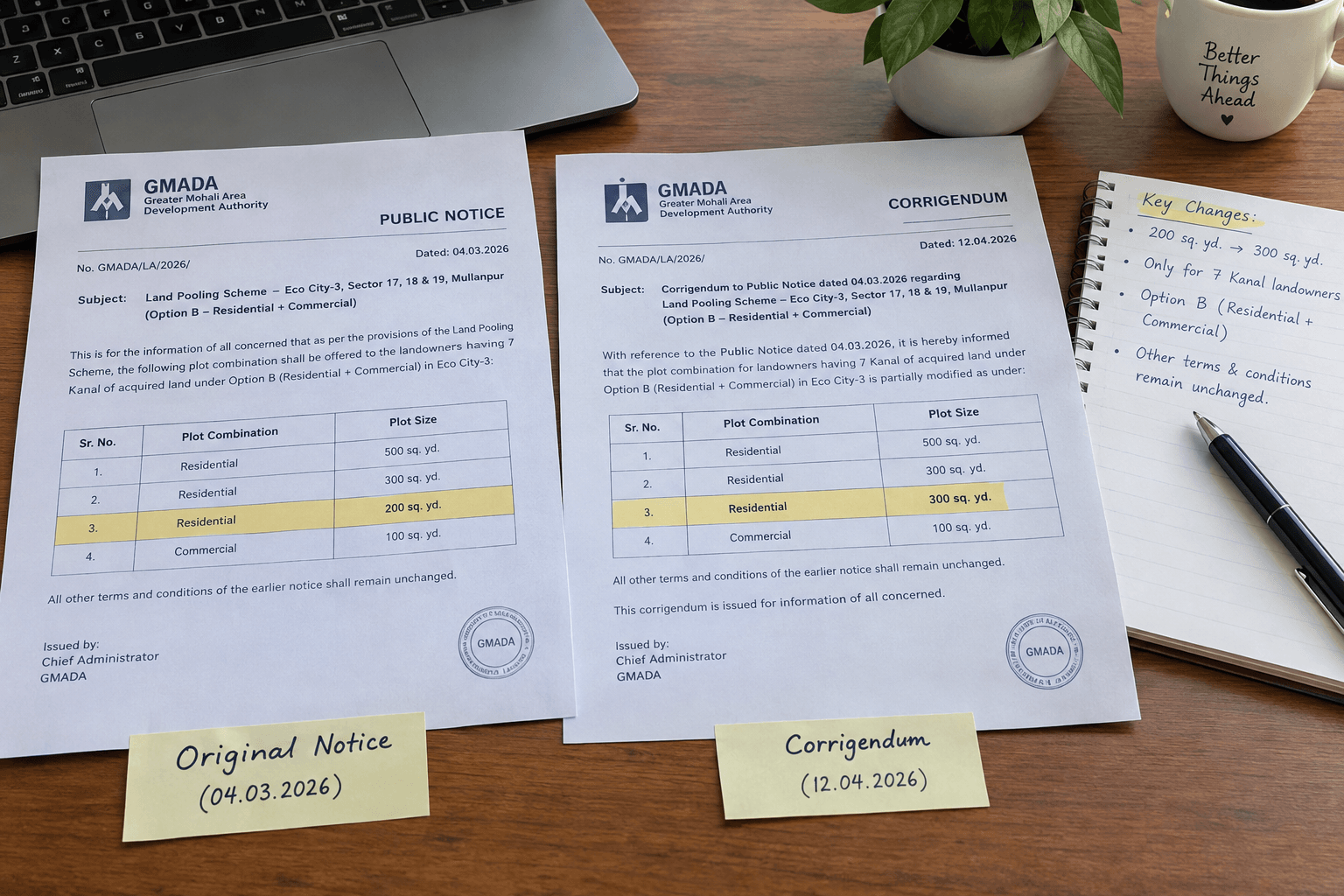
A good example can be seen in a GMADA corrigendum relating to the Eco City-3 Land Pooling Scheme. The corrigendum refers to the earlier Public Notice dated 04.03.2026 and partially modifies it for a specific category of landowners. The change concerns landowners having 7 Kanal of acquired land who choose Option B — Residential + Commercial. And the change comes down to one important difference in the plot combination.
One Plot Size Was Changed
Under the earlier notice, the combination was:
500 sq. yd. residential + 300 sq. yd. residential + 200 sq. yd. residential + 100 sq. yd. commercial.
The later corrigendum revised it to:
1 plot of 500 sq. yd. residential + 2 plots of 300 sq. yd. residential + 1 plot of 100 sq. yd. commercial.
So if you compare the two, the change becomes very clear:
The 200 sq. yd. residential plot was changed to 300 sq. yd.
That is exactly the kind of detail a reader could easily miss when looking only at the original notice.
Did the Whole Notice Change?
No. This is an important distinction. The corrigendum does not say that the entire earlier notice has been replaced. It says that the earlier notice is partially modified for the specified provision, and it also states that all other terms and conditions remain unchanged.
So, in this example, the reader needs to update the particular plot entitlement — not assume that every other part of the earlier notice has changed.
Why Do Government Notices Get Updated?
There is no single reason that applies to every government notice. A later document may be issued to correct or modify a particular part of an earlier publication. The exact reason should be taken from the wording of that particular document rather than assumed.
That is why terms such as corrigendum, amendment, addendum, extension or cancellation should not simply be treated as different names for the same thing. The document itself tells you what has happened.
What Does “Corrigendum” Mean?
The word sounds technical, but the idea is straightforward. A corrigendum is an official document connected to an earlier document that corrects or modifies specified information.
Think of it this way: You have the original notice.
Then the authority publishes an update saying, in effect, “Read this particular part differently.” That is why a corrigendum is important even when it is only one page long.
Why You Should Not Ignore a Short Update
A long government notice can contain several pages of information. A corrigendum may contain only a few paragraphs. It is tempting to think the longer document must be more important. But that is not necessarily true.
If the short document changes something in the original notice, those few lines may contain the latest information about that particular point. In the Eco City-3 example, the original notice gives the earlier plot combination, while the corrigendum tells the reader that the relevant residential combination has been revised.
What If You Only Have the Old PDF?
This is where many readers can get confused. Suppose someone sends you a PDF of the original notice. You read it and find the 200 sq. yd. residential plot. Later, you hear that GMADA issued a correction.
If you continue using the old PDF without checking the update, you may be relying on information that has since been modified. The original PDF has not necessarily become meaningless. It simply needs to be read together with the later document.
How to Check for Changes
You do not need to read every GMADA notice from beginning to end every time. When you find a later document on the same subject, first check its:
- Date
- Subject
- Reference to the earlier notice
Then look for the exact words explaining the modification. Most importantly, check whether the document says that the remaining terms and conditions continue unchanged. This small habit can save a lot of confusion.
Don’t Depend on Old Screenshots
A screenshot can show you exactly what an official notice looked like when it was published. But it cannot tell you whether another official document was issued later.
This is especially important when notices are being shared through WhatsApp groups, social media or other channels. Before relying on an older screenshot or forwarded PDF, it is worth checking the latest official publication connected to that notice.
Not Every New Notice Means the Same Thing
This is another point worth keeping in mind. A corrigendum may correct or modify part of an earlier document. An amendment may change an existing provision. An addendum may add information. An extension may provide additional time. A withdrawal or cancellation can have a different effect altogether.
So the appearance of a new document is not, by itself, enough to tell you what happened to the earlier one. You have to read what the new document actually says.
How to Compare the Old and New Notice
When you find an original notice and a later update, think of them as two pieces of the same story. The first document tells you what was originally announced. The second tells you what has changed since then. Put the two together, and you have a much clearer picture.
That is what happens in the Eco City-3 example: the original notice contains the earlier combination, while the corrigendum gives the revised combination and confirms that the other terms and conditions remain unchanged.
Why These Changes Matter to Landowners
You do not have to be a legal expert to understand a government notice. But you do need to know whether you are reading the original version or the latest applicable update. A changed date may matter. A changed condition may matter. And, as the Eco City-3 example shows, even a changed plot size can matter. The important thing is not to assume that every new document changes everything. Sometimes, the update is much more specific.
What to Check Before You Rely on a Notice
If a GMADA notice is important to you, take a moment to check whether a later document has been issued on the same subject.
- Look at the date.
- Look at the reference.
- Compare the changed portion.
Then check what the latest document says about the rest of the notice. And if something still isn't clear, verify it with the concerned authority rather than relying on an old forwarded copy.
The Main Point to Remember
A government notice does not always remain exactly as it was on the day it was first published. Sometimes a later document changes a particular part. The recent Eco City-3 corrigendum is a useful example:
for the specified Option B category, the residential combination was revised from 500 + 300 + 200 sq. yd. to 500 + 300 + 300 sq. yd., along with the 100 sq. yd. commercial plot. The corrigendum also states that the other terms and conditions remain unchanged.
So, the next time you find an old GMADA notice and then come across a newer document about the same subject, don't immediately ask:
“Which one is wrong?”
Ask something more useful:
“What changed between the two?”
That one question can make a confusing government update much easier to understand.
For More Information
For official GMADA Authority Meeting agendas, proceedings, notifications and project documents, visit gmada.gov.in.
For easy-to-understand updates, local development news and useful context related to Greater Mohali, visit gmada.in.
Important Disclaimer
gmada.in is an independent information portal and is not affiliated with, endorsed by or operated by the Greater Mohali Area Development Authority (GMADA), PUDA, the Government of Punjab, the judiciary or any other government department.