Notices & Public Alerts
You Found an Old GMADA Notice Online — Is It Still Applicable?
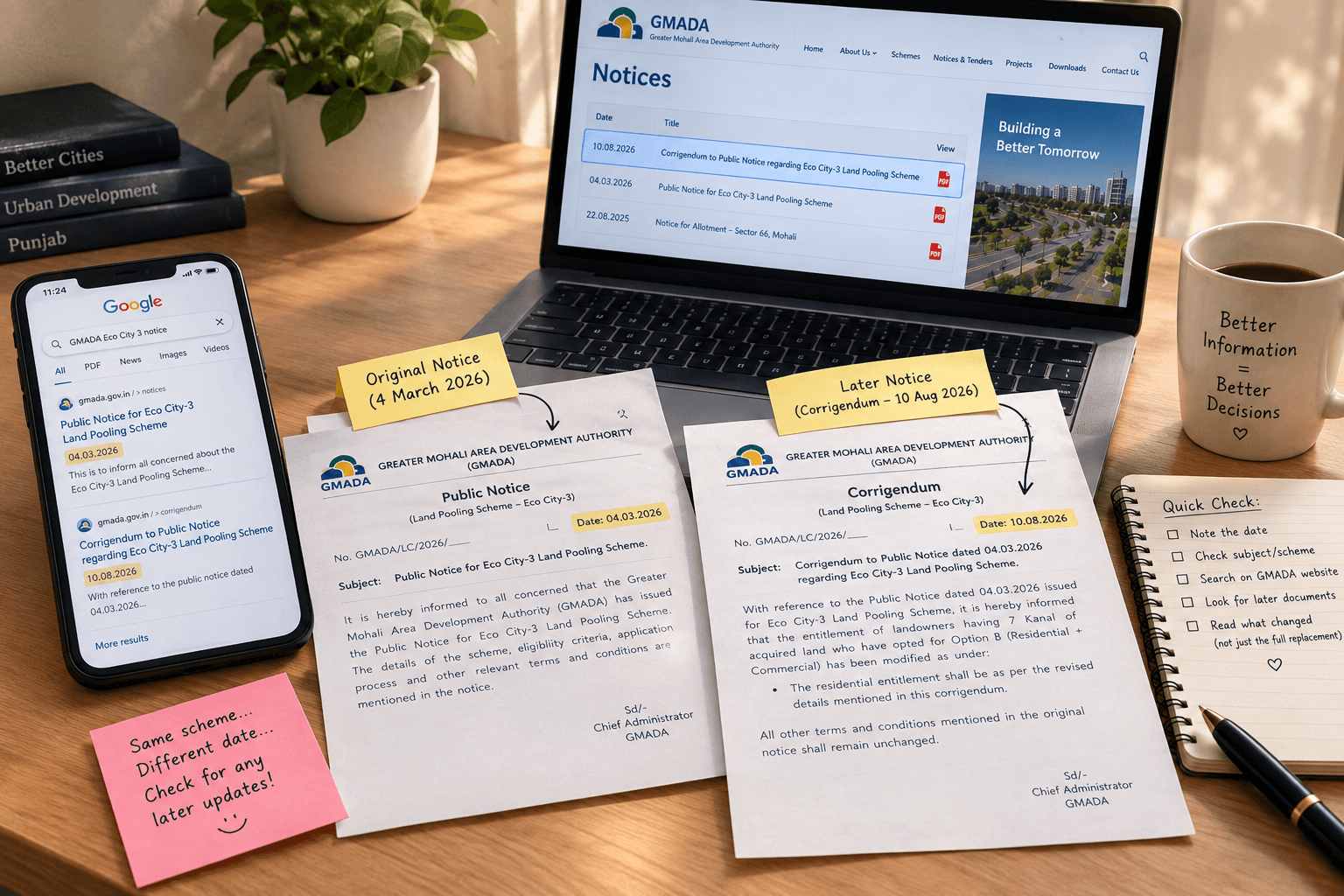
You are looking for some information about GMADA. Maybe you are trying to understand an old scheme, checking a notice related to your village, or looking for details about an application or allotment.
You search online and find a GMADA notice that seems to have the answer.
You open the PDF. It carries the GMADA name, has an official date and contains the information you were looking for.
Then you notice the date.
It is an old notice.
So, what now?
Can you still use the information in it, or could GMADA have changed something later?
This is an easy question to overlook. An old notice may still be useful, but it does not always tell you what happened after it was published.
An Official Notice Can Still Be Outdated
There is an important difference between an official document and the latest information. A notice can be a genuine GMADA document and still be several months or years old. In the meantime, another notice may have changed a date, corrected a condition or added new information.
A good example can be seen in GMADA's Eco City-3 Land Pooling Scheme.
A public notice dated 4 March 2026 was issued for the scheme. A later corrigendum made a change relating to the entitlement of landowners having 7 Kanal of acquired land who had chosen Option B (Residential + Commercial). The change affected part of the residential entitlement, while the other terms and conditions remained unchanged.
So, a person reading only the original notice could miss that later change. The original notice was still an official document. It simply was not the complete picture anymore.
What Happened After the Notice Was Published?
This is probably the most important question to ask when you find an old GMADA notice. Don't look at the date and immediately decide that the notice is useless.
Instead, ask:
Was another notice issued after this one?
Government authorities sometimes publish follow-up documents because something needs to be corrected, extended, clarified or changed.
The later document may be connected to the original notice even if its title looks completely different. For example, you might find words such as “Corrigendum,” “Extension,” “Amendment,” “Clarification,” “Revised” or “Cancellation.”
These words are worth paying attention to because they can indicate that there is more information to consider.
A Later Notice Does Not Always Cancel the Earlier One
This is another point that can easily cause confusion. Suppose you find an original notice and then discover a corrigendum. That does not automatically mean that everything written in the original notice has been cancelled. Sometimes only one part is changed.
The Eco City-3 example is useful here. The later corrigendum changed a particular entitlement while the other terms and conditions remained unchanged. So, rather than assuming that the latest document completely replaces the earlier one, read what the newer document actually says. It may be correcting just one detail. And sometimes, that one detail may be the part that matters most to you.
What If You Found the Notice Through Google?
This is probably how many people come across older GMADA documents in the first place. You type a question into Google, find a PDF and open it. The document looks official, so you naturally trust it.
There is nothing wrong with using Google to find information. The important thing is to remember that a search result does not necessarily mean you have found the latest document. An older PDF can continue to appear in search results long after a newer notice has been published.
So, if the information is important to you, use the old document as a starting point and then look for newer information on the official GMADA website.
The Date Can Give You Your First Clue
The date on the notice is one of the simplest things to look at. Suppose you find a notice from 2024 while searching for information in 2026. Before relying on it, look at the subject and search for the same scheme, village, project or notification on GMADA's website.
You may find that nothing has changed. You may also find a later document. Either way, you now have a clearer picture. This becomes particularly important if the old notice mentions a last date, eligibility requirement, payment, application process or entitlement.
These are the kinds of details where a later change can affect what a person needs to do.
Sometimes One Changed Date Is Enough
Imagine you find an old notice that says applications can be submitted until a particular date. You read the notice and assume that the opportunity is already closed. But later, GMADA may have issued an extension. Now the information you found is incomplete.
The same thing can happen in the opposite direction. A notice may mention a process that was later cancelled or withdrawn. This is why the age of a document is not the real issue. The real issue is whether anything changed after it was published.
How Do You Check Without Getting Confused?
You don't need to read every GMADA document available online. Start with the notice you already found. Look at its date, subject, scheme name, village name and notification number, if one is mentioned. Then search those details on the official GMADA website.
If another document appears on the same matter, read it alongside the original. Pay attention to what has actually changed rather than assuming that the entire earlier notice has been replaced. This is a much better approach than relying on whichever PDF appears first in a Google search.
When Should You Be Extra Careful?
An old notice deserves extra attention when you are planning to take some action based on it. For example, you may be checking information before submitting an application, making a payment, understanding an allotment, checking eligibility or dealing with a matter related to a GMADA scheme.
In such cases, a small change in the latest notice could be important. If the matter has significant legal or financial consequences, it is also sensible to confirm the current position directly with GMADA rather than relying only on an old document found online.
So, Should You Trust an Old GMADA Notice?
An old GMADA notice should not be treated as automatically wrong. It may contain exactly what GMADA announced at that time and can still be useful for understanding the background of a matter.
But if you want to know what applies now, the old notice should be checked against any later information.
Think of it this way:
- The old notice tells you what was announced.
- The later documents tell you what happened afterwards.
And sometimes, that second part is just as important as the first.
A Quick Check Can Save You From the Wrong Information
The next time you find an old GMADA notice online, don't ignore it just because it is old.
Read it.
Note its date and subject.
Then see whether GMADA published anything later about the same matter.
A corrigendum, extension, amendment or cancellation may change the information you originally found — or you may discover that nothing has changed at all.
For More Information
For official GMADA Authority Meeting agendas, proceedings, notifications and project documents, visit gmada.gov.in.
For easy-to-understand updates, local development news and useful context related to Greater Mohali, visit gmada.in.
Important Disclaimer
gmada.in is an independent information portal and is not affiliated with, endorsed by or operated by the Greater Mohali Area Development Authority (GMADA), PUDA, the Government of Punjab, the judiciary or any other government department.