GMADA News & Updates
You Found Your Name in a GMADA Notice — But What Does It Actually Mean?
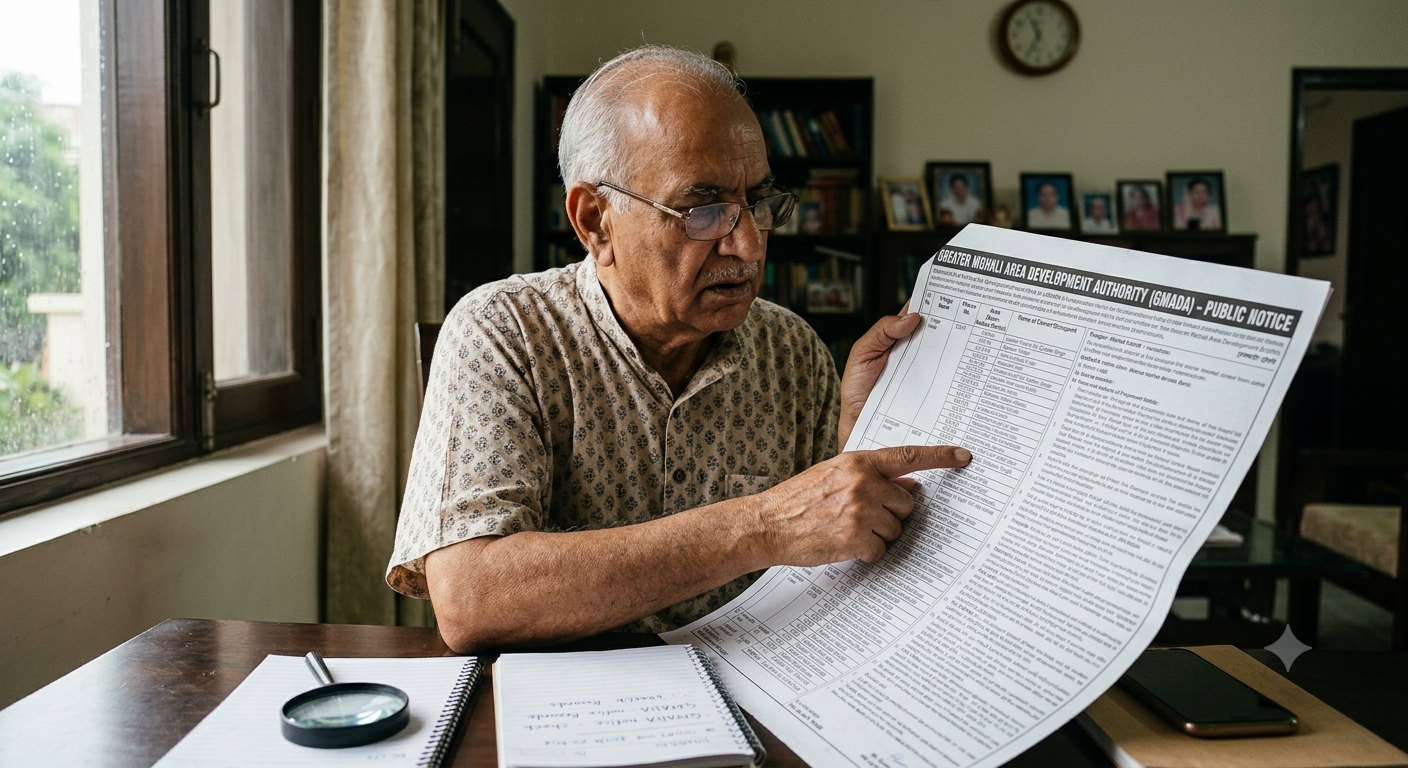
You open a GMADA notice just to check what it is about.
Then you see your name.
You read it once.
Then you read it again.
“Is this about me?”
That is usually the first question. After that, several more follow:
Why has my name been mentioned?
Do I need to do something?
Is there a deadline?
Does this change anything for me?
And this is where things can get confusing. A name appearing in a GMADA notice can look important, but the name itself does not tell you what the notice means. The reason it has been included, the details around it and the purpose of the notice are what actually matter.
Before You Worry, Find Out Why Your Name Is There
Not every person mentioned in a GMADA notice is being asked to do the same thing. A notice may contain names because it relates to a particular area, land parcel, hearing, objection, development proposal or another official proceeding. In some cases, the people listed may be directly concerned with the matter. In others, their names may simply form part of the information being published.
So the important question is not just:
“Is my name there?”
It is:
“Why has my name been put there?”
The answer is usually found in the heading and the paragraphs around your name. That's why reading only the line containing your name can sometimes give you the wrong impression.
The Name May Match — But Does Everything Else Match?
This is one of the easiest things to overlook. Suppose you find your name in a notice. The name looks familiar, so you assume the notice must be about you. But then look at the other information.
Is the village the same?
Does the Khasra number match?
Is the land area correct?
Does the notice refer to the same project or matter you know about?
These details can be much more useful than the name alone. This is especially important where a notice contains a list of people connected with particular land or locations. Two people can have the same or similar names, while the other details make it clear that they are not the same person. A familiar name is a reason to look closer — not a reason to jump to a conclusion.
And Then Comes the Biggest Question: “Do I Have to Do Anything?”
This is probably what most people want to know. Finding your name in an official notice can make you wonder whether you now have to visit an office, submit a document, attend a hearing or respond within a certain period. But there is no single answer. It depends on what the notice is for.
Some notices simply communicate information. Others may invite objections, mention hearings, ask for claims or explain a particular proceeding. Where a response or appearance is required, the notice should contain the relevant instructions.
So instead of guessing what you are supposed to do, look for the part that explains the next step.
If there is a date, read it carefully.
If there is a deadline, note it.
If the notice asks for a response, check how and where that response has to be made.
And if the wording is not clear, don't rely on a random explanation from someone who has only seen a screenshot.
One Screenshot Doesn't Always Tell the Whole Story
This is where things often go wrong. Someone finds their name on page three of a notice, takes a screenshot and sends it to a family group. Within minutes, everyone has a different explanation.
One person says, “You have to go to GMADA.”
Another says, “No, this is only an information notice.”
Someone else says, “This means your land is going to be acquired.”
The problem?
Nobody has read the complete notice.
A screenshot can show your name, but it may not show why your name is there. The heading may explain the purpose of the notice. The next page may contain the important conditions. The final page may mention the date or procedure. So before a small screenshot turns into a big misunderstanding, open the complete document.
What If the Information Doesn't Look Right?
Now consider a different situation. You find your name, but the village is wrong. Or the Khasra number doesn't match your records. Or the area mentioned in the notice doesn't seem to belong to you. Don't simply ignore it. At the same time, don't immediately assume that the entire notice is incorrect. Check the complete document and compare the details with your own records. Also look for any related notice, correction or later update.
This matters because people sometimes continue discussing an old document even after another official update has been issued. The date of the document matters just as much as the information inside it.
“But Someone Told Me What It Means…”
You may have heard this before. A notice is shared in a local WhatsApp group and suddenly everyone seems to know what it means. The problem is that official notices can be technical, and one sentence taken out of context can completely change how people understand the matter. If something genuinely concerns you, go back to the original GMADA document.
Read the title.
Check the date.
Read the section where your name appears.
Look at the details connected with it.
Then see whether the notice actually asks you to do something.
You may find that the situation is different from what you first heard.
The Most Important Part May Not Be Your Name at All
When you see your name in a GMADA notice, it is natural to focus on that one line. But sometimes the more important information is everything around it. The purpose of the notice tells you why it was issued. The location or land details can tell you whether it relates to your particular matter. The date tells you when the information was issued and whether you may be looking at an older document. And the instructions tell you whether anything is actually expected from you. Put these pieces together, and the notice starts making much more sense.
So, What Should You Do When You Find Your Name?
Don't panic. Don't rely on a forwarded screenshot. And don't assume that your name automatically means you have to take action. Instead, take a few minutes to understand the complete notice.
Ask yourself:
Why was this notice issued?
Why is my name included?
Do the other details match me?
Is there a date, deadline or hearing mentioned?
Has any newer information been published?
If the matter involves your legal rights, land acquisition, an objection, a hearing or another significant issue, and the notice is still unclear, getting appropriate professional advice may be the sensible next step.
A Name Can Get Your Attention. The Details Tell You the Story.
Finding your name in a GMADA notice can certainly make you stop and wonder what is happening. But don't let that one line tell the whole story. Read what comes before it. Read what comes after it. Look at the details. Check the date. Understand why the notice was issued and whether it actually asks anything from you.
Because sometimes the most important question isn't:
“Why is my name in this notice?”
It is:
“What exactly is this notice saying about my situation?”
Once you find that answer, the notice becomes much less mysterious.
You May Also Want to Know
If you need to check an official GMADA notice, citizen service, grievance, contact detail, property-related service or the latest telephone directory, visit gmada.gov.in.
For easy-to-understand articles about GMADA procedures, public notices, development activities, land-related matters and other topics connected with Greater Mohali, visit gmada.in.
Important Disclaimer
gmada.in is an independent information portal. It is not affiliated with, endorsed by, or operated by the Greater Mohali Area Development Authority (GMADA), PUDA, the Government of Punjab, or any other government department.