Notices & Public Alerts
Your GMADA Application Has Crossed the Official Time Limit—What Can You Do Next?
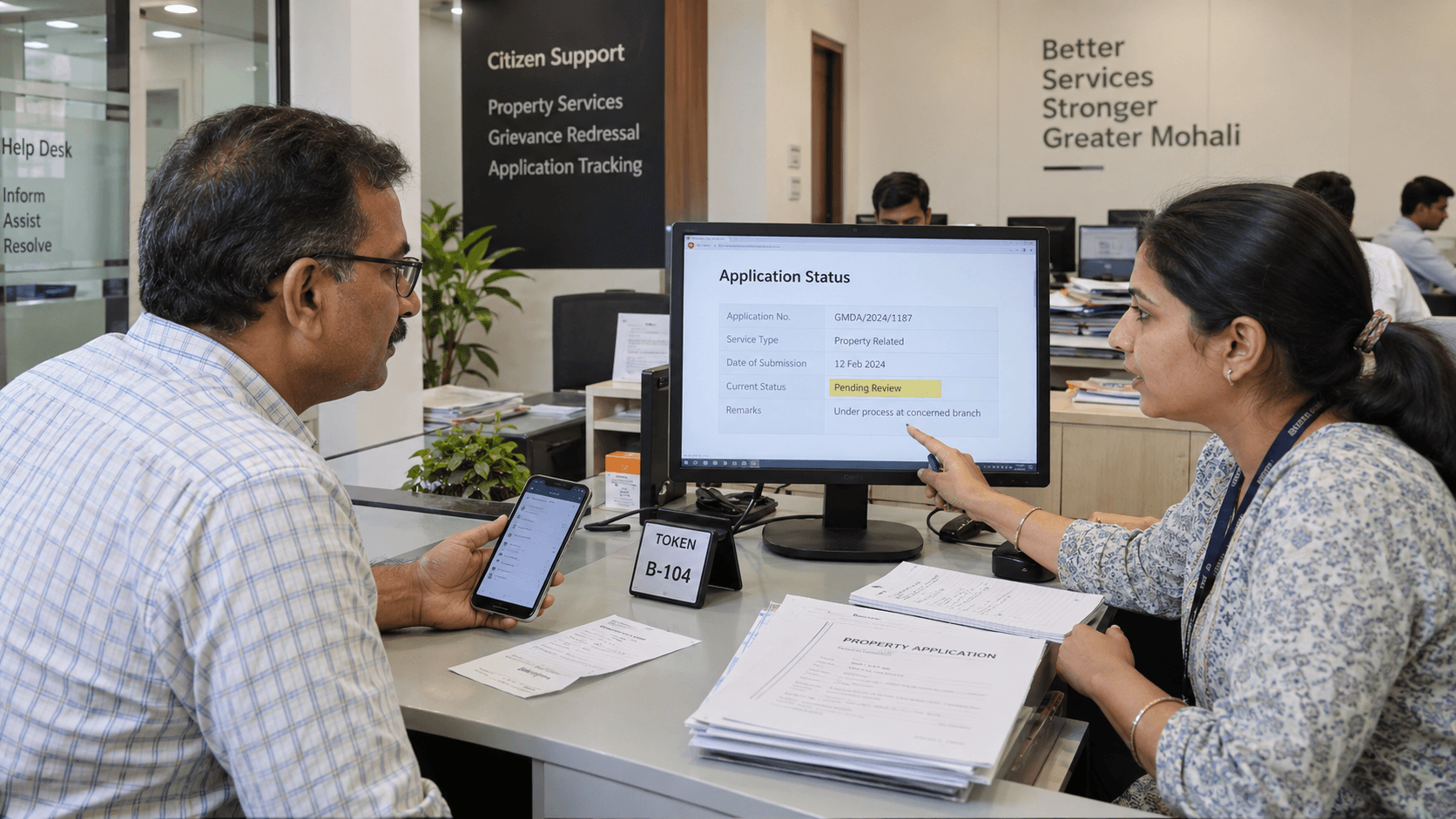
You submitted your application to GMADA. You received an acknowledgement or application number. The expected processing period has passed—but the application is still pending. Should you simply keep waiting? Not necessarily.
GMADA publishes prescribed time limits for many citizen services through its Citizen Charter and Right to Service information. It also provides facilities for checking Single Window status, lodging grievances and escalating cases where a service has not been delivered within the prescribed period. The important first step is to establish whether your application is genuinely delayed.
First Check: Has the Official Time Limit Actually Passed?
Not every GMADA application has the same processing period. The expected timeline depends on the service you applied for. GMADA's current Citizen Charter lists, among others:
- Permission to sell after conveyance deed: 15 working days
- Permission to transfer a plot, house or commercial site: 15 working days
- Conveyance deed: 15 working days
- No Due Certificate: 7 working days
- Copies of documents: 5 working days
- Change of ownership after a registered sale deed: 5 working days
- Transfer after death with a registered will: 45 working days
- Transfer after death with an unregistered will: 45 working days
- Transfer after death with a Legal Heir Certificate: 10 working days
- Permission to mortgage: 10 working days
- Building plan for a plot below 500 sq yd: 30 working days
- Building plan for a plot above 500 sq yd: 60 working days
- Sewerage connection: 5 working days
- Completion or occupation certificate: 15 working days
- NOC, allotment letter or copy of re-allotment letter: 21 working days
- Transfer of Letter of Intent: 20 working days
Before treating your case as delayed, identify the exact service you applied for and check the latest official timeline applicable to that service.
Important: GMADA Has More Than One Published Timeline Source
This is something users should understand. GMADA's current Citizen Charter and its published Right to Service material do not give identical time limits for every service. For example, GMADA's Right to Service material currently shows:
- No Due Certificate — 5 days
- Permission for mortgage — 7 days
- Attested copy of a document — 3 days
- Demarcation — 5 days
- Plinth/Roof Level Certificate — 7 days
- Water and sewerage connection — 7 days
- Transfer of Letter of Intent/Allocation — 21 days
It also states that an appeal can be filed with the appellate authority if a notified service is not delivered within the stipulated time. Because different official GMADA pages can show different timelines, do not rely on an old screenshot, WhatsApp message or third-party website. Check the latest GMADA page for your specific service and the applicable Right to Service information.
Step 1: Find Your Application or Reference Number
Your application number is one of the most important things to keep. Do not follow up by saying only:
“I submitted my papers last month.”
Instead, keep ready:
- Application/reference number
- Property number
- Sector
- Applicant's name
- Date of submission
- Service applied for
- Mobile number used in the application
- Receipt or acknowledgement
GMADA currently provides a Know My Single Window Status facility through its Citizen Services/How Do I section. Check the online status before making an office visit.
Step 2: Check Whether the Application Is Actually Pending or an Objection Has Been Raised
A delayed application and an incomplete application are not necessarily the same thing. An application may be waiting because:
- a required document is missing
- clarification has been sought
- an objection has been raised
- a document requires correction
- another branch has to provide verification
- further action is required from the applicant
Do not assume the reason. Check the recorded status first. If GMADA has raised an objection, ask specifically:
- What is deficient?
- Which document is required?
- Where should it be submitted?
- Does the processing period restart or continue after compliance?
Keep a copy of whatever you submit in response.
Step 3: Check Whether Your Application Was Complete When Submitted
The official processing period should not be treated as a guarantee that an incomplete application will be approved within that time. Before escalating, check whether you submitted the checklist required for that particular service. GMADA provides separate procedures for services including:
- Conveyance deed
- NDC
- Duplicate documents
- Sale/transfer permission
- Mortgage permission
- Building plans
- DPC certificate
- Completion/occupation certificate
- Water connection
- Sewerage connection
- Natural succession
- Transfer through a will
- Transfer through registered sale/gift/transfer deed
Step 4: Keep Proof of the Date You Submitted the Application
This is essential. Keep:
- Acknowledgement receipt
- Diary/reference number
- Online submission receipt
- SMS acknowledgement
- Email confirmation
- Payment receipt
- Screenshot of online status
- Copies of submitted documents
If you later need to show that the prescribed period has expired, you should be able to establish when the complete application was received. A verbal statement that “I submitted it a long time ago” is much weaker than a dated acknowledgement.
Step 5: Contact GMADA With a Specific Question
If the prescribed period has passed, contact GMADA—but make the enquiry specific. Instead of asking:
“Why is my work not happening?”
ask:
“Application No. ______ for ______ service was submitted on ______. The Citizen Charter/available service timeline shows ______ working days. Please confirm the present status, whether any deficiency is pending from my side, and which officer or branch currently has the application.”
This makes the follow-up much easier to understand and document. GMADA currently lists its
helpdesk at: PUDA Bhawan, Sector 62, S.A.S. Nagar, Punjab
Email: helpdesk@gmada.gov.in
Helpdesk: 78886-96869
Landlines: 0172-2215202, 2215204, 2215206 and 5027180
Working hours: 9:00 AM to 5:00 PM on working days.
Check the latest official contact information before visiting.
Step 6: Use GMADA's Monday Escalation Route
This is one of the most useful points in GMADA's Citizen Charter. GMADA states: n case of non-compliance, applicants may meet the concerned Estate Officer or ACA on the appointed day—every Monday of the week. If your application has genuinely crossed the prescribed period and no clear deficiency is pending from your side, this gives you a defined escalation route. Carry:
- Original acknowledgement
- Application/reference number
- Current status screenshot
- Copies of documents submitted
- Any objection or deficiency letter
- Your replies to those objections
- Short written chronology of the case
Do not arrive with an unorganised bundle of papers. A one-page timeline makes the issue much easier for an officer to understand.
Step 7: Lodge a Formal Grievance if the Matter Still Does Not Move
GMADA's website provides facilities to Lodge Grievance and Know My Grievance Status. A grievance should be factual rather than emotional. Include:
- Application number
- Property details
- Service requested
- Submission date
- Official timeline, where applicable
- Current status
- Details of previous follow-ups
- Any outstanding objection
- Specific relief requested
For example:
“Please confirm the reason for the delay and arrange disposal of Application No. ____ in accordance with the applicable service timeline.”
After lodging a grievance, save its reference number as well.
Step 8: Check Whether the Service Is Covered by Right to Service
GMADA's current Right to Service material states that designated officers are required to provide specified services within prescribed time limits and that an appeal can be filed with the appellate authority if the service is not delivered within the stipulated time. This is different from simply telephoning the helpdesk. If your particular service falls under the applicable Right to Service framework, check:
- the notified service
- applicable time limit
- designated officer
- appellate authority
- current procedure for filing an appeal
Because service designations and timelines can be updated, verify these details from the current official record before filing.
Step 9: Do Not Confuse a Status Enquiry, Grievance, Appeal and RTI
These tools serve different purposes.
Status Check
Use this when you simply want to know where the application stands.
Grievance
Use this when there is a service problem, unexplained delay or administrative issue that requires resolution.
Right to Service Appeal
This may be relevant when a notified service has not been provided within its stipulated period.
RTI Application
RTI is primarily a mechanism for obtaining information or records. For example, an RTI application may be useful if you need existing records showing:
- movement of a file
- dates of action
- copies of orders
- recorded objections
- other available official information
But an RTI application should not automatically be treated as a substitute for the normal service or grievance process. GMADA provides separate online facilities for Single Window status, grievance status and RTI status.
A Useful Escalation Sequence
For most straightforward citizen-service delays, think of the process like this:
Check official timeline
↓
Check Single Window status
↓
Check for deficiency or objection
↓
Follow up with the concerned branch
↓
Use Monday EO/ACA escalation where applicable
↓
Lodge and track a grievance
↓
Check the applicable Right to Service appeal mechanism
This is much more effective than repeatedly visiting different counters without knowing where the application stands.
What Not to Do
Do Not Assume GMADA's Infrastructure Projects Are Causing Your Delay
Large projects, tenders and land-acquisition activity may be taking place simultaneously, but that does not prove they caused a particular citizen-service application to be delayed. The correct approach is to establish the recorded status of your application.
Do Not Submit the Same Documents Repeatedly Without a Record
If documents are requested again, submit them with a covering letter or acknowledgement and keep proof.
Do Not Rely Only on Verbal Assurances
Statements such as:
“Come next week.”
or
“The file is under process.”
do not tell you what action has actually been taken. Ask for the status or deficiency clearly and keep a record of your follow-up.
Do Not Quote an Outdated Timeline Without Checking
GMADA currently publishes more than one timeline-related source, and some figures differ. Always identify the latest applicable provision for your service.
When Is a Delay Not Really a Delay?
An application may reasonably require further action where:
- mandatory documents are incomplete
- an objection remains unanswered
- ownership is disputed
- court proceedings affect the matter
- verification from another authority is required
- property dues or mortgage issues remain unresolved
- the application is not eligible under the procedure used
This is why knowing the reason for the pending status is more important than simply counting days.
A 10-Point Checklist When Your GMADA Application Is Stuck
Before escalating, confirm that you have:
- Identified the exact service.
- Checked the latest official time limit.
- Kept the application/reference number.
- Preserved the acknowledgement date.
- Checked Single Window status.
- Confirmed whether any objection is pending.
- Submitted any requested clarification with proof.
- Recorded previous follow-ups.
- Used the appropriate GMADA escalation/grievance channel.
- Checked whether Right to Service applies.
One More Important Point: Count Working Days Correctly
Where GMADA's Citizen Charter specifies working days, do not automatically calculate the deadline as ordinary calendar days. Weekends and applicable holidays can affect the calculation. Also check whether the applicable procedure counts the period from receipt of the application or from receipt of a complete application/document set. If this distinction could determine whether your case has actually crossed the deadline, confirm it with the concerned service branch.
What If Nothing Happens Even After Escalation?
If you have:
- submitted a complete application
- crossed the applicable official timeline
- responded to all objections
- followed up with the concerned authority
- lodged a grievance
- used any applicable Right to Service remedy
but the matter still remains unresolved, consider obtaining appropriate professional advice based on the nature of the case. The next step will depend on what you are seeking. A delayed NDC, disputed ownership transfer, building-plan issue and land-acquisition matter may require completely different remedies.
Final Takeaway
If your GMADA application is delayed, do not begin with speculation about why GMADA is busy. Begin with your own file.
Ask four questions:
- What service did I apply for?
- What is its current official timeline?
- Is anything pending from my side?
- What is the next official escalation route?
GMADA already provides a Citizen Charter, Single Window status facility, grievance mechanism and Right to Service information for many citizen services. Using these in the right order gives you a much clearer path than repeated informal follow-ups.
Where to Check
For current Citizen Services, the Citizen Charter, application procedures, Single Window status and grievance facilities, visit gmada.gov.in.
For simplified explanations of GMADA procedures, public notices and Greater Mohali development, visit gmada.in.
Important Disclaimer
gmada.in is an independent information portal and is not affiliated with, endorsed by or operated by the Greater Mohali Area Development Authority (GMADA), PUDA, the Government of Punjab or any other government department.